Papers with Code 아카이브

3D Human Pose Estimation

태스크의 하위 분류와 논문·코드·평가·기법·데이터셋을 탐색하세요.

하위 태스크
9
평가표
25
보존된 평가 기록
447

3D Human Pose Estimation is a computer vision task that involves estimating the 3D positions and orientations of body joints and bones from 2D images or videos. The goal is to reconstruct the 3D pose of a person in real-time, which can be used in a variety of applications, such as virtual reality, human-computer interaction, and motion analysis.

데이터셋

출처에 같은 태스크 이름으로 연결된 데이터셋입니다. 동명 태스크가 포함될 수 있으므로, 비교할 때는 평가 결과의 조건도 확인하세요.

KITTI

KITTI (Karlsruhe Institute of Technology and Toyota Technological Institute) is one of the most popular datasets for use in mobile robotics and autonomous driving. It consists of hours of traffic scenarios recorded with a variety of sensor modalities, including high-resolution RGB, grayscale stereo cameras, and a 3D laser scanner. Despite its popularity, the dataset itself does not contain ground truth for semantic segmentation. However, various researchers have manually annotated parts of the dataset to fit their necessities. Álvarez et al. generated ground truth for 323 images from the road detection challenge with three classes: road, vertical, and sky. Zhang et al. annotated 252 (140 for training and 112 for testing) acquisitions – RGB and Velodyne scans – from the tracking challenge for ten object categories: building, sky, road, vegetation, sidewalk, car, pedestrian, cyclist, sign/pole, and fence. Ros et al. labeled 170 training images and 46 testing images (from the visual odometry challenge) with 11 classes: building, tree, sky, car, sign, road, pedestrian, fence, pole, sidewalk, and bicyclist. Source: A Review on Deep Learning Techniques Applied to Semantic Segmentation Image Source: http://www.cvlibs.net/datasets/kitti/eval_object.php?obj_benchmark=3d
Human3.6M

The Human3.6M dataset is one of the largest motion capture datasets, which consists of 3.6 million human poses and corresponding images captured by a high-speed motion capture system. There are 4 high-resolution progressive scan cameras to acquire video data at 50 Hz. The dataset contains activities by 11 professional actors in 17 scenarios: discussion, smoking, taking photo, talking on the phone, etc., as well as provides accurate 3D joint positions and high-resolution videos. Source: Space-Time Representation of People Based on 3D Skeletal Data: A Review Image Source: Yu et al

Waymo Open Dataset

The Waymo Open Dataset is comprised of high resolution sensor data collected by autonomous vehicles operated by the Waymo Driver in a wide variety of conditions. The Waymo Open Dataset currently contains 1,950 segments. The authors plan to grow this dataset in the future. Currently the datasets includes: * 1,950 segments of 20s each, collected at 10Hz (390,000 frames) in diverse geographies and conditions * Sensor data * 1 mid-range lidar * 4 short-range lidars * 5 cameras (front and sides) * Synchronized lidar and camera data * Lidar to camera projections * Sensor calibrations and vehicle poses * Labeled data * Labels for 4 object classes - Vehicles, Pedestrians, Cyclists, Signs * High-quality labels for lidar data in 1,200 segments * 12.6M 3D bounding box labels with tracking IDs on lidar data * High-quality labels for camera data in 1,000 segments * 11.8M 2D bounding box labels with tracking IDs on camera data

NTU RGB+D

NTU RGB+D is a large-scale dataset for RGB-D human action recognition. It involves 56,880 samples of 60 action classes collected from 40 subjects. The actions can be generally divided into three categories: 40 daily actions (e.g., drinking, eating, reading), nine health-related actions (e.g., sneezing, staggering, falling down), and 11 mutual actions (e.g., punching, kicking, hugging). These actions take place under 17 different scene conditions corresponding to 17 video sequences (i.e., S001–S017). The actions were captured using three cameras with different horizontal imaging viewpoints, namely, −45∘,0∘, and +45∘. Multi-modality information is provided for action characterization, including depth maps, 3D skeleton joint position, RGB frames, and infrared sequences. The performance evaluation is performed by a cross-subject test that split the 40 subjects into training and test groups, and by a cross-view test that employed one camera (+45∘) for testing, and the other two cameras for training. Source: Action Recognition for Depth Video using Multi-view Dynamic Images

3DPW

The 3D Poses in the Wild dataset is the first dataset in the wild with accurate 3D poses for evaluation. While other datasets outdoors exist, they are all restricted to a small recording volume. 3DPW is the first one that includes video footage taken from a moving phone camera. The dataset includes: * 60 video sequences. * 2D pose annotations. * 3D poses obtained with the method introduced in the paper. * Camera poses for every frame in the sequences. * 3D body scans and 3D people models (re-poseable and re-shapeable). Each sequence contains its corresponding models. * 18 3D models in different clothing variations. Source: https://virtualhumans.mpi Image Source: https://virtualhumans.mpi

AMASS

AMASS is a large database of human motion unifying different optical marker-based motion capture datasets by representing them within a common framework and parameterization. AMASS is readily useful for animation, visualization, and generating training data for deep learning.

DensePose

DensePose-COCO is a large-scale ground-truth dataset with image-to-surface correspondences manually annotated on 50K COCO images and train DensePose-RCNN, to densely regress part-specific UV coordinates within every human region at multiple frames per second. Source: DensePose: Dense Human Pose Estimation In The Wildc Image Source: Guler et al

LSP

The Leeds Sports Pose (LSP) dataset is widely used as the benchmark for human pose estimation. The original LSP dataset contains 2,000 images of sportspersons gathered from Flickr, 1000 for training and 1000 for testing. Each image is annotated with 14 joint locations, where left and right joints are consistently labelled from a person-centric viewpoint. The extended LSP dataset contains additional 10,000 images labeled for training. Source: Deep Deformation Network for Object Landmark Localization Image: Sumer et al

PASCAL VOC

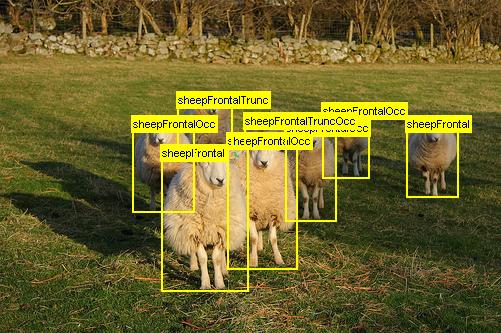
The PASCAL Visual Object Classes (VOC) 2012 dataset contains 20 object categories including vehicles, household, animals, and other: aeroplane, bicycle, boat, bus, car, motorbike, train, bottle, chair, dining table, potted plant, sofa, TV/monitor, bird, cat, cow, dog, horse, sheep, and person. Each image in this dataset has pixel-level segmentation annotations, bounding box annotations, and object class annotations. This dataset has been widely used as a benchmark for object detection, semantic segmentation, and classification tasks. The PASCAL VOC dataset is split into three subsets: 1,464 images for training, 1,449 images for validation and a private testing set. Source: Self-supervised Visual Feature Learning with Deep Neural Networks: A Survey Image Source: http://host.robots.ox.ac.uk/pascal/VOC/voc2012/examples/images/sheep_06.jpg

Panoptic

CMU Panoptic is a large scale dataset providing 3D pose annotations (1.5 millions) for multiple people engaging social activities. It contains 65 videos (5.5 hours) with multi-view annotations, but only 17 of them are in multi-person scenario and have the camera parameters. Massively Multiview System * 480 VGA camera views * 30+ HD views * 10 RGB-D sensors * Hardware-based sync * Calibration * Interesting Scenes with Labels Multiple people * Socially interacting groups * 3D body pose * 3D facial landmarks * Transcripts + speaker ID Hardware setup * 480 VGA cameras, 640 x 480 resolution, 25 fps, synchronized among themselves using a hardware clock * 31 HD cameras, 1920 x 1080 resolution, 30 fps, synchronized among themselves using a hardware clock, timing aligned with VGA cameras * 10 Kinect Ⅱ Sensors. 1920 x 1080 (RGB), 512 x 424 (depth), 30 fps, timing aligned among themselves and other sensors 5 DLP Projectors. synchronized with HD cameras Source: Single-Stage Multi-Person Pose Machines Image Source: http://domedb.perception.cs.cmu.edu/

AGORA

AGORA is a synthetic human dataset with high realism and accurate ground truth. It consists of around 14K training and 3K test images by rendering between 5 and 15 people per image using either image-based lighting or rendered 3D environments, taking care to make the images physically plausible and photoreal. In total, AGORA contains 173K individual person crops. AGORA provides (1) SMPL/SMPL-X parameters and (2) segmentation masks for each subject in images.

VOCASET

VOCASET is a 4D face dataset with about 29 minutes of 4D scans captured at 60 fps and synchronized audio. The dataset has 12 subjects and 480 sequences of about 3-4 seconds each with sentences chosen from an array of standard protocols that maximize phonetic diversity. Source: timzhang642

TotalCapture

The TotalCapture dataset consists of 5 subjects performing several activities such as walking, acting, a range of motion sequence (ROM) and freestyle motions, which are recorded using 8 calibrated, static HD RGB cameras and 13 IMUs attached to head, sternum, waist, upper arms, lower arms, upper legs, lower legs and feet, however the IMU data is not required for our experiments. The dataset has publicly released foreground mattes and RGB images. Ground-truth poses are obtained using a marker-based motion capture system, with the markers are <5mm in size. All data is synchronised and operates at a framerate of 60Hz, providing ground truth poses as joint positions. Source: Semantic Estimation of 3D Body Shape and Pose using Minimal Cameras Image Source: https://cvssp.org/data/totalcapture/

RICH

Inferring human-scene contact (HSC) is the first step toward understanding how humans interact with their surroundings. While detecting 2D human-object interaction (HOI) and reconstructing 3D human pose and shape (HPS) have enjoyed significant progress, reasoning about 3D human-scene contact from a single image is still challenging. Existing HSC detection methods consider only a few types of predefined contact, often reduce body and scene to a small number of primitives, and even overlook image evidence. To predict human-scene contact from a single image, we address the limitations above from both data and algorithmic perspectives. We capture a new dataset called RICH for “Real scenes, Interaction, Contact and Humans.” RICH contains multiview outdoor/indoor video sequences at 4K resolution, ground-truth 3D human bodies captured using markerless motion capture, 3D body scans, and high resolution 3D scene scans. A key feature of RICH is that it also contains accurate vertex-level contact labels on the body

BEDLAM

BEDLAM is a large-scale synthetic video dataset designed to train and test algorithms on the task of 3D human pose and shape estimation (HPS). It contains diverse body shapes, skin tones, and motions. The clothing is realistically simulated on the moving bodies using commercial clothing physics simulation.

PosePrior

Accurate modeling of priors over 3D human pose is fundamental to many problems in computer vision. Most previous priors are either not general enough for the diverse nature of human poses or not restrictive enough to avoid invalid 3D poses. We propose a physically-motivated prior that only allows anthropometrically valid poses and restricts the ones that are invalid. One can use joint-angle limits to evaluate whether two connected bones are valid or not. However, it is established in biomechanics that there are dependencies in joint-angle limits between certain pair of bones. For example how much one can flex one’s arm depends on whether it is in front of, or behind, the back. Medical textbooks only provide joint-angle limits in a few positions and the complete configuration of pose-dependent joint-angle limits for the full body is unknown.

Campus & Shelf

The Campus and Shelf datasets were presented in the paper 3D Pictorial Structures for Multiple Human Pose Estimation. The first dataset shows persons walking and talking in front of a building, and the second up to four persons assembling a shelf.

JTA

JTA is a dataset for people tracking in urban scenarios by exploiting a photorealistic videogame. It is up to now the vastest dataset (about 500.000 frames, almost 10 million body poses) of human body parts for people tracking in urban scenarios. Source: Learning to Detect and Track Visible and Occluded Body Joints in a Virtual World

EgoBody

EgoBody dataset is a novel large-scale dataset for egocentric 3D human pose, shape and motions under interactions in complex 3D scenes.

EMDB

EMDB contains in-the-wild videos of human activity recorded with a hand-held iPhone. It features reference SMPL body pose and shape parameters, as well as global body root and camera trajectories. The reference 3D poses were obtained by jointly fitting SMPL to 12 body-worn electromagnetic sensors and image data. For the latter we fit a neural implicit avatar model to allow for a dense pixel-wise fitting objective. EMDB contains: * 81 sequences * 105 000 frames * 10 actors (5 female, 5 male) * Global camera trajectories * SMPL pose and shape parameters * 2D Keypoints The dataset can be used to evaluate the following tasks: * Camera-relative 3D human pose and shape estimation from monocular videos. * Global 3D human pose and shape estimation including camera trajectories from monocular videos. * Human motion prediction.

Deep Fashion3D

A novel benchmark and dataset for the evaluation of image-based garment reconstruction systems. Deep Fashion3D contains 2078 models reconstructed from real garments, which covers 10 different categories and 563 garment instances. It provides rich annotations including 3D feature lines, 3D body pose and the corresponded multi-view real images. In addition, each garment is randomly posed to enhance the variety of real clothing deformations. Source: Deep Fashion3D: A Dataset and Benchmark for 3D Garment Reconstruction from Single Images

ExPose

Curates a dataset of SMPL-X fits on in-the-wild images. Source: Monocular Expressive Body Regression through Body-Driven Attention

G3D

The Gaming 3D Dataset (G3D) focuses on real-time action recognition in a gaming scenario. It contains 10 subjects performing 20 gaming actions: “punch right”, “punch left”, “kick right”, “kick left”, “defend”, “golf swing”, “tennis swing forehand”, “tennis swing backhand”, “tennis serve”, “throw bowling ball”, “aim and fire gun”, “walk”, “run”, “jump”, “climb”, “crouch”, “steer a car”, “wave”, “flap” and “clap”. Source: Skeleton Based Action Recognition Using Translation-Scale Invariant Image Mapping And Multi-Scale Deep CNN Image Source: G3D: A gaming action dataset and real time action recognition evaluation framework

Vid4

The Vid4 dataset is generally used for testing video super-resolution. It consists of four sequences: walk (740x480, 47 frames), foliage (740x480, 49 frames), city (704x576, 34 frames), and calendar (720x576, 41 frames).

MSU SR-QA Dataset

Our dataset was made of videos from MSU Video Upscalers Benchmark Dataset, MSU Video Super-Resolution Benchmark Dataset and MSU Super-Resolution for Video Compression Benchmark Dataset. Dataset consists of real videos (were filmed with 2 cameras), video games footages, movies, cartoons, dynamic ads. How we brought our dataset closer to completeness? * The dataset covers a large number of use cases in the field of SR due to the large number of content types * The dataset contains videos with completely different resolutions, FPS values: 8, 24, 25, 30, 60, as well as high and low spatio-temporal complexity * Distorted videos were obtained using 46 SR methods, some of them were preprocessed with 5 codecs: aomenc, vvenc, x264, x265, uavs3es with different bitrates and qp values * The dataset was manually checked for redundancy Videos from benchmarks are FullHD video crops, since the subjective comparison was made on crops. Therefore, the resolution of all videos in the received dataset is low.

MSU Video Super Resolution Benchmark: Detail Restoration

This is a dataset for a video super-resolution task. The dataset contains the most complex content for the restoration task: faces, text, QR-codes, car numbers, unpatterned textures, small details. Videos include different types of motion and different types of degradation: bicubic interpolation (BI) and Gaussian blurring and downsampling (BD). The resolution of all input video sequences is 480x320. Source: https://videoprocessing.ai/benchmarks/video-super-resolution.html Image Source: https://videoprocessing.ai/benchmarks/video-super-resolution.html

MSU Video Upscalers: Quality Enhancement

The dataset aims to find the algorithms that produce the most visually pleasant image possible and generalize well to a broad range of content. It consists of 30 clips and contains 15 2D-animated segments losslessly recorded from various video games and 15 camera-shot segments from high-bitrate YUV444 sources. The complexity of clips varies significantly in terms of spatial and temporal indexes. Multiple bicubic downscaling mixed with sharpening is used to simulate complex real-world camera degradation. The authors used slight compression and YUV420 conversion to simulate a practical use case. 1920×1080 sources were downscaled to 480×270 input.

BEAT2

We propose EMAGE, a framework to generate full-body human gestures from audio and masked gestures, encompassing facial, local body, hands, and global movements. To achieve this, we first introduce BEAT2 (BEAT-SMPLX-FLAME), a new mesh-level holistic co-speech dataset. BEAT2 combines MoShed SMPLX body with FLAME head parameters and further refines the modeling of head, neck, and finger movements, offering a community-standardized, high-quality 3D motion captured dataset. EMAGE leverages masked body gesture priors during training to boost inference performance. It involves a Masked Audio Gesture Transformer, facilitating joint training on audio-to-gesture generation and masked gesture reconstruction to effectively encode audio and body gesture hints. Encoded body hints from masked gestures are then separately employed to generate facial and body movements. Moreover, EMAGE adaptively merges speech features from the audio's rhythm and content and utilizes four compositional VQ-VAEs to enhance the results' fidelity and diversity. Experiments demonstrate that EMAGE generates holistic gestures with state-of-the-art performance and is flexible in accepting predefined spatial-temporal gesture inputs, generating complete, audio-synchronized results.

HPS

HPS Dataset is a collection of 3D humans interacting with large 3D scenes (300-1000 $m^2$, up to 2500 $m^2$). The dataset contains images captured from a head-mounted camera coupled with the reference 3D pose and location of the person in a pre-scanned 3D scene. 7 people in 8 large scenes are captured performing activities such as exercising, reading, eating, lecturing, using a computer, making coffee, dancing. The dataset provides more than 300K synchronized RGB images coupled with the reference 3D pose and location. The dataset can be used as a testbed for ego-centric tracking with scene constraints, to learn how humans interact and move within large scenes over long periods of time, and to learn how humans process visual input arriving at their eyes.

ITOP

The ITOP dataset consists of 40K training and 10K testing depth images for each of the front-view and top-view tracks. This dataset contains depth images with 20 actors who perform 15 sequences each and is recorded by two Asus Xtion Pro cameras. The ground-truth of this dataset is the 3D coordinates of 15 body joints. Source: V2V-PoseNet: Voxel-to-Voxel Prediction Network for Accurate 3D Hand and Human Pose Estimation from a Single Depth Map Image Source: https://www.youtube.com/watch?v=4gPI-GOf9wg

AIST++

AIST++ is a 3D dance dataset which contains 3D motion reconstructed from real dancers paired with music. The AIST++ Dance Motion Dataset is constructed from the AIST Dance Video DB. With multi-view videos, an elaborate pipeline is designed to estimate the camera parameters, 3D human keypoints and 3D human dance motion sequences: - It provides 3D human keypoint annotations and camera parameters for 10.1M images, covering 30 different subjects in 9 views. These attributes makes it the largest and richest existing dataset with 3D human keypoint annotations. - It also contains 1,408 sequences of 3D human dance motion, represented as joint rotations along with root trajectories. The dance motions are equally distributed among 10 dance genres with hundreds of choreographies. Motion durations vary from 7.4 sec. to 48.0 sec. All the dance motions have corresponding music.

SSP-3D

SSP-3D is an evaluation dataset consisting of 311 images of sportspersons in tight-fitted clothes, with a variety of body shapes and poses. The images were collected from the Sports-1M dataset. SSP-3D is intended for use as a benchmark for body shape prediction methods. Pseudo-ground-truth 3D shape labels (using the SMPL body model) were obtained via multi-frame optimisation with shape consistency between frames, as described here.

출처: Papers with Code · CC BY-SA 4.0. 아카이브 자료와 새로 수집한 논문은 별도로 관리합니다.