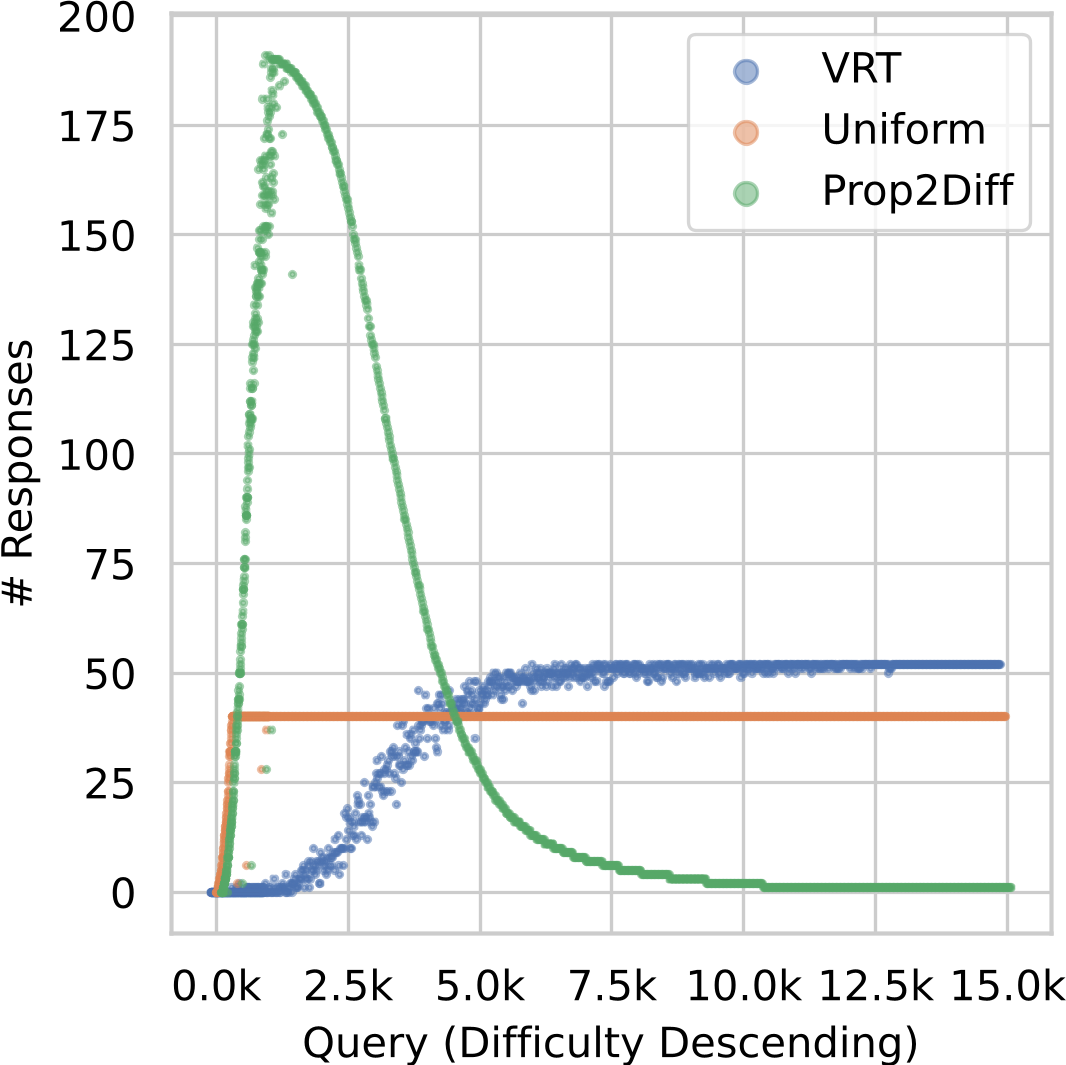
🎯 DART-Math > Difficulty-Aware Rejection Tuning for Mathematical Problem-Solving 📝 Paper@arXiv | 🤗 Datasets&Models@HF | 🐱 Code@GitHub 🐦 Thread@X(Twitter) | 🐶 中文博客@知乎 | 📊 Leaderboard@PapersWithCode | 📑 BibTeX ## Datasets: DART-MathDART-Math datasets are the state-of-the-art and data-efficientopen-source instruction tuning datasets for mathematical reasoning. DART-Math-Hard contains ~585k mathematical QA pair samples constructed by applying DARS-Prop2Diff to the query set from MATH and GSK8K training sets, achieves SOTA on many challenging mathematical reasoning benchmarks. It introduces a deliberate bias towards hard queries, opposite to vanilla rejection sampling. Performance produced by DART-Math-Hard is usually but not necessarily slightly better (~1% absolutely) than DART-Math-Uniform, which contains ~591k samples constructed by applying DARS-Uniform. ### Comparison between Mathematical Instruction Tuning Datasets Most of previous datasets are constructed with ChatGPT, and many of them are not open-source, especially for ones of the best performance. | Math SFT Dataset | # of Samples | MATH | GSM8K | College | Synthesis Agent(s) | Open-Source | | :--------------------------------------------------------------------------------- | -----------: | -----------------------------------------------------------------: | ---------------------------------------------: | -----------------------------------------------------------------------------------------------------------: | :---------------------- | :-------------------------------------------------------------------------: | | WizardMath | 96k | 32.3 | 80.4 | 23.1 | GPT-4 | ✗ | | MetaMathQA | 395k | 29.8 | 76.5 | 19.3 | GPT-3.5 | ✓ | | MMIQC | 2294k | 37.4 | 75.4 | 28.5 | GPT-4+GPT-3.5+Human | ✓ | | Orca-Math | 200k | -- | -- | -- | GPT-4 | ✓ | | Xwin-Math-V1.1 | 1440k | 45.5 | 84.9 | 27.6 | GPT-4 | ✗ | | KPMath-Plus | 1576k | 46.8 | 82.1 | -– | GPT-4 | ✗ | | MathScaleQA | 2021k | 35.2 | 74.8 | 21.8 | GPT-3.5+Human | ✗ | | DART-Math-Uniform | 591k | 43.5 | 82.6 | 26.9 | DeepSeekMath-7B-RL | ✓ | | DART-Math-Hard | 585k | 45.5 | 81.1 | 29.4 | DeepSeekMath-7B-RL | ✓ | <sup>MATH and GSM8K are in-domain, while College(Math) is out-of-domain. Performance here are of models fine-tuned from Mistral-7B, except for Xwin-Math-V1.1 based on Llama2-7B. Bold/Italic means the best/second best score here.</sup> ## Dataset Construction: DARS - Difficulty-Aware Rejection Sampling Previous works usually synthesize data from proprietary models to augment existing datasets, followed by instruction tuning to achieve top-tier results. However, our analysis of these datasets reveals severe biases towards easy queries, with frequent failures to generate any correct response for the most challenging queries. Motivated by the observation above, we propose to Difficulty-Aware Rejection Sampling (DARS), to collect more responses for more difficult queries. Specifically, we introduce two strategies to increase the number of correct responses for difficult queries: 1) Uniform, which involves sampling responses for each query until each query accumulates $k_u$ correct responses, where $k_u$ is a preset hyperparameter determined by the desired size of the synthetic dataset; 2) Prop2Diff, where we continue sampling responses until the number of correct responses for each query is proportional to its difficulty score. The most challenging queries will receive $k_p$ responses and kp is a hyperparameter. This method introduces a deliberate bias in the opposite direction to vanilla rejection sampling, towards more difficult queries, inspired by previous works that demonstrate difficult samples can be more effective to enhance model capabilities (Sorscher et al., 2022; Liu et al., 2024b). See Figure 1 (Right) for examples of DART-Math-Uniform by DARS-Uniform and DART-Math-Hard by DARS-Prop2Diff. ## Citation If you find our data, model or code useful for your work, please kindly cite our paper: latex @article{tong2024dartmath, title={DART-Math: Difficulty-Aware Rejection Tuning for Mathematical Problem-Solving}, author={Yuxuan Tong and Xiwen Zhang and Rui Wang and Ruidong Wu and Junxian He}, year={2024}, eprint={2407.13690}, archivePrefix={arXiv}, primaryClass={cs.CL}, url={https://arxiv.org/abs/2407.13690}, }
Educational Grade School Math (EGSM) contains 2,093 question/answer pairs generated by MATHWELL, a reference-free educational grade school math word problem generator that outputs a word problem and Program of Thought (PoT) solution based solely on an optional student interest, as introduced in MATHWELL: Generating Educational Math Word Problems Using Teacher Annotations. The question/answer pairs are verified by human experts. EGSM is the first teacher-annotated math word problem training dataset for LLMs. EGSM is designed to train reference-free educational grade school math word problem generators, but can also be used to train math QA models. Please refer to our paper for more information on the dataset.
Existing arithmetic benchmarks have a limited number of multiple-choice questions. To address this gap, MathMC is created including 1,000 Chinese mathematical multiple-choice questions with detailed explanations and focusing on math problems typically encountered in grades 4 to 6. It features a wide range of question types, including arithmetic, algebra, geometry, statistics, reasoning, and more, enhancing the diversity of current Chinese arithmetic datasets.
Existing arithmetic benchmarks have a limited number of True-or-False questions. To address this gap, MathToF is created including 1,000 Chinese mathematical True-or-False questions with detailed explanations and focusing on math problems typically encountered in grades 4 to 6. It features a wide range of question types, including arithmetic, algebra, geometry, statistics, reasoning, and more, enhancing the diversity of current Chinese arithmetic datasets.
PolyMATH, a challenging benchmark aimed at evaluating the general cognitive reasoning abilities of MLLMs. PolyMATH comprises 5,000 manually collected high-quality images of cognitive textual and visual challenges across 10 distinct categories, including pattern recognition, spatial reasoning, and relative reasoning PaperCodeProject
This dataset tests the capabilities of language models to correctly capture the meaning of words denoting probabilities (WEP, also called verbal probabilities), e.g. words like "probably", "maybe", "surely", "impossible".
Click to add a brief description of the dataset (Markdown and LaTeX enabled). Provide: * a high-level explanation of the dataset characteristics * explain motivations and summary of its content * potential use cases of the dataset