Papers with Code 아카이브

Object Detection

태스크의 하위 분류와 논문·코드·평가·기법·데이터셋을 탐색하세요.

하위 태스크
39
평가표
124
보존된 평가 기록
977

데이터셋

출처에 같은 태스크 이름으로 연결된 데이터셋입니다. 동명 태스크가 포함될 수 있으므로, 비교할 때는 평가 결과의 조건도 확인하세요.

ImageNet

The ImageNet dataset contains 14,197,122 annotated images according to the WordNet hierarchy. Since 2010 the dataset is used in the ImageNet Large Scale Visual Recognition Challenge (ILSVRC), a benchmark in image classification and object detection. The publicly released dataset contains a set of manually annotated training images. A set of test images is also released, with the manual annotations withheld. ILSVRC annotations fall into one of two categories: (1) image-level annotation of a binary label for the presence or absence of an object class in the image, e.g., “there are cars in this image” but “there are no tigers,” and (2) object-level annotation of a tight bounding box and class label around an object instance in the image, e.g., “there is a screwdriver centered at position (20,25) with width of 50 pixels and height of 30 pixels”. The ImageNet project does not own the copyright of the images, therefore only thumbnails and URLs of images are provided. * Total number of non-empty WordNet synsets: 21841 * Total number of images: 14197122 * Number of images with bounding box annotations: 1,034,908 * Number of synsets with SIFT features: 1000 * Number of images with SIFT features: 1.2 million Source: ImageNet Large Scale Visual Recognition Challenge Image Source: https://cs.stanford.edu/people/karpathy/cnnembed/
COCO (Common Objects in Context)

The COCO (Common Objects in Context) dataset is a large-scale object detection, segmentation, and captioning dataset. It is designed to encourage research on a wide variety of object categories and is commonly used for benchmarking computer vision models. It is an essential dataset for researchers and developers working on object detection, segmentation, and pose estimation tasks.

Cityscapes

Cityscapes is a large-scale database which focuses on semantic understanding of urban street scenes. It provides semantic, instance-wise, and dense pixel annotations for 30 classes grouped into 8 categories (flat surfaces, humans, vehicles, constructions, objects, nature, sky, and void). The dataset consists of around 5000 fine annotated images and 20000 coarse annotated ones. Data was captured in 50 cities during several months, daytimes, and good weather conditions. It was originally recorded as video so the frames were manually selected to have the following features: large number of dynamic objects, varying scene layout, and varying background. Source: A Review on Deep Learning Techniques Applied to Semantic Segmentation Image Source: https://www.cityscapes-dataset.com/dataset-overview/

KITTI

KITTI (Karlsruhe Institute of Technology and Toyota Technological Institute) is one of the most popular datasets for use in mobile robotics and autonomous driving. It consists of hours of traffic scenarios recorded with a variety of sensor modalities, including high-resolution RGB, grayscale stereo cameras, and a 3D laser scanner. Despite its popularity, the dataset itself does not contain ground truth for semantic segmentation. However, various researchers have manually annotated parts of the dataset to fit their necessities. Álvarez et al. generated ground truth for 323 images from the road detection challenge with three classes: road, vertical, and sky. Zhang et al. annotated 252 (140 for training and 112 for testing) acquisitions – RGB and Velodyne scans – from the tracking challenge for ten object categories: building, sky, road, vegetation, sidewalk, car, pedestrian, cyclist, sign/pole, and fence. Ros et al. labeled 170 training images and 46 testing images (from the visual odometry challenge) with 11 classes: building, tree, sky, car, sign, road, pedestrian, fence, pole, sidewalk, and bicyclist. Source: A Review on Deep Learning Techniques Applied to Semantic Segmentation Image Source: http://www.cvlibs.net/datasets/kitti/eval_object.php?obj_benchmark=3d

nuScenes

The nuScenes dataset is a large-scale autonomous driving dataset. The dataset has 3D bounding boxes for 1000 scenes collected in Boston and Singapore. Each scene is 20 seconds long and annotated at 2Hz. This results in a total of 28130 samples for training, 6019 samples for validation and 6008 samples for testing. The dataset has the full autonomous vehicle data suite: 32-beam LiDAR, 6 cameras and radars with complete 360° coverage. The 3D object detection challenge evaluates the performance on 10 classes: cars, trucks, buses, trailers, construction vehicles, pedestrians, motorcycles, bicycles, traffic cones and barriers. Source: PointPainting: Sequential Fusion for 3D Object Detection

ScanNet

ScanNet is an instance-level indoor RGB-D dataset that includes both 2D and 3D data. It is a collection of labeled voxels rather than points or objects. Up to now, ScanNet v2, the newest version of ScanNet, has collected 1513 annotated scans with an approximate 90% surface coverage. In the semantic segmentation task, this dataset is marked in 20 classes of annotated 3D voxelized objects. Source: A Review of Point Cloud Semantic Segmentation Image Source: http://www.scan-net.org/

Visual Genome

Visual Genome contains Visual Question Answering data in a multi-choice setting. It consists of 101,174 images from MSCOCO with 1.7 million QA pairs, 17 questions per image on average. Compared to the Visual Question Answering dataset, Visual Genome represents a more balanced distribution over 6 question types: What, Where, When, Who, Why and How. The Visual Genome dataset also presents 108K images with densely annotated objects, attributes and relationships. Source: RaAM: A Relation-aware Attention Model for Visual Question Answering Image Source: Visual Genome: Connecting Language and Vision Using Crowdsourced Dense Image Annotations

NYUv2

The NYU-Depth V2 data set is comprised of video sequences from a variety of indoor scenes as recorded by both the RGB and Depth cameras from the Microsoft Kinect. It features: * 1449 densely labeled pairs of aligned RGB and depth images * 464 new scenes taken from 3 cities * 407,024 new unlabeled frames * Each object is labeled with a class and an instance number. The dataset has several components: * Labeled: A subset of the video data accompanied by dense multi-class labels. This data has also been preprocessed to fill in missing depth labels. * Raw: The raw RGB, depth and accelerometer data as provided by the Kinect. * Toolbox: Useful functions for manipulating the data and labels. Source: https://cs.nyu.edu/~silberman/datasets/nyu_depth_v2.html Image Source: https://cs.nyu.edu/~silberman/datasets/nyu_depth_v2.html

GQA

The GQA dataset is a large-scale visual question answering dataset with real images from the Visual Genome dataset and balanced question-answer pairs. Each training and validation image is also associated with scene graph annotations describing the classes and attributes of those objects in the scene, and their pairwise relations. Along with the images and question-answer pairs, the GQA dataset provides two types of pre-extracted visual features for each image – convolutional grid features of size 7×7×2048 extracted from a ResNet-101 network trained on ImageNet, and object detection features of size Ndet×2048 (where Ndet is the number of detected objects in each image with a maximum of 100 per image) from a Faster R-CNN detector. Source: Language-Conditioned Graph Networks for Relational Reasoning Image Source: https://arxiv.org/pdf/1902.09506.pdf

LVIS

LVIS is a dataset for long tail instance segmentation. It has annotations for over 1000 object categories in 164k images. Source: LVIS

Waymo Open Dataset

The Waymo Open Dataset is comprised of high resolution sensor data collected by autonomous vehicles operated by the Waymo Driver in a wide variety of conditions. The Waymo Open Dataset currently contains 1,950 segments. The authors plan to grow this dataset in the future. Currently the datasets includes: * 1,950 segments of 20s each, collected at 10Hz (390,000 frames) in diverse geographies and conditions * Sensor data * 1 mid-range lidar * 4 short-range lidars * 5 cameras (front and sides) * Synchronized lidar and camera data * Lidar to camera projections * Sensor calibrations and vehicle poses * Labeled data * Labels for 4 object classes - Vehicles, Pedestrians, Cyclists, Signs * High-quality labels for lidar data in 1,200 segments * 12.6M 3D bounding box labels with tracking IDs on lidar data * High-quality labels for camera data in 1,000 segments * 11.8M 2D bounding box labels with tracking IDs on camera data

BDD100K

Datasets drive vision progress, yet existing driving datasets are impoverished in terms of visual content and supported tasks to study multitask learning for autonomous driving. Researchers are usually constrained to study a small set of problems on one dataset, while real-world computer vision applications require performing tasks of various complexities. We construct BDD100K, the largest driving video dataset with 100K videos and 10 tasks to evaluate the exciting progress of image recognition algorithms on autonomous driving. The dataset possesses geographic, environmental, and weather diversity, which is useful for training models that are less likely to be surprised by new conditions. Based on this diverse dataset, we build a benchmark for heterogeneous multitask learning and study how to solve the tasks together. Our experiments show that special training strategies are needed for existing models to perform such heterogeneous tasks. BDD100K opens the door for future studies in this important venue. More detail is at the dataset home page.

Common Voice

Common Voice is an audio dataset that consists of a unique MP3 and corresponding text file. There are 9,283 recorded hours in the dataset. The dataset also includes demographic metadata like age, sex, and accent. The dataset consists of 7,335 validated hours in 60 languages.

Charades

The Charades dataset is composed of 9,848 videos of daily indoors activities with an average length of 30 seconds, involving interactions with 46 objects classes in 15 types of indoor scenes and containing a vocabulary of 30 verbs leading to 157 action classes. Each video in this dataset is annotated by multiple free-text descriptions, action labels, action intervals and classes of interacting objects. 267 different users were presented with a sentence, which includes objects and actions from a fixed vocabulary, and they recorded a video acting out the sentence. In total, the dataset contains 66,500 temporal annotations for 157 action classes, 41,104 labels for 46 object classes, and 27,847 textual descriptions of the videos. In the standard split there are7,986 training video and 1,863 validation video. Source: Temporal Reasoning Graph for Activity Recognition

Argoverse

Argoverse is a tracking benchmark with over 30K scenarios collected in Pittsburgh and Miami. Each scenario is a sequence of frames sampled at 10 HZ. Each sequence has an interesting object called “agent”, and the task is to predict the future locations of agents in a 3 seconds future horizon. The sequences are split into training, validation and test sets, which have 205,942, 39,472 and 78,143 sequences respectively. These splits have no geographical overlap. Source: Learning Lane Graph Representations for Motion Forecasting Image Source: https://arxiv.org/pdf/1911.02620.pdf

Manga109

Manga109 has been compiled by the Aizawa Yamasaki Matsui Laboratory, Department of Information and Communication Engineering, the Graduate School of Information Science and Technology, the University of Tokyo. The compilation is intended for use in academic research on the media processing of Japanese manga. Manga109 is composed of 109 manga volumes drawn by professional manga artists in Japan. These manga were commercially made available to the public between the 1970s and 2010s, and encompass a wide range of target readerships and genres (see the table in Explore for further details.) Most of the manga in the compilation are available at the manga library “Manga Library Z” (formerly the “Zeppan Manga Toshokan” library of out-of-print manga). Source: Manga109 Image Source: https://arxiv.org/pdf/1510.04389v1.pdf

DOTA

DOTA is a large-scale dataset for object detection in aerial images. It can be used to develop and evaluate object detectors in aerial images. The images are collected from different sensors and platforms. Each image is of the size in the range from 800 × 800 to 20,000 × 20,000 pixels and contains objects exhibiting a wide variety of scales, orientations, and shapes. The instances in DOTA images are annotated by experts in aerial image interpretation by arbitrary (8 d.o.f.) quadrilateral. We will continue to update DOTA, to grow in size and scope to reflect evolving real-world conditions. Now it has three versions: DOTA-v1.0 contains 15 common categories, 2,806 images and 188, 282 instances. The proportions of the training set, validation set, and testing set in DOTA-v1.0 are 1/2, 1/6, and 1/3, respectively. DOTA-v1.5 uses the same images as DOTA-v1.0, but the extremely small instances (less than 10 pixels) are also annotated. Moreover, a new category, ”container crane” is added. It contains 403,318 instances in total. The number of images and dataset splits are the same as DOTA-v1.0. This version was released for the DOAI Challenge 2019 on Object Detection in Aerial Images in conjunction with IEEE CVPR 2019. DOTA-v2.0 collects more Google Earth, GF-2 Satellite, and aerial images. There are 18 common categories, 11,268 images and 1,793,658 instances in DOTA-v2.0. Compared to DOTA-v1.5, it further adds the new categories of ”airport” and ”helipad”. The 11,268 images of DOTA are split into training, validation, test-dev, and test-challenge sets. To avoid the problem of overfitting, the proportion of training and validation set is smaller than the test set. Furthermore, we have two test sets, namely test-dev and test-challenge. Training contains 1,830 images and 268,627 instances. Validation contains 593 images and 81,048 instances. We released the images and ground truths for training and validation sets. Test-dev contains 2,792 images and 353,346 instances. We released the images but not the ground truths. Test-challenge contains 6,053 images and 1,090,637 instances. Source: https://captain-whu.github.io/DOTA/index.html Image Source: https://captain-whu.github.io/DOTA/

DUTS

DUTS is a saliency detection dataset containing 10,553 training images and 5,019 test images. All training images are collected from the ImageNet DET training/val sets, while test images are collected from the ImageNet DET test set and the SUN data set. Both the training and test set contain very challenging scenarios for saliency detection. Accurate pixel-level ground truths are manually annotated by 50 subjects. Source: http://saliencydetection.net/duts/ Image Source: https://ieeexplore.ieee.org/document/8099887

10,000 People - Human Pose Recognition Data

Description: 10,000 People - Human Pose Recognition Data. This dataset includes indoor and outdoor scenes.This dataset covers males and females. Age distribution ranges from teenager to the elderly, the middle-aged and young people are the majorities. The data diversity includes different shooting heights, different ages, different light conditions, different collecting environment, clothes in different seasons, multiple human poses. For each subject, the labels of gender, race, age, collecting environment and clothes were annotated. The data can be used for human pose recognition and other tasks. Data size: 10,000 people Race distribution: Asian (Chinese)

KITTI-360

KITTI-360 is a large-scale dataset that contains rich sensory information and full annotations. It is the successor of the popular KITTI dataset, providing more comprehensive semantic/instance labels in 2D and 3D, richer 360 degree sensory information (fisheye images and pushbroom laser scans), very accurate and geo-localized vehicle and camera poses, and a series of new challenging benchmarks.

PASCAL3D+

The Pascal3D+ multi-view dataset consists of images in the wild, i.e., images of object categories exhibiting high variability, captured under uncontrolled settings, in cluttered scenes and under many different poses. Pascal3D+ contains 12 categories of rigid objects selected from the PASCAL VOC 2012 dataset. These objects are annotated with pose information (azimuth, elevation and distance to camera). Pascal3D+ also adds pose annotated images of these 12 categories from the ImageNet dataset. Source: Convolutional Models for Joint Object Categorization and Pose Estimation Image Source: Beyond PASCAL: A benchmark for 3D object detection in the wild

Kvasir-SEG

Kvasir-SEG is an open-access dataset of gastrointestinal polyp images and corresponding segmentation masks, manually annotated by a medical doctor and then verified by an experienced gastroenterologist. Source: Kvasir-SEG: A Segmented Polyp Dataset Image Source: https://datasets.simula.no/kvasir-seg/

PASCAL VOC

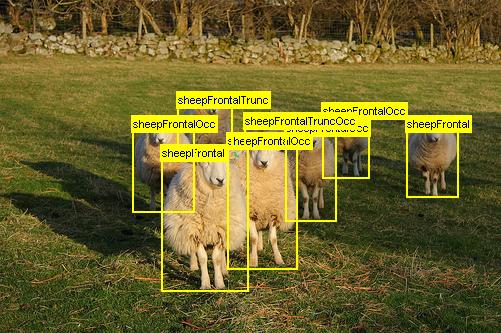
The PASCAL Visual Object Classes (VOC) 2012 dataset contains 20 object categories including vehicles, household, animals, and other: aeroplane, bicycle, boat, bus, car, motorbike, train, bottle, chair, dining table, potted plant, sofa, TV/monitor, bird, cat, cow, dog, horse, sheep, and person. Each image in this dataset has pixel-level segmentation annotations, bounding box annotations, and object class annotations. This dataset has been widely used as a benchmark for object detection, semantic segmentation, and classification tasks. The PASCAL VOC dataset is split into three subsets: 1,464 images for training, 1,449 images for validation and a private testing set. Source: Self-supervised Visual Feature Learning with Deep Neural Networks: A Survey Image Source: http://host.robots.ox.ac.uk/pascal/VOC/voc2012/examples/images/sheep_06.jpg

Argoverse 2

Argoverse 2 (AV2) is a collection of three datasets for perception and forecasting research in the self-driving domain. The annotated Sensor Dataset contains 1,000 sequences of multimodal data, encompassing high-resolution imagery from seven ring cameras, and two stereo cameras in addition to lidar point clouds, and 6-DOF map-aligned pose. Sequences contain 3D cuboid annotations for 26 object categories, all of which are sufficiently-sampled to support training and evaluation of 3D perception models. The Lidar Dataset contains 20,000 sequences of unlabeled lidar point clouds and map-aligned pose. This dataset is the largest ever collection of lidar sensor data and supports self-supervised learning and the emerging task of point cloud forecasting. Finally, the Motion Forecasting Dataset contains 250,000 scenarios mined for interesting and challenging interactions be- tween the autonomous vehicle and other actors in each local scene. Models are tasked with the prediction of future motion for “scored actors" in each scenario and are provided with track histories that capture object location, heading, velocity, and category. In all three datasets, each scenario contains its own HD Map with 3D lane and crosswalk geometry — sourced from data captured in six distinct cities. We believe these datasets will support new and existing machine learning research problems in ways that existing datasets do not. All datasets are released under the CC BY-NC-SA 4.0 license.

HICO-DET

HICO-DET is a dataset for detecting human-object interactions (HOI) in images. It contains 47,776 images (38,118 in train set and 9,658 in test set), 600 HOI categories constructed by 80 object categories and 117 verb classes. HICO-DET provides more than 150k annotated human-object pairs. V-COCO provides 10,346 images (2,533 for training, 2,867 for validating and 4,946 for testing) and 16,199 person instances. Each person has annotations for 29 action categories and there are no interaction labels including objects. Source: Visual Compositional Learning for Human-Object Interaction Detection Image Source: http://www-personal.umich.edu/~ywchao/hico/

NoCaps

The nocaps benchmark consists of 166,100 human-generated captions describing 15,100 images from the OpenImages validation and test sets. Source: nocaps: novel object captioning at scale Image Source: https://nocaps.org/

COD10K

Sensory ecologists have found that this s background matching camouflage strategy works by deceiving the visual perceptual system of the observer. Naturally, addressing concealed object detection (COD) requires a significant amount of visual perception knowledge. Understanding COD has not only scientific value in itself, but it also important for applications in many fundamental fields, such as computer vision (e.g., for search-and-rescue work, or rare species discovery), medicine (e.g., polyp segmentation, lung infection segmentation), agriculture (e.g., locust detection to prevent invasion), and art (e.g., recreational art). The high intrinsic similarities between the targets and non-targets make COD far more challenging than traditional object segmentation/detection. Although it has gained increased attention recently, studies on COD still remain scarce, mainly due to the lack of a sufficiently large dataset and a standard benchmark like Pascal-VOC, ImageNet, MS-COCO, ADE20K, and DAVIS. To build the large-scale COD dataset, we build the COD10K, which contains 10,000 images (5,066 camouflaged, 3,000 background, 1,934 noncamouflaged), divided into 10 super-classes, and 78 sub-classes (69 camouflaged, nine non-camouflaged) which are collected from multiple photography websites.

CrowdHuman

CrowdHuman is a large and rich-annotated human detection dataset, which contains 15,000, 4,370 and 5,000 images collected from the Internet for training, validation and testing respectively. The number is more than 10× boosted compared with previous challenging pedestrian detection dataset like CityPersons. The total number of persons is also noticeably larger than the others with ∼340k person and ∼99k ignore region annotations in the CrowdHuman training subset. Source: SADet: Learning An Efficient and Accurate Pedestrian Detector Image Source: http://www.crowdhuman.org/

Objects365

Objects365 is a large-scale object detection dataset, Objects365, which has 365 object categories over 600K training images. More than 10 million, high-quality bounding boxes are manually labeled through a three-step, carefully designed annotation pipeline. It is the largest object detection dataset (with full annotation) so far and establishes a more challenging benchmark for the community. Source: Objects365: A Large-Scale, High-Quality Dataset for Object Detection Image Source: https://www.objects365.org/overview.html

출처: Papers with Code · CC BY-SA 4.0. 아카이브 자료와 새로 수집한 논문은 별도로 관리합니다.