Papers with Code 아카이브

Knowledge Distillation

태스크의 하위 분류와 논문·코드·평가·기법·데이터셋을 탐색하세요.

하위 태스크
2
평가표
11
보존된 평가 기록
90

Knowledge distillation is the process of transferring knowledge from a large model to a smaller one. While large models (such as very deep neural networks or ensembles of many models) have higher knowledge capacity than small models, this capacity might not be fully utilized.

데이터셋

출처에 같은 태스크 이름으로 연결된 데이터셋입니다. 동명 태스크가 포함될 수 있으므로, 비교할 때는 평가 결과의 조건도 확인하세요.

ImageNet

The ImageNet dataset contains 14,197,122 annotated images according to the WordNet hierarchy. Since 2010 the dataset is used in the ImageNet Large Scale Visual Recognition Challenge (ILSVRC), a benchmark in image classification and object detection. The publicly released dataset contains a set of manually annotated training images. A set of test images is also released, with the manual annotations withheld. ILSVRC annotations fall into one of two categories: (1) image-level annotation of a binary label for the presence or absence of an object class in the image, e.g., “there are cars in this image” but “there are no tigers,” and (2) object-level annotation of a tight bounding box and class label around an object instance in the image, e.g., “there is a screwdriver centered at position (20,25) with width of 50 pixels and height of 30 pixels”. The ImageNet project does not own the copyright of the images, therefore only thumbnails and URLs of images are provided. * Total number of non-empty WordNet synsets: 21841 * Total number of images: 14197122 * Number of images with bounding box annotations: 1,034,908 * Number of synsets with SIFT features: 1000 * Number of images with SIFT features: 1.2 million Source: ImageNet Large Scale Visual Recognition Challenge Image Source: https://cs.stanford.edu/people/karpathy/cnnembed/
COCO (Common Objects in Context)

The COCO (Common Objects in Context) dataset is a large-scale object detection, segmentation, and captioning dataset. It is designed to encourage research on a wide variety of object categories and is commonly used for benchmarking computer vision models. It is an essential dataset for researchers and developers working on object detection, segmentation, and pose estimation tasks.

CIFAR-100

The CIFAR-100 dataset (Canadian Institute for Advanced Research, 100 classes) is a subset of the Tiny Images dataset and consists of 60000 32x32 color images. The 100 classes in the CIFAR-100 are grouped into 20 superclasses. There are 600 images per class. Each image comes with a "fine" label (the class to which it belongs) and a "coarse" label (the superclass to which it belongs). There are 500 training images and 100 testing images per class. The criteria for deciding whether an image belongs to a class were as follows: * The class name should be high on the list of likely answers to the question “What is in this picture?” * The image should be photo-realistic. Labelers were instructed to reject line drawings. * The image should contain only one prominent instance of the object to which the class refers. * The object may be partially occluded or seen from an unusual viewpoint as long as its identity is still clear to the labeler. Source: https://www.cs.toronto.edu/~kriz/cifar.html Image Source: https://www.cs.toronto.edu/~kriz/cifar.html

Cityscapes

Cityscapes is a large-scale database which focuses on semantic understanding of urban street scenes. It provides semantic, instance-wise, and dense pixel annotations for 30 classes grouped into 8 categories (flat surfaces, humans, vehicles, constructions, objects, nature, sky, and void). The dataset consists of around 5000 fine annotated images and 20000 coarse annotated ones. Data was captured in 50 cities during several months, daytimes, and good weather conditions. It was originally recorded as video so the frames were manually selected to have the following features: large number of dynamic objects, varying scene layout, and varying background. Source: A Review on Deep Learning Techniques Applied to Semantic Segmentation Image Source: https://www.cityscapes-dataset.com/dataset-overview/

KITTI

KITTI (Karlsruhe Institute of Technology and Toyota Technological Institute) is one of the most popular datasets for use in mobile robotics and autonomous driving. It consists of hours of traffic scenarios recorded with a variety of sensor modalities, including high-resolution RGB, grayscale stereo cameras, and a 3D laser scanner. Despite its popularity, the dataset itself does not contain ground truth for semantic segmentation. However, various researchers have manually annotated parts of the dataset to fit their necessities. Álvarez et al. generated ground truth for 323 images from the road detection challenge with three classes: road, vertical, and sky. Zhang et al. annotated 252 (140 for training and 112 for testing) acquisitions – RGB and Velodyne scans – from the tracking challenge for ten object categories: building, sky, road, vegetation, sidewalk, car, pedestrian, cyclist, sign/pole, and fence. Ros et al. labeled 170 training images and 46 testing images (from the visual odometry challenge) with 11 classes: building, tree, sky, car, sign, road, pedestrian, fence, pole, sidewalk, and bicyclist. Source: A Review on Deep Learning Techniques Applied to Semantic Segmentation Image Source: http://www.cvlibs.net/datasets/kitti/eval_object.php?obj_benchmark=3d

QNLI

The QNLI (Question-answering NLI) dataset is a Natural Language Inference dataset automatically derived from the Stanford Question Answering Dataset v1.1 (SQuAD). SQuAD v1.1 consists of question-paragraph pairs, where one of the sentences in the paragraph (drawn from Wikipedia) contains the answer to the corresponding question (written by an annotator). The dataset was converted into sentence pair classification by forming a pair between each question and each sentence in the corresponding context, and filtering out pairs with low lexical overlap between the question and the context sentence. The task is to determine whether the context sentence contains the answer to the question. This modified version of the original task removes the requirement that the model select the exact answer, but also removes the simplifying assumptions that the answer is always present in the input and that lexical overlap is a reliable cue. The QNLI dataset is part of GLUE benchmark. Source: https://arxiv.org/pdf/1804.07461.pdf

PASCAL VOC

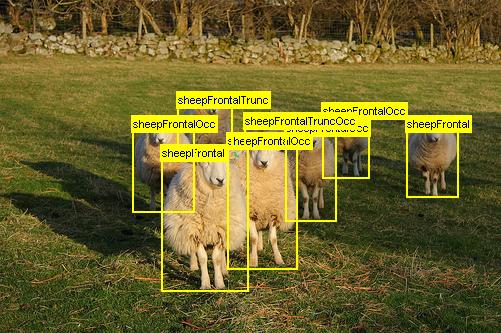
The PASCAL Visual Object Classes (VOC) 2012 dataset contains 20 object categories including vehicles, household, animals, and other: aeroplane, bicycle, boat, bus, car, motorbike, train, bottle, chair, dining table, potted plant, sofa, TV/monitor, bird, cat, cow, dog, horse, sheep, and person. Each image in this dataset has pixel-level segmentation annotations, bounding box annotations, and object class annotations. This dataset has been widely used as a benchmark for object detection, semantic segmentation, and classification tasks. The PASCAL VOC dataset is split into three subsets: 1,464 images for training, 1,449 images for validation and a private testing set. Source: Self-supervised Visual Feature Learning with Deep Neural Networks: A Survey Image Source: http://host.robots.ox.ac.uk/pascal/VOC/voc2012/examples/images/sheep_06.jpg

SQuAD

The Stanford Question Answering Dataset (SQuAD) is a collection of question-answer pairs derived from Wikipedia articles. In SQuAD, the correct answers of questions can be any sequence of tokens in the given text. Because the questions and answers are produced by humans through crowdsourcing, it is more diverse than some other question-answering datasets. SQuAD 1.1 contains 107,785 question-answer pairs on 536 articles. SQuAD2.0 (open-domain SQuAD, SQuAD-Open), the latest version, combines the 100,000 questions in SQuAD1.1 with over 50,000 un-answerable questions written adversarially by crowdworkers in forms that are similar to the answerable ones. Source: Deep Learning Based Text Classification: A Comprehensive Review Image Source: https://rajpurkar.github.io/SQuAD-explorer/explore/v2.0/dev/Prime_number.html

Wiki-40B

A new multilingual language model benchmark that is composed of 40+ languages spanning several scripts and linguistic families containing round 40 billion characters and aimed to accelerate the research of multilingual modeling. Source: Wiki-40B: Multilingual Language Model Dataset

CropAndWeed

The CropAndWeed dataset is focused on the fine-grained identification of 74 relevant crop and weed species with a strong emphasis on data variability. Annotations of labeled bounding boxes, semantic masks and stem positions are provided for about 112k instances in more than 8k high-resolution images of both real-world agricultural sites and specifically cultivated outdoor plots of rare weed types. Additionally, each sample is enriched with meta-annotations regarding environmental conditions.

Europarl-ASR

Europarl-ASR (EN) is a 1300-hour English-language speech and text corpus of parliamentary debates for (streaming) Automatic Speech Recognition training and benchmarking, speech data filtering and speech data verbatimization, based on European Parliament speeches and their official transcripts (1996-2020). Includes dev-test sets for streaming ASR benchmarking, made up of 18 hours of manually revised speeches. The availability of manual non-verbatim and verbatim transcripts for dev-test speeches makes this corpus also useful for the assessment of automatic filtering and verbatimization techniques. The corpus is released under an open licence at https://www.mllp.upv.es/europarl-asr/ Europarl-ASR CONTENTS: [Speech data] 1300 hours of English-language annotated speech data, 3 full sets of timed transcriptions (official non-verbatim, automatically noise-filtered, automatically verbatimized), 18 hours of speech data with both manually revised verbatim transcriptions and official non-verbatim transcriptions, split in 2 independent validation- evaluation partitions for 2 realistic ASR tasks (with vs. without previous knowledge of the speaker); [Text data] 70 million tokens of English-language text data; [Pretrained language models] the Europarl-ASR English-language n-gram language model and vocabulary.

Apron Dataset

The Apron Dataset focuses on training and evaluating classification and detection models for airport-apron logistics. In addition to bounding boxes and object categories the dataset is enriched with meta parameters to quantify the models’ robustness against environmental influences.

COCO-N Medium

COCO-N Medium introduces a stochastic benchmark that simulates common real-world scenarios with noticeable label inaccuracies in the COCO dataset. This benchmark combines class and spatial noises to create a challenging yet realistic evaluation framework for instance segmentation models. It mimics datasets manually annotated by crowd workers, where a moderate level of label noise is expected. By incorporating both class and spatial inaccuracies, COCO-N Medium allows researchers to assess their models' basic robustness to label noise, providing insights into performance in typical real-world applications where perfect annotations are rare. This medium-level benchmark serves as a crucial middle ground, offering a more rigorous test than minimally noisy datasets while remaining within the bounds of commonly encountered data quality issues. COCO-N Medium enables a nuanced evaluation of model performance under realistic conditions, helping identify areas for improvement in handling noisy labels and guiding the development of more robust instance segmentation algorithms.

CSTS

CSTS: Correlation Structures in Time Series CSTS is a comprehensive synthetic benchmarking dataset designed specifically for evaluating correlation structure discovery in time series data. The dataset systematically models known correlation structures between time series variables and enables rigorous assessment of clustering algorithms and validation methods. ## Dataset Characteristics: - 23 distinct correlation structures between three time series variables (iob, cob, ig) - Correlation relationships in three categories: strong positive ([0.7,1]), negligible ([-0.2,0.2]), and strong negative ([-1,-0.7]) - Stationary segments with regime-switching correlation structures, no temporal dependencies (autocorrelation, trends, seasonality) - Segments varying in length from 15 minutes to 10 hours (900-36000 observations) - Data variants include normal distributions, non-normal distributions (similar to insulin, carbohydrates, and glucose data), downsampled versions, and three sparsity levels (complete, partial - missing 30% of observations, sparse - missing 90% of observations) - 60 subjects in total, 30 per data variant, two splits (exploratory/confirmatory) - Ground truth information for segmentation and clustering, and labels for controlled degraded segmentation and clustering ## Motivation: CSTS addresses a critical gap in time series clustering evaluation by providing a structure-first benchmark with well-defined correlation structures rather than arbitrary classification boundaries. This enables researchers to systematically distinguish between correlation structure deterioration and algorithmic limitations, moving clustering analysis from "art" toward science. ## Use Cases: - Evaluating time series clustering algorithms' ability to detect correlation structures under varying data conditions - Assessing clustering validation methods under varying data conditions - Investigating how preprocessing techniques affect correlation structure discovery - Establishing performance thresholds for high-quality clustering results Source: CSTS: A Benchmark for the Discovery of Correlation Structures in Time Series Clustering

GenoTEX

GenoTEX (Genomics Data Automatic Exploration Benchmark) is a benchmark dataset for the automated analysis of gene expression data to identify disease-associated genes while considering the influence of other biological factors. It provides analysis code and results for solving a wide range of gene-trait association (GTA) analysis problems, encompassing dataset selection, preprocessing, and statistical analysis, in a pipeline that follows computational genomics standards. The benchmark includes expert-curated annotations from bioinformaticians to ensure accuracy and reliability.

PsOCR

PsOCR is a large-scale synthetic dataset for Optical Character Recognition in low-resource Pashto language.

SemanticSugarBeets

SemanticSugarBeets, a novel and high-quality dataset containing 953 monocular RGB images and 2920 annotations of sugar beets, enables a wide range of learning tasks including object detection, semantic segmentation, instance segmentation and mass estimation for post-harvest and post-storage analysis.

출처: Papers with Code · CC BY-SA 4.0. 아카이브 자료와 새로 수집한 논문은 별도로 관리합니다.