Papers with Code 아카이브

2D Semantic Segmentation

태스크의 하위 분류와 논문·코드·평가·기법·데이터셋을 탐색하세요.

하위 태스크
17
평가표
11
보존된 평가 기록
42

데이터셋

출처에 같은 태스크 이름으로 연결된 데이터셋입니다. 동명 태스크가 포함될 수 있으므로, 비교할 때는 평가 결과의 조건도 확인하세요.

ImageNet

The ImageNet dataset contains 14,197,122 annotated images according to the WordNet hierarchy. Since 2010 the dataset is used in the ImageNet Large Scale Visual Recognition Challenge (ILSVRC), a benchmark in image classification and object detection. The publicly released dataset contains a set of manually annotated training images. A set of test images is also released, with the manual annotations withheld. ILSVRC annotations fall into one of two categories: (1) image-level annotation of a binary label for the presence or absence of an object class in the image, e.g., “there are cars in this image” but “there are no tigers,” and (2) object-level annotation of a tight bounding box and class label around an object instance in the image, e.g., “there is a screwdriver centered at position (20,25) with width of 50 pixels and height of 30 pixels”. The ImageNet project does not own the copyright of the images, therefore only thumbnails and URLs of images are provided. * Total number of non-empty WordNet synsets: 21841 * Total number of images: 14197122 * Number of images with bounding box annotations: 1,034,908 * Number of synsets with SIFT features: 1000 * Number of images with SIFT features: 1.2 million Source: ImageNet Large Scale Visual Recognition Challenge Image Source: https://cs.stanford.edu/people/karpathy/cnnembed/
COCO (Common Objects in Context)

The COCO (Common Objects in Context) dataset is a large-scale object detection, segmentation, and captioning dataset. It is designed to encourage research on a wide variety of object categories and is commonly used for benchmarking computer vision models. It is an essential dataset for researchers and developers working on object detection, segmentation, and pose estimation tasks.

Cityscapes

Cityscapes is a large-scale database which focuses on semantic understanding of urban street scenes. It provides semantic, instance-wise, and dense pixel annotations for 30 classes grouped into 8 categories (flat surfaces, humans, vehicles, constructions, objects, nature, sky, and void). The dataset consists of around 5000 fine annotated images and 20000 coarse annotated ones. Data was captured in 50 cities during several months, daytimes, and good weather conditions. It was originally recorded as video so the frames were manually selected to have the following features: large number of dynamic objects, varying scene layout, and varying background. Source: A Review on Deep Learning Techniques Applied to Semantic Segmentation Image Source: https://www.cityscapes-dataset.com/dataset-overview/

KITTI

KITTI (Karlsruhe Institute of Technology and Toyota Technological Institute) is one of the most popular datasets for use in mobile robotics and autonomous driving. It consists of hours of traffic scenarios recorded with a variety of sensor modalities, including high-resolution RGB, grayscale stereo cameras, and a 3D laser scanner. Despite its popularity, the dataset itself does not contain ground truth for semantic segmentation. However, various researchers have manually annotated parts of the dataset to fit their necessities. Álvarez et al. generated ground truth for 323 images from the road detection challenge with three classes: road, vertical, and sky. Zhang et al. annotated 252 (140 for training and 112 for testing) acquisitions – RGB and Velodyne scans – from the tracking challenge for ten object categories: building, sky, road, vegetation, sidewalk, car, pedestrian, cyclist, sign/pole, and fence. Ros et al. labeled 170 training images and 46 testing images (from the visual odometry challenge) with 11 classes: building, tree, sky, car, sign, road, pedestrian, fence, pole, sidewalk, and bicyclist. Source: A Review on Deep Learning Techniques Applied to Semantic Segmentation Image Source: http://www.cvlibs.net/datasets/kitti/eval_object.php?obj_benchmark=3d

ScanNet

ScanNet is an instance-level indoor RGB-D dataset that includes both 2D and 3D data. It is a collection of labeled voxels rather than points or objects. Up to now, ScanNet v2, the newest version of ScanNet, has collected 1513 annotated scans with an approximate 90% surface coverage. In the semantic segmentation task, this dataset is marked in 20 classes of annotated 3D voxelized objects. Source: A Review of Point Cloud Semantic Segmentation Image Source: http://www.scan-net.org/

Visual Genome

Visual Genome contains Visual Question Answering data in a multi-choice setting. It consists of 101,174 images from MSCOCO with 1.7 million QA pairs, 17 questions per image on average. Compared to the Visual Question Answering dataset, Visual Genome represents a more balanced distribution over 6 question types: What, Where, When, Who, Why and How. The Visual Genome dataset also presents 108K images with densely annotated objects, attributes and relationships. Source: RaAM: A Relation-aware Attention Model for Visual Question Answering Image Source: Visual Genome: Connecting Language and Vision Using Crowdsourced Dense Image Annotations

Human3.6M

The Human3.6M dataset is one of the largest motion capture datasets, which consists of 3.6 million human poses and corresponding images captured by a high-speed motion capture system. There are 4 high-resolution progressive scan cameras to acquire video data at 50 Hz. The dataset contains activities by 11 professional actors in 17 scenarios: discussion, smoking, taking photo, talking on the phone, etc., as well as provides accurate 3D joint positions and high-resolution videos. Source: Space-Time Representation of People Based on 3D Skeletal Data: A Review Image Source: Yu et al

GQA

The GQA dataset is a large-scale visual question answering dataset with real images from the Visual Genome dataset and balanced question-answer pairs. Each training and validation image is also associated with scene graph annotations describing the classes and attributes of those objects in the scene, and their pairwise relations. Along with the images and question-answer pairs, the GQA dataset provides two types of pre-extracted visual features for each image – convolutional grid features of size 7×7×2048 extracted from a ResNet-101 network trained on ImageNet, and object detection features of size Ndet×2048 (where Ndet is the number of detected objects in each image with a maximum of 100 per image) from a Faster R-CNN detector. Source: Language-Conditioned Graph Networks for Relational Reasoning Image Source: https://arxiv.org/pdf/1902.09506.pdf

Places205

The Places205 dataset is a large-scale scene-centric dataset with 205 common scene categories. The training dataset contains around 2,500,000 images from these categories. In the training set, each scene category has the minimum 5,000 and maximum 15,000 images. The validation set contains 100 images per category (a total of 20,500 images), and the testing set includes 200 images per category (a total of 41,000 images). Source: Knowledge Guided Disambiguation for Large-Scale Scene Classification with Multi-Resolution CNNs Image Source: http://places.csail.mit.edu/browser.html

Argoverse

Argoverse is a tracking benchmark with over 30K scenarios collected in Pittsburgh and Miami. Each scenario is a sequence of frames sampled at 10 HZ. Each sequence has an interesting object called “agent”, and the task is to predict the future locations of agents in a 3 seconds future horizon. The sequences are split into training, validation and test sets, which have 205,942, 39,472 and 78,143 sequences respectively. These splits have no geographical overlap. Source: Learning Lane Graph Representations for Motion Forecasting Image Source: https://arxiv.org/pdf/1911.02620.pdf

KITTI-360

KITTI-360 is a large-scale dataset that contains rich sensory information and full annotations. It is the successor of the popular KITTI dataset, providing more comprehensive semantic/instance labels in 2D and 3D, richer 360 degree sensory information (fisheye images and pushbroom laser scans), very accurate and geo-localized vehicle and camera poses, and a series of new challenging benchmarks.

CamVid

CamVid (Cambridge-driving Labeled Video Database) is a road/driving scene understanding database which was originally captured as five video sequences with a 960×720 resolution camera mounted on the dashboard of a car. Those sequences were sampled (four of them at 1 fps and one at 15 fps) adding up to 701 frames. Those stills were manually annotated with 32 classes: void, building, wall, tree, vegetation, fence, sidewalk, parking block, column/pole, traffic cone, bridge, sign, miscellaneous text, traffic light, sky, tunnel, archway, road, road shoulder, lane markings (driving), lane markings (non-driving), animal, pedestrian, child, cart luggage, bicyclist, motorcycle, car, SUV/pickup/truck, truck/bus, train, and other moving object Source: A Review on Deep Learning TechniquesApplied to Semantic Segmentation Image Source: http://mi.eng.cam.ac.uk/research/projects/VideoRec/CamVid/

PASCAL VOC

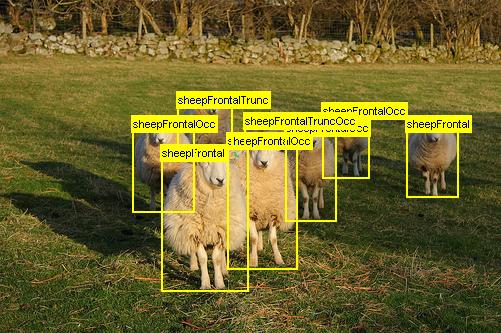
The PASCAL Visual Object Classes (VOC) 2012 dataset contains 20 object categories including vehicles, household, animals, and other: aeroplane, bicycle, boat, bus, car, motorbike, train, bottle, chair, dining table, potted plant, sofa, TV/monitor, bird, cat, cow, dog, horse, sheep, and person. Each image in this dataset has pixel-level segmentation annotations, bounding box annotations, and object class annotations. This dataset has been widely used as a benchmark for object detection, semantic segmentation, and classification tasks. The PASCAL VOC dataset is split into three subsets: 1,464 images for training, 1,449 images for validation and a private testing set. Source: Self-supervised Visual Feature Learning with Deep Neural Networks: A Survey Image Source: http://host.robots.ox.ac.uk/pascal/VOC/voc2012/examples/images/sheep_06.jpg

SA-1B

SA-1B consists of 11M diverse, high resolution, licensed, and privacy protecting images and 1.1B high-quality segmentation masks. Source: Segment Anything Image Source: Segment Anything

VRD

The Visual Relationship Dataset (VRD) contains 4000 images for training and 1000 for testing annotated with visual relationships. Bounding boxes are annotated with a label containing 100 unary predicates. These labels refer to animals, vehicles, clothes and generic objects. Pairs of bounding boxes are annotated with a label containing 70 binary predicates. These labels refer to actions, prepositions, spatial relations, comparatives or preposition phrases. The dataset has 37993 instances of visual relationships and 6672 types of relationships. 1877 instances of relationships occur only in the test set and they are used to evaluate the zero-shot learning scenario. Source: Compensating Supervision Incompleteness with Prior Knowledge in Semantic Image Interpretation Image Source: https://cs.stanford.edu/people/ranjaykrishna/vrd/

2D-3D-S

The 2D-3D-S dataset provides a variety of mutually registered modalities from 2D, 2.5D and 3D domains, with instance-level semantic and geometric annotations. It covers over 6,000 m2 collected in 6 large-scale indoor areas that originate from 3 different buildings. It contains over 70,000 RGB images, along with the corresponding depths, surface normals, semantic annotations, global XYZ images (all in forms of both regular and 360° equirectangular images) as well as camera information. It also includes registered raw and semantically annotated 3D meshes and point clouds. The dataset enables development of joint and cross-modal learning models and potentially unsupervised approaches utilizing the regularities present in large-scale indoor spaces. Source: https://github.com/alexsax/2D-3D-Semantics Image Source: https://github.com/alexsax/2D-3D-Semantics

GYAFC

Grammarly’s Yahoo Answers Formality Corpus (GYAFC) is the largest dataset for any style containing a total of 110K informal / formal sentence pairs. Yahoo Answers is a question answering forum, contains a large number of informal sentences and allows redistribution of data. The authors used the Yahoo Answers L6 corpus to create the GYAFC dataset of informal and formal sentence pairs. In order to ensure a uniform distribution of data, they removed sentences that are questions, contain URLs, and are shorter than 5 words or longer than 25. After these preprocessing steps, 40 million sentences remain. The Yahoo Answers corpus consists of several different domains like Business, Entertainment & Music, Travel, Food, etc. Pavlick and Tetreault formality classifier (PT16) shows that the formality level varies significantly across different genres. In order to control for this variation, the authors work with two specific domains that contain the most informal sentences and show results on training and testing within those categories. The authors use the formality classifier from PT16 to identify informal sentences and train this classifier on the Answers genre of the PT16 corpus which consists of nearly 5,000 randomly selected sentences from Yahoo Answers manually annotated on a scale of -3 (very informal) to 3 (very formal). They find that the domains of Entertainment & Music and Family & Relationships contain the most informal sentences and create the GYAFC dataset using these domains. Source: Dear Sir or Madam, May I Introduce the GYAFC Dataset: Corpus, Benchmarks and Metrics for Formality Style Transfer

SUN360

The goal of the SUN360 panorama database is to provide academic researchers in computer vision, computer graphics and computational photography, cognition and neuroscience, human perception, machine learning and data mining, with a comprehensive collection of annotated panoramas covering 360x180-degree full view for a large variety of environmental scenes, places and the objects within. To build the core of the dataset, the authors download a huge number of high-resolution panorama images from the Internet, and group them into different place categories. Then, they designed a WebGL annotation tool for annotating the polygons and cuboids for objects in the scene. Source: Scene UNderstanding 360° panorama Image Source: http://3dvision.princeton.edu/projects/2012/SUN360/

COCO-Text

The COCO-Text dataset is a dataset for text detection and recognition. It is based on the MS COCO dataset, which contains images of complex everyday scenes. The COCO-Text dataset contains non-text images, legible text images and illegible text images. In total there are 22184 training images and 7026 validation images with at least one instance of legible text. Source: Improving Text Proposals for Scene Images with Fully Convolutional Networks Image Source: https://vision.cornell.edu/se3/coco-text-2/

Yelp

The Yelp Dataset is a valuable resource for academic research, teaching, and learning. It provides a rich collection of real-world data related to businesses, reviews, and user interactions. Here are the key details about the Yelp Dataset: Reviews: A whopping 6,990,280 reviews from users. Businesses: Information on 150,346 businesses. Pictures: A collection of 200,100 pictures. Metropolitan Areas: Data from 11 metropolitan areas. Tips: Over 908,915 tips provided by 1,987,897 users. Business Attributes: Details like hours, parking availability, and ambiance for more than 1.2 million businesses. Aggregated Check-ins: Historical check-in data for each of the 131,930 businesses.

PASCAL-Part

PASCAL-Part is a set of additional annotations for PASCAL VOC 2010. It goes beyond the original PASCAL object detection task by providing segmentation masks for each body part of the object. For categories that do not have a consistent set of parts (e.g., boat), it provides the silhouette annotation. It can also serve as a set for human semantic part segmentation: It contains multiple humans per image in unconstrained poses and occlusions (1,716 for training and 1,817 for testing). It provides careful pixel-wise annotations for six body parts (i.e., head, torso, upper/lower-arms, and upper-/lower-legs). Source: The Ultimate Theory of Human Parsing Image Source: https://www.researchgate.net/profile/Zhedong_Zheng/publication/328123707/figure/fig4/AS:704683136016384@1545020960225/Qualitative-parsing-results-on-the-Pascal-Person-Part-dataset.png

Places365

The Places365 dataset is a scene recognition dataset. It is composed of 10 million images comprising 434 scene classes. There are two versions of the dataset: Places365-Standard with 1.8 million train and 36000 validation images from K=365 scene classes, and Places365-Challenge-2016, in which the size of the training set is increased up to 6.2 million extra images, including 69 new scene classes (leading to a total of 8 million train images from 434 scene classes). Source: Semantic-Aware Scene Recognition Image Source: Places

SoccerNet-v2

A novel large-scale corpus of manual annotations for the SoccerNet video dataset, along with open challenges to encourage more research in soccer understanding and broadcast production. Source: SoccerNet-v2 : A Dataset and Benchmarks for Holistic Understanding of Broadcast Soccer Videos

RELLIS-3D

RELLIS-3D is a multi-modal dataset for off-road robotics. It was collected in an off-road environment containing annotations for 13,556 LiDAR scans and 6,235 images. The data was collected on the Rellis Campus of Texas A&M University and presents challenges to existing algorithms related to class imbalance and environmental topography. The dataset also provides full-stack sensor data in ROS bag format, including RGB camera images, LiDAR point clouds, a pair of stereo images, high-precision GPS measurement, and IMU data. Source: https://github.com/unmannedlab/RELLIS-3D Image Source: https://github.com/unmannedlab/RELLIS-3D

UAVid

UAVid is a high-resolution UAV semantic segmentation dataset as a complement, which brings new challenges, including large scale variation, moving object recognition and temporal consistency preservation. The UAV dataset consists of 30 video sequences capturing 4K high-resolution images in slanted views. In total, 300 images have been densely labeled with 8 classes for the semantic labeling task. Source: UAVid: A Semantic Segmentation Dataset for UAV Imagery Image Source: https://uavid.nl/

MUSIC-AVQA

The large-scale MUSIC-AVQA dataset of musical performance contains 45,867 question-answer pairs, distributed in 9,288 videos for over 150 hours. All QA pairs types are divided into 3 modal scenarios, which contain 9 question types and 33 question templates. Finally, as an open-ended problem of our AVQA tasks, all 42 kinds of answers constitute a set for selection.

xBD

The xBD dataset contains over 45,000KM2 of polygon labeled pre and post disaster imagery. The dataset provides the post-disaster imagery with transposed polygons from pre over the buildings, with damage classification labels. Source: xBD Image Source: Gupta et al

MOSE

CoMplex video Object SEgmentation (MOSE) is a dataset to study the tracking and segmenting objects in complex environments. MOSE contains 2,149 video clips and 5,200 objects from 36 categories, with 431,725 high-quality object segmentation masks. The most notable feature of MOSE dataset is complex scenes with crowded and occluded objects. Source: MOSE: A New Dataset for Video Object Segmentation in Complex Scenes

출처: Papers with Code · CC BY-SA 4.0. 아카이브 자료와 새로 수집한 논문은 별도로 관리합니다.