Papers with Code 아카이브

Node Classification

태스크의 하위 분류와 논문·코드·평가·기법·데이터셋을 탐색하세요.

하위 태스크
5
평가표
138
보존된 평가 기록
1,793

Node Classification is a machine learning task in graph-based data analysis, where the goal is to assign labels to nodes in a graph based on the properties of nodes and the relationships between them.

Node Classification models aim to predict non-existing node properties (known as the target property) based on other node properties. Typical models used for node classification consists of a large family of graph neural networks. Model performance can be measured using benchmark datasets like Cora, Citeseer, and Pubmed, among others, typically using Accuracy and F1.

<span style="color:grey; opacity: 0.6">( Image credit: Fast Graph Representation Learning With PyTorch Geometric )</span>

데이터셋

출처에 같은 태스크 이름으로 연결된 데이터셋입니다. 동명 태스크가 포함될 수 있으므로, 비교할 때는 평가 결과의 조건도 확인하세요.

Pubmed

The PubMed dataset consists of 19717 scientific publications from PubMed database pertaining to diabetes classified into one of three classes. The citation network consists of 44338 links. Each publication in the dataset is described by a TF/IDF weighted word vector from a dictionary which consists of 500 unique words. Source: https://linqs.soe.ucsc.edu/data

OGB

The Open Graph Benchmark (OGB) is a collection of realistic, large-scale, and diverse benchmark datasets for machine learning on graphs. OGB datasets are automatically downloaded, processed, and split using the OGB Data Loader. The model performance can be evaluated using the OGB Evaluator in a unified manner. OGB is a community-driven initiative in active development. Source: https://ogb.stanford.edu/ Image Source: https://ogb.stanford.edu/

Reddit

The Reddit dataset is a graph dataset from Reddit posts made in the month of September, 2014. The node label in this case is the community, or “subreddit”, that a post belongs to. 50 large communities have been sampled to build a post-to-post graph, connecting posts if the same user comments on both. In total this dataset contains 232,965 posts with an average degree of 492. The first 20 days are used for training and the remaining days for testing (with 30% used for validation). For features, off-the-shelf 300-dimensional GloVe CommonCrawl word vectors are used. Source: https://arxiv.org/pdf/1706.02216.pdf Image Source: https://minimaxir.com/2016/05/reddit-graph/

Cora

The Cora dataset consists of 2708 scientific publications classified into one of seven classes. The citation network consists of 5429 links. Each publication in the dataset is described by a 0/1-valued word vector indicating the absence/presence of the corresponding word from the dictionary. The dictionary consists of 1433 unique words. Source: https://relational.fit.cvut.cz/dataset/CORA Image Source: https://arxiv.org/abs/1611.08402

Citeseer

The CiteSeer dataset consists of 3312 scientific publications classified into one of six classes. The citation network consists of 4732 links. Each publication in the dataset is described by a 0/1-valued word vector indicating the absence/presence of the corresponding word from the dictionary. The dictionary consists of 3703 unique words. Source: https://linqs.soe.ucsc.edu/data

PPI

protein roles—in terms of their cellular functions from gene ontology—in various protein-protein interaction (PPI) graphs, with each graph corresponding to a different human tissue [41]. positional gene sets are used, motif gene sets and immunological signatures as features and gene ontology sets as labels (121 in total), collected from the Molecular Signatures Database [34]. The average graph contains 2373 nodes, with an average degree of 28.8.

MUTAG

In particular, MUTAG is a collection of nitroaromatic compounds and the goal is to predict their mutagenicity on Salmonella typhimurium. Input graphs are used to represent chemical compounds, where vertices stand for atoms and are labeled by the atom type (represented by one-hot encoding), while edges between vertices represent bonds between the corresponding atoms. It includes 188 samples of chemical compounds with 7 discrete node labels. Source: Fast and Deep Graph Neural Networks

MoleculeNet

MoleculeNet is a large scale benchmark for molecular machine learning. MoleculeNet curates multiple public datasets, establishes metrics for evaluation, and offers high quality open-source implementations of multiple previously proposed molecular featurization and learning algorithms (released as part of the DeepChem open source library). MoleculeNet benchmarks demonstrate that learnable representations are powerful tools for molecular machine learning and broadly offer the best performance.

DBLP

The DBLP is a citation network dataset. The citation data is extracted from DBLP, ACM, MAG (Microsoft Academic Graph), and other sources. The first version contains 629,814 papers and 632,752 citations. Each paper is associated with abstract, authors, year, venue, and title. The data set can be used for clustering with network and side information, studying influence in the citation network, finding the most influential papers, topic modeling analysis, etc. Source: https://www.aminer.org/citation

Wiki Squirrel

The data was collected from the English Wikipedia (December 2018). These datasets represent page-page networks on specific topics (chameleons, crocodiles and squirrels). Nodes represent articles and edges are mutual links between them. The edges csv files contain the edges - nodes are indexed from 0. The features json files contain the features of articles - each key is a page id, and node features are given as lists. The presence of a feature in the feature list means that an informative noun appeared in the text of the Wikipedia article. The target csv contains the node identifiers and the average monthly traffic between October 2017 and November 2018 for each page. For each page-page network we listed the number of nodes an edges with some other descriptive statistics.

PASCAL VOC

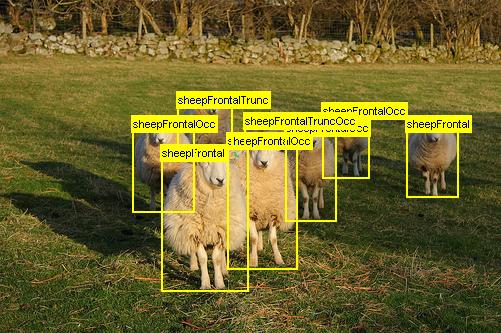
The PASCAL Visual Object Classes (VOC) 2012 dataset contains 20 object categories including vehicles, household, animals, and other: aeroplane, bicycle, boat, bus, car, motorbike, train, bottle, chair, dining table, potted plant, sofa, TV/monitor, bird, cat, cow, dog, horse, sheep, and person. Each image in this dataset has pixel-level segmentation annotations, bounding box annotations, and object class annotations. This dataset has been widely used as a benchmark for object detection, semantic segmentation, and classification tasks. The PASCAL VOC dataset is split into three subsets: 1,464 images for training, 1,449 images for validation and a private testing set. Source: Self-supervised Visual Feature Learning with Deep Neural Networks: A Survey Image Source: http://host.robots.ox.ac.uk/pascal/VOC/voc2012/examples/images/sheep_06.jpg
CLUSTER

CLUSTER is a node classification tasks generated with Stochastic Block Models, which is widely used to model communities in social networks by modulating the intra- and extra-communities connections, thereby controlling the difficulty of the task. CLUSTER aims at identifying community clusters in a semi-supervised setting. Source: Benchmarking Graph Neural Networks

PATTERN

PATTERN is a node classification tasks generated with Stochastic Block Models, which is widely used to model communities in social networks by modulating the intra- and extra-communities connections, thereby controlling the difficulty of the task. PATTERN tests the fundamental graph task of recognizing specific predetermined subgraphs. Source: Benchmarking Graph Neural Networks

AVA

AVA is a project that provides audiovisual annotations of video for improving our understanding of human activity. Each of the video clips has been exhaustively annotated by human annotators, and together they represent a rich variety of scenes, recording conditions, and expressions of human activity. There are annotations for: - Kinetics (AVA-Kinetics) - a crossover between AVA and Kinetics. In order to provide localized action labels on a wider variety of visual scenes, authors provide AVA action labels on videos from Kinetics-700, nearly doubling the number of total annotations, and increasing the number of unique videos by over 500x. - Actions (AvA Actions) - the AVA dataset densely annotates 80 atomic visual actions in 430 15-minute movie clips, where actions are localized in space and time, resulting in 1.62M action labels with multiple labels per human occurring frequently. - Spoken Activity (AVA ActiveSpeaker, AVA Speech). AVA ActiveSpeaker: associates speaking activity with a visible face, on the AVA v1.0 videos, resulting in 3.65 million frames labeled across ~39K face tracks. AVA Speech densely annotates audio-based speech activity in AVA v1.0 videos, and explicitly labels 3 background noise conditions, resulting in ~46K labeled segments spanning 45 hours of data. Image Source: https://www.researchgate.net/profile/Paolo_Napoletano/publication/309327222/figure/fig1/AS:419620126248965@1477056642346/Sample-images-from-the-Aesthetic-Visual-Analysis-AVA-database-sorted-by-their-aesthetic.png

WebKB

WebKB is a dataset that includes web pages from computer science departments of various universities. 4,518 web pages are categorized into 6 imbalanced categories (Student, Faculty, Staff, Department, Course, Project). Additionally there is Other miscellanea category that is not comparable to the rest. Source: Using Fuzzy Logic to Leverage HTML Markup for Web Page Representation

Wiki-CS

Wiki-CS is a Wikipedia-based dataset for benchmarking Graph Neural Networks. The dataset is constructed from Wikipedia categories, specifically 10 classes corresponding to branches of computer science, with very high connectivity. The node features are derived from the text of the corresponding articles. They were calculated as the average of pretrained GloVe word embeddings (Pennington et al., 2014), resulting in 300-dimensional node features. The dataset has 11,701 nodes and 216,123 edges. Source: Wiki-CS: A Wikipedia-Based Benchmark for Graph Neural Networks Image Source: https://arxiv.org/pdf/2007.02901v1.pdf

Yelp

The Yelp Dataset is a valuable resource for academic research, teaching, and learning. It provides a rich collection of real-world data related to businesses, reviews, and user interactions. Here are the key details about the Yelp Dataset: Reviews: A whopping 6,990,280 reviews from users. Businesses: Information on 150,346 businesses. Pictures: A collection of 200,100 pictures. Metropolitan Areas: Data from 11 metropolitan areas. Tips: Over 908,915 tips provided by 1,987,897 users. Business Attributes: Details like hours, parking availability, and ambiance for more than 1.2 million businesses. Aggregated Check-ins: Historical check-in data for each of the 131,930 businesses.

AMiner

The AMiner Dataset is a collection of different relational datasets. It consists of a set of relational networks such as citation networks, academic social networks or topic-paper-autor networks among others.

Long Range Graph Benchmark (LRGB)

The Long Range Graph Benchmark (LRGB) is a collection of 5 graph learning datasets that arguably require long-range reasoning to achieve strong performance in a given task. The 5 datasets in this benchmark can be used to prototype new models that can capture long range dependencies in graphs. | Dataset | Domain | Task | |---|---|---| | PascalVOC-SP| Computer Vision | Node Classification | | COCO-SP | Computer Vision | Node Classification | | PCQM-Contact | Quantum Chemistry | Link Prediction | | Peptides-func | Chemistry | Graph Classification | | Peptides-struct | Chemistry | Graph Regression |

Friendster

Friendster is an on-line gaming network. Before re-launching as a game website, Friendster was a social networking site where users can form friendship edge each other. Friendster social network also allows users form a group which other members can then join. The Friendster dataset consist of ground-truth communities (based on user-defined groups) and the social network from induced subgraph of the nodes that either belong to at least one community or are connected to other nodes that belong to at least one community. Source: https://snap.stanford.edu/data/com-Friendster.html

Penn94

Node classification on Penn94

roman-empire

Roman-empire is a word dependency graph based on the Roman Empire article from the English Wikipedia.

questions

Questions is an interaction graph of users of a question-answering website based on data provided by Yandex Q.

tolokers

Tolokers is a crowdsourcing platform workers network based on data provided by Toloka.

genius

node classification on genius

BioGRID

BioGRID is a biomedical interaction repository with data compiled through comprehensive curation efforts. The current index is version 4.2.192 and searches 75,868 publications for 1,997,840 protein and genetic interactions, 29,093 chemical interactions and 959,750 post translational modifications from major model organism species. Source: https://thebiogrid.org/

minesweeper

minesweeper is a synthetic graph emulating the eponymous game.

OGB-LSC

OGB Large-Scale Challenge (OGB-LSC) is a collection of three real-world datasets for advancing the state-of-the-art in large-scale graph ML. OGB-LSC provides graph datasets that are orders of magnitude larger than existing ones and covers three core graph learning tasks -- link prediction, graph regression, and node classification. OGB-LSC consists of three datasets: MAG240M-LSC, WikiKG90M-LSC, and PCQM4M-LSC. Each dataset offers an independent task. * MAG240M-LSC is a heterogeneous academic graph, and the task is to predict the subject areas of papers situated in the heterogeneous graph (node classification). * WikiKG90M-LSC is a knowledge graph, and the task is to impute missing triplets (link prediction). * PCQM4M-LSC is a quantum chemistry dataset, and the task is to predict an important molecular property, the HOMO-LUMO gap, of a given molecule (graph regression).

amazon-ratings

amazon-ratings is a product co-purchasing network based on data from SNAP datasets

Deezer-Europe

Node classification on Deezer Europe with 50%/25%/25% random splits for training/validation/test.

출처: Papers with Code · CC BY-SA 4.0. 아카이브 자료와 새로 수집한 논문은 별도로 관리합니다.