Papers with Code 아카이브

Face Reconstruction

태스크의 하위 분류와 논문·코드·평가·기법·데이터셋을 탐색하세요.

하위 태스크
1
평가표
0
보존된 평가 기록
0

Face reconstruction is the task of recovering the facial geometry of a face from an image.

<span style="color:grey; opacity: 0.6">( Image credit: Microsoft Deep3DFaceReconstruction )</span>

데이터셋

출처에 같은 태스크 이름으로 연결된 데이터셋입니다. 동명 태스크가 포함될 수 있으므로, 비교할 때는 평가 결과의 조건도 확인하세요.

FFHQ

Flickr-Faces-HQ (FFHQ) consists of 70,000 high-quality PNG images at 1024×1024 resolution and contains considerable variation in terms of age, ethnicity and image background. It also has good coverage of accessories such as eyeglasses, sunglasses, hats, etc. The images were crawled from Flickr, thus inheriting all the biases of that website, and automatically aligned and cropped using dlib. Only images under permissive licenses were collected. Various automatic filters were used to prune the set, and finally Amazon Mechanical Turk was used to remove the occasional statues, paintings, or photos of photos. Source: Flickr-Faces-HQ Dataset (FFHQ) Image Source: https://github.com/NVlabs/ffhq-dataset

VoxCeleb1

VoxCeleb1 is an audio dataset containing over 100,000 utterances for 1,251 celebrities, extracted from videos uploaded to YouTube.

VoxCeleb2

VoxCeleb2 is a large scale speaker recognition dataset obtained automatically from open-source media. VoxCeleb2 consists of over a million utterances from over 6k speakers. Since the dataset is collected ‘in the wild’, the speech segments are corrupted with real world noise including laughter, cross-talk, channel effects, music and other sounds. The dataset is also multilingual, with speech from speakers of 145 different nationalities, covering a wide range of accents, ages, ethnicities and languages. The dataset is audio-visual, so is also useful for a number of other applications, for example – visual speech synthesis, speech separation, cross-modal transfer from face to voice or vice versa and training face recognition from video to complement existing face recognition datasets. Source: VoxCeleb2: Deep Speaker Recognition Image Source: https://www.robots.ox.ac.uk/~vgg/data/voxceleb/

VGGFace2

VGGFace2 is a large-scale face recognition dataset. Images are downloaded from Google Image Search and have large variations in pose, age, illumination, ethnicity and profession. VGGFace2 contains images from identities spanning a wide range of different ethnicities, accents, professions and ages. All face images are captured "in the wild", with pose and emotion variations and different lighting and occlusion conditions. Face distribution for different identities is varied, from 87 to 843, with an average of 362 images for each subject.

CUHK03

The CUHK03 consists of 14,097 images of 1,467 different identities, where 6 campus cameras were deployed for image collection and each identity is captured by 2 campus cameras. This dataset provides two types of annotations, one by manually labelled bounding boxes and the other by bounding boxes produced by an automatic detector. The dataset also provides 20 random train/test splits in which 100 identities are selected for testing and the rest for training Source: Attention Driven Person Re-identification Image Source: Person Re-Identification Techniques for Intelligent Video Surveillance Systems

FaceForensics++

FaceForensics++ is a forensics dataset consisting of 1000 original video sequences that have been manipulated with four automated face manipulation methods: Deepfakes, Face2Face, FaceSwap and NeuralTextures. The data has been sourced from 977 youtube videos and all videos contain a trackable mostly frontal face without occlusions which enables automated tampering methods to generate realistic forgeries. Source: https://github.com/ondyari/FaceForensics Image Source: https://github.com/ondyari/FaceForensics

Manga109

Manga109 has been compiled by the Aizawa Yamasaki Matsui Laboratory, Department of Information and Communication Engineering, the Graduate School of Information Science and Technology, the University of Tokyo. The compilation is intended for use in academic research on the media processing of Japanese manga. Manga109 is composed of 109 manga volumes drawn by professional manga artists in Japan. These manga were commercially made available to the public between the 1970s and 2010s, and encompass a wide range of target readerships and genres (see the table in Explore for further details.) Most of the manga in the compilation are available at the manga library “Manga Library Z” (formerly the “Zeppan Manga Toshokan” library of out-of-print manga). Source: Manga109 Image Source: https://arxiv.org/pdf/1510.04389v1.pdf

UTKFace

The UTKFace dataset is a large-scale face dataset with long age span (range from 0 to 116 years old). The dataset consists of over 20,000 face images with annotations of age, gender, and ethnicity. The images cover large variation in pose, facial expression, illumination, occlusion, resolution, etc. This dataset could be used on a variety of tasks, e.g., face detection, age estimation, age progression/regression, landmark localization, etc. Source: https://susanqq.github.io/UTKFace/ Image Source: https://susanqq.github.io/UTKFace/

CK+

The Extended Cohn-Kanade (CK+) dataset contains 593 video sequences from a total of 123 different subjects, ranging from 18 to 50 years of age with a variety of genders and heritage. Each video shows a facial shift from the neutral expression to a targeted peak expression, recorded at 30 frames per second (FPS) with a resolution of either 640x490 or 640x480 pixels. Out of these videos, 327 are labelled with one of seven expression classes: anger, contempt, disgust, fear, happiness, sadness, and surprise. The CK+ database is widely regarded as the most extensively used laboratory-controlled facial expression classification database available, and is used in the majority of facial expression classification methods. Source: EmotionNet Nano: An Efficient Deep Convolutional Neural Network Design for Real-time Facial Expression Recognition

MegaFace

MegaFace was a publicly available dataset which is used for evaluating the performance of face recognition algorithms with up to a million distractors (i.e., up to a million people who are not in the test set). MegaFace contains 1M images from 690K individuals with unconstrained pose, expression, lighting, and exposure. MegaFace captures many different subjects rather than many images of a small number of subjects. The gallery set of MegaFace is collected from a subset of Flickr. The probe set of MegaFace used in the challenge consists of two databases; Facescrub and FGNet. FGNet contains 975 images of 82 individuals, each with several images spanning ages from 0 to 69. Facescrub dataset contains more than 100K face images of 530 people. The MegaFace challenge evaluates performance of face recognition algorithms by increasing the numbers of “distractors” (going from 10 to 1M) in the gallery set. In order to evaluate the face recognition algorithms fairly, MegaFace challenge has two protocols including large or small training sets. If a training set has more than 0.5M images and 20K subjects, it is considered as large. Otherwise, it is considered as small. NOTE: This dataset has been retired. Source: A Deep Face Identification Network Enhanced by Facial Attributes Prediction

FairFace

FairFace is a face image dataset which is race balanced. It contains 108,501 images from 7 different race groups: White, Black, Indian, East Asian, Southeast Asian, Middle Eastern, and Latino. Images were collected from the YFCC-100M Flickr dataset and labeled with race, gender, and age groups. Source: https://github.com/joojs/fairface

300W

The 300-W is a face dataset that consists of 300 Indoor and 300 Outdoor in-the-wild images. It covers a large variation of identity, expression, illumination conditions, pose, occlusion and face size. The images were downloaded from google.com by making queries such as “party”, “conference”, “protests”, “football” and “celebrities”. Compared to the rest of in-the-wild datasets, the 300-W database contains a larger percentage of partially-occluded images and covers more expressions than the common “neutral” or “smile”, such as “surprise” or “scream”. Images were annotated with the 68-point mark-up using a semi-automatic methodology. The images of the database were carefully selected so that they represent a characteristic sample of challenging but natural face instances under totally unconstrained conditions. Thus, methods that achieve accurate performance on the 300-W database can demonstrate the same accuracy in most realistic cases. Many images of the database contain more than one annotated faces (293 images with 1 face, 53 images with 2 faces and 53 images with [3, 7] faces). Consequently, the database consists of 600 annotated face instances, but 399 unique images. Finally, there is a large variety of face sizes. Specifically, 49.3% of the faces have size in the range [48.6k, 2.0M] and the overall mean size is 85k (about 292 × 292) pixels. Source: https://ibug.doc.ic.ac.uk/media/uploads/documents/sagonas_2016_imavis.pdf Image Source: https://www.researchgate.net/profile/Xuanyi_Dong/publication/323722412/figure/fig1/AS:679426136227845@1538999222829/Face-samples-from-300-W-dataset-Different-faces-have-different-styles-whereas-the-style_Q640.jpg

PASCAL VOC

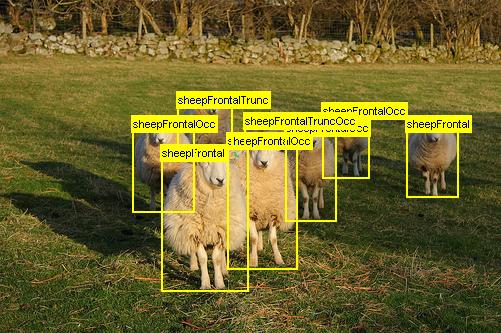
The PASCAL Visual Object Classes (VOC) 2012 dataset contains 20 object categories including vehicles, household, animals, and other: aeroplane, bicycle, boat, bus, car, motorbike, train, bottle, chair, dining table, potted plant, sofa, TV/monitor, bird, cat, cow, dog, horse, sheep, and person. Each image in this dataset has pixel-level segmentation annotations, bounding box annotations, and object class annotations. This dataset has been widely used as a benchmark for object detection, semantic segmentation, and classification tasks. The PASCAL VOC dataset is split into three subsets: 1,464 images for training, 1,449 images for validation and a private testing set. Source: Self-supervised Visual Feature Learning with Deep Neural Networks: A Survey Image Source: http://host.robots.ox.ac.uk/pascal/VOC/voc2012/examples/images/sheep_06.jpg

LRW

The Lip Reading in the Wild (LRW) dataset a large-scale audio-visual database that contains 500 different words from over 1,000 speakers. Each utterance has 29 frames, whose boundary is centered around the target word. The database is divided into training, validation and test sets. The training set contains at least 800 utterances for each class while the validation and test sets contain 50 utterances. Source: Towards Pose-invariant Lip-Reading Image Source: https://www.robots.ox.ac.uk/~vgg/data/lip_reading/lrw1.html

RAF-DB

The Real-world Affective Faces Database (RAF-DB) is a dataset for facial expression. It contains 29672 facial images tagged with basic or compound expressions by 40 independent taggers. Images in this database are of great variability in subjects' age, gender and ethnicity, head poses, lighting conditions, occlusions, (e.g. glasses, facial hair or self-occlusion), post-processing operations (e.g. various filters and special effects), etc. Source: Landmark Guidance Independent Spatio-channel Attention and Complementary Context Information based Facial Expression Recognition Image Source: http://www.whdeng.cn/raf/model1.html

FER2013

Fer2013 contains approximately 30,000 facial RGB images of different expressions with size restricted to 48×48, and the main labels of it can be divided into 7 types: 0=Angry, 1=Disgust, 2=Fear, 3=Happy, 4=Sad, 5=Surprise, 6=Neutral. The Disgust expression has the minimal number of images – 600, while other labels have nearly 5,000 samples each. Source: Eavesdrop the Composition Proportion of Training Labels in Federated Learning Image Source: https://medium.com/@birdortyedi_23820/deep-learning-lab-episode-3-fer2013-c38f2e052280

FDDB

The Face Detection Dataset and Benchmark (FDDB) dataset is a collection of labeled faces from Faces in the Wild dataset. It contains a total of 5171 face annotations, where images are also of various resolution, e.g. 363x450 and 229x410. The dataset incorporates a range of challenges, including difficult pose angles, out-of-focus faces and low resolution. Both greyscale and color images are included. Source: A Comparison of CNN-based Face and Head Detectors for Real-Time Video Surveillance Applications

IJB-B

The IJB-B dataset is a template-based face dataset that contains 1845 subjects with 11,754 images, 55,025 frames and 7,011 videos where a template consists of a varying number of still images and video frames from different sources. These images and videos are collected from the Internet and are totally unconstrained, with large variations in pose, illumination, image quality etc. In addition, the dataset comes with protocols for 1-to-1 template-based face verification, 1-to-N template-based open-set face identification, and 1-to-N open-set video face identification. Source: An Automatic System for Unconstrained Video-Based Face Recognition Image Source: https://www.vislab.ucr.edu/Biometrics2017/program_slides/Noblis_CVPRW_IJBB.pdf

IJB-A

The IARPA Janus Benchmark A (IJB-A) database is developed with the aim to augment more challenges to the face recognition task by collecting facial images with a wide variations in pose, illumination, expression, resolution and occlusion. IJB-A is constructed by collecting 5,712 images and 2,085 videos from 500 identities, with an average of 11.4 images and 4.2 videos per identity. Source: von Mises-Fisher Mixture Model-based Deep learning: Application to Face Verification Image Source: Ruan et al

AFLW

The Annotated Facial Landmarks in the Wild (AFLW) is a large-scale collection of annotated face images gathered from Flickr, exhibiting a large variety in appearance (e.g., pose, expression, ethnicity, age, gender) as well as general imaging and environmental conditions. In total about 25K faces are annotated with up to 21 landmarks per image. Source: Nose, Eyes and Ears: Head Pose Estimation by Locating Facial Keypoints

DISFA

The Denver Intensity of Spontaneous Facial Action (DISFA) dataset consists of 27 videos of 4844 frames each, with 130,788 images in total. Action unit annotations are on different levels of intensity, which are ignored in the following experiments and action units are either set or unset. DISFA was selected from a wider range of databases popular in the field of facial expression recognition because of the high number of smiles, i.e. action unit 12. In detail, 30,792 have this action unit set, 82,176 images have some action unit(s) set and 48,612 images have no action unit(s) set at all. Source: Deep Learning For Smile Recognition Image Source: https://www.researchgate.net/figure/Examples-of-images-extracted-from-the-DISFA-dataset_fig5_301830237

Aff-Wild2

Aff-Wild2 is a large-scale in-the-wild database and an extension of the Aff-Wild dataset for affect recognition. It approximately doubles the number of included video frames and the number of subjects; thus, improving the variability of the included behaviors and of the involved persons. It is the only existing in-the-wild database with annotations for all 3 main behaviour tasks. The Aff-Wild2 is annotated in a per frame basis for the seven basic expressions (i.e., happiness, surprise, anger, disgust, fear, sadness and the neutral state), twelve action units (AUs 1,2,4,6,7,10,12,15,23,24,25, 26) and valence and arousal. In total Aff-Wild2 consists of 564 videos of around 2.8M frames with 554 subjects. Aff-Wild2 displays a big diversity in terms of subjects' ages, ethnicities and nationalities; it has also great variations and diversities of environments. Sources: 1) Expression, affect, action unit recognition: Aff-wild2, multi-task learning and arcface; 2) The 6th affective behavior analysis in-the-wild (abaw) competition

Replay-Attack

The Replay-Attack Database for face spoofing consists of 1300 video clips of photo and video attack attempts to 50 clients, under different lighting conditions. All videos are generated by either having a (real) client trying to access a laptop through a built-in webcam or by displaying a photo or a video recording of the same client for at least 9 seconds. Source: https://www.idiap.ch/dataset/replayattack Image Source: https://www.researchgate.net/figure/Sample-images-from-the-PRINT-ATTACK-1-and-REPLAY-ATTACK-12-databases-Top-and-bottom_fig1_330400888

출처: Papers with Code · CC BY-SA 4.0. 아카이브 자료와 새로 수집한 논문은 별도로 관리합니다.