VoxCeleb1
VoxCeleb1 is an audio dataset containing over 100,000 utterances for 1,251 celebrities, extracted from videos uploaded to YouTube.
태스크의 하위 분류와 논문·코드·평가·기법·데이터셋을 탐색하세요.
Face generation is the task of generating (or interpolating) new faces from an existing dataset.
The state-of-the-art results for this task are located in the Image Generation parent.
<span style="color:grey; opacity: 0.6">( Image credit: Progressive Growing of GANs for Improved Quality, Stability, and Variation )</span>
출처에 같은 태스크 이름으로 연결된 데이터셋입니다. 동명 태스크가 포함될 수 있으므로, 비교할 때는 평가 결과의 조건도 확인하세요.
VoxCeleb1 is an audio dataset containing over 100,000 utterances for 1,251 celebrities, extracted from videos uploaded to YouTube.
VoxCeleb2 is a large scale speaker recognition dataset obtained automatically from open-source media. VoxCeleb2 consists of over a million utterances from over 6k speakers. Since the dataset is collected ‘in the wild’, the speech segments are corrupted with real world noise including laughter, cross-talk, channel effects, music and other sounds. The dataset is also multilingual, with speech from speakers of 145 different nationalities, covering a wide range of accents, ages, ethnicities and languages. The dataset is audio-visual, so is also useful for a number of other applications, for example – visual speech synthesis, speech separation, cross-modal transfer from face to voice or vice versa and training face recognition from video to complement existing face recognition datasets. Source: VoxCeleb2: Deep Speaker Recognition Image Source: https://www.robots.ox.ac.uk/~vgg/data/voxceleb/
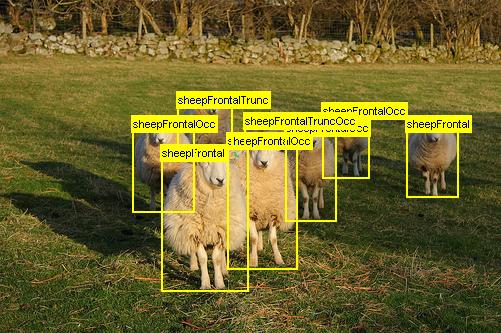
The PASCAL Visual Object Classes (VOC) 2012 dataset contains 20 object categories including vehicles, household, animals, and other: aeroplane, bicycle, boat, bus, car, motorbike, train, bottle, chair, dining table, potted plant, sofa, TV/monitor, bird, cat, cow, dog, horse, sheep, and person. Each image in this dataset has pixel-level segmentation annotations, bounding box annotations, and object class annotations. This dataset has been widely used as a benchmark for object detection, semantic segmentation, and classification tasks. The PASCAL VOC dataset is split into three subsets: 1,464 images for training, 1,449 images for validation and a private testing set. Source: Self-supervised Visual Feature Learning with Deep Neural Networks: A Survey Image Source: http://host.robots.ox.ac.uk/pascal/VOC/voc2012/examples/images/sheep_06.jpg
The Lip Reading in the Wild (LRW) dataset a large-scale audio-visual database that contains 500 different words from over 1,000 speakers. Each utterance has 29 frames, whose boundary is centered around the target word. The database is divided into training, validation and test sets. The training set contains at least 800 utterances for each class while the validation and test sets contain 50 utterances. Source: Towards Pose-invariant Lip-Reading Image Source: https://www.robots.ox.ac.uk/~vgg/data/lip_reading/lrw1.html
The Oxford-BBC Lip Reading Sentences 2 (LRS2) dataset is one of the largest publicly available datasets for lip reading sentences in-the-wild. The database consists of mainly news and talk shows from BBC programs. Each sentence is up to 100 characters in length. The training, validation and test sets are divided according to broadcast date. It is a challenging set since it contains thousands of speakers without speaker labels and large variation in head pose. The pre-training set contains 96,318 utterances, the training set contains 45,839 utterances, the validation set contains 1,082 utterances and the test set contains 1,242 utterances. Source: Audio-visual Recognition of Overlapped speech for the LRS2 dataset Image Source: https://www.robots.ox.ac.uk/~vgg/data/lip_reading/lrs2.html
VOCASET is a 4D face dataset with about 29 minutes of 4D scans captured at 60 fps and synchronized audio. The dataset has 12 subjects and 480 sequences of about 3-4 seconds each with sentences chosen from an array of standard protocols that maximize phonetic diversity. Source: timzhang642
CREMA-D is an emotional multimodal actor data set of 7,442 original clips from 91 actors. These clips were from 48 male and 43 female actors between the ages of 20 and 74 coming from a variety of races and ethnicities (African America, Asian, Caucasian, Hispanic, and Unspecified). Actors spoke from a selection of 12 sentences. The sentences were presented using one of six different emotions (Anger, Disgust, Fear, Happy, Neutral, and Sad) and four different emotion levels (Low, Medium, High, and Unspecified). Participants rated the emotion and emotion levels based on the combined audiovisual presentation, the video alone, and the audio alone. Due to the large number of ratings needed, this effort was crowd-sourced and a total of 2443 participants each rated 90 unique clips, 30 audio, 30 visual, and 30 audio-visual. 95% of the clips have more than 7 ratings.
FFHQ-Aging is a Dataset of human faces designed for benchmarking age transformation algorithms as well as many other possible vision tasks. This dataset is an extention of the NVIDIA FFHQ dataset, on top of the 70,000 original FFHQ images, it also contains the following information for each image: * Gender information (male/female with confidence score) * Age group information (10 classes with confidence score) * Head pose (pitch, roll & yaw) * Glasses type (none, normal or dark) * Eye occlusion score (0-100, different score for each eye) * Full semantic map (19 classes, based on CelebAMask-HQ labels) Source: https://github.com/royorel/FFHQ-Aging-Dataset Image Source: https://github.com/royorel/FFHQ-Aging-Dataset
The German Lipreading dataset consists of 250,000 publicly available videos of the faces of speakers of the Hessian Parliament, which was processed for word-level lip reading using an automatic pipeline. The format is similar to that of the English language Lip Reading in the Wild (LRW) dataset, with each H264-compressed MPEG-4 video encoding one word of interest in a context of 1.16 seconds duration, which yields compatibility for studying transfer learning between both datasets. Choosing video material based on naturally spoken language in a natural environment ensures more robust results for real-world applications than artificially generated datasets with as little noise as possible. The 500 different spoken words ranging between 4-18 characters in length each have 500 instances and separate MPEG-4 audio- and text metadata-files, originating from 1018 parliamentary sessions. Additionally, the complete TextGrid files containing the segmentation information of those sessions are also included. The size of the uncompressed dataset is 15GB.
We created a new dataset, named DFDM, with 6,450 Deepfake videos generated by different Autoencoder models. Specifically, five Autoencoder models with variations in encoder, decoder, intermediate layer, and input resolution, respectively, have been selected to generate Deepfakes based on the same input. We have observed the visible but subtle visual differences among different Deepfakes, demonstrating the evidence of model attribution artifacts.
iFakeFaceDB is a face image dataset for the study of synthetic face manipulation detection, comprising about 87,000 synthetic face images generated by the Style-GAN model and transformed with the GANprintR approach. All images were aligned and resized to the size of 224 x 224. Source: https://github.com/socialabubi/iFakeFaceDB Image Source: https://github.com/socialabubi/iFakeFaceDB
We present a novel Animation CelebHeads dataset (AnimeCeleb) to address an animation head reenactment. Different from previous animation head datasets, we utilize 3D animation models as the controllable image samplers, which can provide a large amount of head images with their corresponding detailed pose annotations. To facilitate a data creation process, we build a semi-automatic pipeline leveraging an open 3D computer graphics software with a developed annotation system. After training with the AnimeCeleb, recent head reenactment models produce high-quality animation head reenactment results, which are not achievable with existing datasets. Furthermore, motivated by metaverse application, we propose a novel pose mapping method and architecture to tackle a cross-domain head reenactment task. During inference, a user can easily transfer one's motion to an arbitrary animation head. Experiments demonstrate the usefulness of the AnimeCeleb to train animation head reenactment models, and the superiority of our cross-domain head reenactment model compared to state-of-the-art methods. Our dataset and code are available at https://github.com/kangyeolk/AnimeCeleb.
The FLUXSynID Dataset comprises 14,889 high-resolution synthetic face identities, each uniquely represented with paired images: document-style images and trusted live-capture images. The document-style images are designed to simulate ID photos, while the live-capture images are generated to reflect real-world conditions, including variations in lighting, facial expressions, and camera angles. This dual representation facilitates robust benchmarking for face recognition, morphing attack detection, and cross-domain identity verification tasks. FLUXSynID leverages cutting-edge generative models to ensure high fidelity and diversity across identities, enabling comprehensive analysis of biometric systems under varied conditions. For more information and to generate your own custom datasets using the FLUXSynID framework, visit the FLUXSynID GitHub repository.
This dataset provides a collection of 162K images and 70 Videos of Meta-Humans. There are 10 Highly realistic Meta-Humans expressing 7 facial expressions.
A high-resolution version of VGGFace2 for academic face editing purposes. This project uses GFPGAN for image restoration and insightface for data preprocessing (crop and align).
The free Face dataset made for students and teachers. It contains 10,000 photos with equal distribution of race and gender parameters, along with metadata and facial landmarks. Free to use for research with citation Photos by Generated.Photos. Photos All the photos are 100% synthetic. Based on model-released photos. Royalty-free. Can be used for any research purpose except for the ones violating the law. Worldwide. No time limitations. Quantity 10,000 Quality 256x256px Diversity Ethnicity, gender Metadata The JSON files contain the metadata for each image in a machine-readable format, including: (1) FaceLandmarks: mouth, right_eyebrow, left_eyebrow, right_eye, left_eye, nose, jaw. (2) FaceAttributes: headPose, gender, makeup, emotion, facialHair, hair (hairColor, hairLength, bald), occlusion, ethnicity, eye_color, smile, age
출처: Papers with Code · CC BY-SA 4.0. 아카이브 자료와 새로 수집한 논문은 별도로 관리합니다.