Papers with Code 아카이브

Unsupervised Semantic Segmentation

태스크의 하위 분류와 논문·코드·평가·기법·데이터셋을 탐색하세요.

하위 태스크
1
평가표
18
보존된 평가 기록
97

Models that learn to segment each image (i.e. assign a class to every pixel) without seeing the ground truth labels.

<span style="color:grey; opacity: 0.6">( Image credit: SegSort: Segmentation by Discriminative Sorting of Segments )</span>

데이터셋

출처에 같은 태스크 이름으로 연결된 데이터셋입니다. 동명 태스크가 포함될 수 있으므로, 비교할 때는 평가 결과의 조건도 확인하세요.

COCO (Common Objects in Context)

The COCO (Common Objects in Context) dataset is a large-scale object detection, segmentation, and captioning dataset. It is designed to encourage research on a wide variety of object categories and is commonly used for benchmarking computer vision models. It is an essential dataset for researchers and developers working on object detection, segmentation, and pose estimation tasks.

Cityscapes

Cityscapes is a large-scale database which focuses on semantic understanding of urban street scenes. It provides semantic, instance-wise, and dense pixel annotations for 30 classes grouped into 8 categories (flat surfaces, humans, vehicles, constructions, objects, nature, sky, and void). The dataset consists of around 5000 fine annotated images and 20000 coarse annotated ones. Data was captured in 50 cities during several months, daytimes, and good weather conditions. It was originally recorded as video so the frames were manually selected to have the following features: large number of dynamic objects, varying scene layout, and varying background. Source: A Review on Deep Learning Techniques Applied to Semantic Segmentation Image Source: https://www.cityscapes-dataset.com/dataset-overview/

COCO-Stuff

The Common Objects in COntext-stuff (COCO-stuff) dataset is a dataset for scene understanding tasks like semantic segmentation, object detection and image captioning. It is constructed by annotating the original COCO dataset, which originally annotated things while neglecting stuff annotations. There are 164k images in COCO-stuff dataset that span over 172 categories including 80 things, 91 stuff, and 1 unlabeled class. Source: Image Colorization: A Survey and Dataset Image Source: https://github.com/nightrome/cocostuff

PASCAL VOC

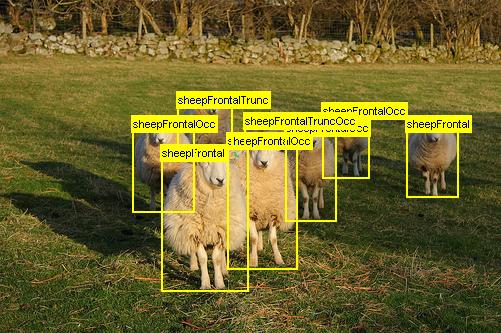
The PASCAL Visual Object Classes (VOC) 2012 dataset contains 20 object categories including vehicles, household, animals, and other: aeroplane, bicycle, boat, bus, car, motorbike, train, bottle, chair, dining table, potted plant, sofa, TV/monitor, bird, cat, cow, dog, horse, sheep, and person. Each image in this dataset has pixel-level segmentation annotations, bounding box annotations, and object class annotations. This dataset has been widely used as a benchmark for object detection, semantic segmentation, and classification tasks. The PASCAL VOC dataset is split into three subsets: 1,464 images for training, 1,449 images for validation and a private testing set. Source: Self-supervised Visual Feature Learning with Deep Neural Networks: A Survey Image Source: http://host.robots.ox.ac.uk/pascal/VOC/voc2012/examples/images/sheep_06.jpg
PASCAL VOC 2007

PASCAL VOC 2007 is a dataset for image recognition. The twenty object classes that have been selected are: Person: person Animal: bird, cat, cow, dog, horse, sheep Vehicle: aeroplane, bicycle, boat, bus, car, motorbike, train Indoor: bottle, chair, dining table, potted plant, sofa, tv/monitor The dataset can be used for image classification and object detection tasks. Image Source: Object Detection and Recognition in Images

Dark Zurich

Dark Zurich is an image dataset containing a total of 8779 images captured at nighttime, twilight, and daytime, along with the respective GPS coordinates of the camera for each image. These GPS annotations are used to construct cross-time-of-day correspondences, i.e., to match each nighttime or twilight image to its daytime counterpart. These attributes allow the usage of Dark Zurich as a dataset to build models and systems that perform: 1) domain adaptation (unsupervised, weakly supervised or semi-supervised), e.g. for semantic segmentation or object detection, 2) image translation / style transfer to different times of day, 3) robust image matching / visual localization across diverse domains, and 4) other visual perception tasks that are central for autonomous vehicles and other robotic applications.

ImageNet-S

Powered by the ImageNet dataset, unsupervised learning on large-scale data has made significant advances for classification tasks. There are two major challenges to allowing such an attractive learning modality for segmentation tasks: i) a large-scale benchmark for assessing algorithms is missing; ii) unsupervised shape representation learning is difficult. We propose a new problem of large-scale unsupervised semantic segmentation (LUSS) with a newly created benchmark dataset to track the research progress. Based on the ImageNet dataset, we propose the ImageNet-S dataset with 1.2 million training images and 50k high-quality semantic segmentation annotations for evaluation. Our benchmark has a high data diversity and a clear task objective. We also present a simple yet effective baseline method that works surprisingly well for LUSS. In addition, we benchmark related un/weakly/fully supervised methods accordingly, identifying the challenges and possible directions of LUSS.

SUIM

The Segmentation of Underwater IMagery (SUIM) dataset contains over 1500 images with pixel annotations for eight object categories: fish (vertebrates), reefs (invertebrates), aquatic plants, wrecks/ruins, human divers, robots, and sea-floor. The images have been rigorously collected during oceanic explorations and human-robot collaborative experiments, and annotated by human participants. Source: Semantic Segmentation of Underwater Imagery: Dataset and Benchmark Image Source: http://irvlab.cs.umn.edu/resources/suim-dataset

ACDC (Adverse Conditions Dataset with Correspondences)

We introduce ACDC, the Adverse Conditions Dataset with Correspondences for training and testing semantic segmentation methods on adverse visual conditions. It comprises a large set of 4006 images which are evenly distributed between fog, nighttime, rain, and snow. Each adverse-condition image comes with a high-quality fine pixel-level semantic annotation, a corresponding image of the same scene taken under normal conditions and a binary mask that distinguishes between intra-image regions of clear and uncertain semantic content. ACDC supports two tasks: 1. standard semantic segmentation 2. uncertainty-aware semantic segmentation

KITTI-STEP

The Segmenting and Tracking Every Pixel (STEP) benchmark consists of 21 training sequences and 29 test sequences. It is based on the KITTI Tracking Evaluation and the Multi-Object Tracking and Segmentation (MOTS) benchmark. This benchmark extends the annotations to the Segmenting and Tracking Every Pixel (STEP) task. [Copy-pasted from http://www.cvlibs.net/datasets/kitti/eval_step.php]

출처: Papers with Code · CC BY-SA 4.0. 아카이브 자료와 새로 수집한 논문은 별도로 관리합니다.