Papers with Code 아카이브

Semantic Segmentation

태스크의 하위 분류와 논문·코드·평가·기법·데이터셋을 탐색하세요.

하위 태스크
29
평가표
150
보존된 평가 기록
1,918

데이터셋

출처에 같은 태스크 이름으로 연결된 데이터셋입니다. 동명 태스크가 포함될 수 있으므로, 비교할 때는 평가 결과의 조건도 확인하세요.

COCO (Common Objects in Context)

The COCO (Common Objects in Context) dataset is a large-scale object detection, segmentation, and captioning dataset. It is designed to encourage research on a wide variety of object categories and is commonly used for benchmarking computer vision models. It is an essential dataset for researchers and developers working on object detection, segmentation, and pose estimation tasks.

Cityscapes

Cityscapes is a large-scale database which focuses on semantic understanding of urban street scenes. It provides semantic, instance-wise, and dense pixel annotations for 30 classes grouped into 8 categories (flat surfaces, humans, vehicles, constructions, objects, nature, sky, and void). The dataset consists of around 5000 fine annotated images and 20000 coarse annotated ones. Data was captured in 50 cities during several months, daytimes, and good weather conditions. It was originally recorded as video so the frames were manually selected to have the following features: large number of dynamic objects, varying scene layout, and varying background. Source: A Review on Deep Learning Techniques Applied to Semantic Segmentation Image Source: https://www.cityscapes-dataset.com/dataset-overview/

KITTI

KITTI (Karlsruhe Institute of Technology and Toyota Technological Institute) is one of the most popular datasets for use in mobile robotics and autonomous driving. It consists of hours of traffic scenarios recorded with a variety of sensor modalities, including high-resolution RGB, grayscale stereo cameras, and a 3D laser scanner. Despite its popularity, the dataset itself does not contain ground truth for semantic segmentation. However, various researchers have manually annotated parts of the dataset to fit their necessities. Álvarez et al. generated ground truth for 323 images from the road detection challenge with three classes: road, vertical, and sky. Zhang et al. annotated 252 (140 for training and 112 for testing) acquisitions – RGB and Velodyne scans – from the tracking challenge for ten object categories: building, sky, road, vegetation, sidewalk, car, pedestrian, cyclist, sign/pole, and fence. Ros et al. labeled 170 training images and 46 testing images (from the visual odometry challenge) with 11 classes: building, tree, sky, car, sign, road, pedestrian, fence, pole, sidewalk, and bicyclist. Source: A Review on Deep Learning Techniques Applied to Semantic Segmentation Image Source: http://www.cvlibs.net/datasets/kitti/eval_object.php?obj_benchmark=3d

nuScenes

The nuScenes dataset is a large-scale autonomous driving dataset. The dataset has 3D bounding boxes for 1000 scenes collected in Boston and Singapore. Each scene is 20 seconds long and annotated at 2Hz. This results in a total of 28130 samples for training, 6019 samples for validation and 6008 samples for testing. The dataset has the full autonomous vehicle data suite: 32-beam LiDAR, 6 cameras and radars with complete 360° coverage. The 3D object detection challenge evaluates the performance on 10 classes: cars, trucks, buses, trailers, construction vehicles, pedestrians, motorcycles, bicycles, traffic cones and barriers. Source: PointPainting: Sequential Fusion for 3D Object Detection

ShapeNet

ShapeNet is a large scale repository for 3D CAD models developed by researchers from Stanford University, Princeton University and the Toyota Technological Institute at Chicago, USA. The repository contains over 300M models with 220,000 classified into 3,135 classes arranged using WordNet hypernym-hyponym relationships. ShapeNet Parts subset contains 31,693 meshes categorised into 16 common object classes (i.e. table, chair, plane etc.). Each shapes ground truth contains 2-5 parts (with a total of 50 part classes). Source: A review on deep learning techniques for 3D sensed data classification Image Source: ShapeNet: An Information-Rich 3D Model Repository

ScanNet

ScanNet is an instance-level indoor RGB-D dataset that includes both 2D and 3D data. It is a collection of labeled voxels rather than points or objects. Up to now, ScanNet v2, the newest version of ScanNet, has collected 1513 annotated scans with an approximate 90% surface coverage. In the semantic segmentation task, this dataset is marked in 20 classes of annotated 3D voxelized objects. Source: A Review of Point Cloud Semantic Segmentation Image Source: http://www.scan-net.org/

NYUv2

The NYU-Depth V2 data set is comprised of video sequences from a variety of indoor scenes as recorded by both the RGB and Depth cameras from the Microsoft Kinect. It features: * 1449 densely labeled pairs of aligned RGB and depth images * 464 new scenes taken from 3 cities * 407,024 new unlabeled frames * Each object is labeled with a class and an instance number. The dataset has several components: * Labeled: A subset of the video data accompanied by dense multi-class labels. This data has also been preprocessed to fill in missing depth labels. * Raw: The raw RGB, depth and accelerometer data as provided by the Kinect. * Toolbox: Useful functions for manipulating the data and labels. Source: https://cs.nyu.edu/~silberman/datasets/nyu_depth_v2.html Image Source: https://cs.nyu.edu/~silberman/datasets/nyu_depth_v2.html

DAVIS

The Densely Annotation Video Segmentation dataset (DAVIS) is a high quality and high resolution densely annotated video segmentation dataset under two resolutions, 480p and 1080p. There are 50 video sequences with 3455 densely annotated frames in pixel level. 30 videos with 2079 frames are for training and 20 videos with 1376 frames are for validation. Source: TENet: Triple Excitation Network for Video Salient Object Detection

EuroSAT

Eurosat is a dataset and deep learning benchmark for land use and land cover classification. The dataset is based on Sentinel-2 satellite images covering 13 spectral bands and consisting out of 10 classes with in total 27,000 labeled and geo-referenced images. Source: EuroSAT Image Source: EuroSAT

SemanticKITTI

SemanticKITTI is a large-scale outdoor-scene dataset for point cloud semantic segmentation. It is derived from the KITTI Vision Odometry Benchmark which it extends with dense point-wise annotations for the complete 360 field-of-view of the employed automotive LiDAR. The dataset consists of 22 sequences. Overall, the dataset provides 23201 point clouds for training and 20351 for testing. Source: Cylinder3D: An Effective 3D Framework for Driving-scene LiDAR Semantic Segmentation Image Source: https://github.com/PRBonn/semantic-kitti-api

Waymo Open Dataset

The Waymo Open Dataset is comprised of high resolution sensor data collected by autonomous vehicles operated by the Waymo Driver in a wide variety of conditions. The Waymo Open Dataset currently contains 1,950 segments. The authors plan to grow this dataset in the future. Currently the datasets includes: * 1,950 segments of 20s each, collected at 10Hz (390,000 frames) in diverse geographies and conditions * Sensor data * 1 mid-range lidar * 4 short-range lidars * 5 cameras (front and sides) * Synchronized lidar and camera data * Lidar to camera projections * Sensor calibrations and vehicle poses * Labeled data * Labels for 4 object classes - Vehicles, Pedestrians, Cyclists, Signs * High-quality labels for lidar data in 1,200 segments * 12.6M 3D bounding box labels with tracking IDs on lidar data * High-quality labels for camera data in 1,000 segments * 11.8M 2D bounding box labels with tracking IDs on camera data

BDD100K

Datasets drive vision progress, yet existing driving datasets are impoverished in terms of visual content and supported tasks to study multitask learning for autonomous driving. Researchers are usually constrained to study a small set of problems on one dataset, while real-world computer vision applications require performing tasks of various complexities. We construct BDD100K, the largest driving video dataset with 100K videos and 10 tasks to evaluate the exciting progress of image recognition algorithms on autonomous driving. The dataset possesses geographic, environmental, and weather diversity, which is useful for training models that are less likely to be surprised by new conditions. Based on this diverse dataset, we build a benchmark for heterogeneous multitask learning and study how to solve the tasks together. Our experiments show that special training strategies are needed for existing models to perform such heterogeneous tasks. BDD100K opens the door for future studies in this important venue. More detail is at the dataset home page.

Matterport3D

The Matterport3D dataset is a large RGB-D dataset for scene understanding in indoor environments. It contains 10,800 panoramic views inside 90 real building-scale scenes, constructed from 194,400 RGB-D images. Each scene is a residential building consisting of multiple rooms and floor levels, and is annotated with surface construction, camera poses, and semantic segmentation. Source: Vision-based Navigation with Language-based Assistance via Imitation Learning with Indirect Intervention

RefCOCO

The RefCOCO dataset is a referring expression generation (REG) dataset used for tasks related to understanding natural language expressions that refer to specific objects in images. Here are the key details about RefCOCO: 1. Collection Method: The dataset was collected using the ReferitGame, a two-player game. In this game, the first player views an image with a segmented target object and writes a natural language expression referring to that object. The second player sees only the image and the referring expression and must click on the corresponding object. If both players perform correctly, they earn points and switch roles; otherwise, they receive a new object and image for description. 2. Dataset Variants: RefCOCO: Contains 142,209 refer expressions for 50,000 objects across 19,994 images. RefCOCO+: Includes 141,564 expressions for 49,856 objects in 19,992 images. RefCOCOg: This variant has 25,799 images, 95,010 referring expressions, and 49,822 object instances. 3. Language and Restrictions: RefCOCO allows any type of language in the referring expressions. RefCOCO+ disallows location words in expressions to focus purely on appearance-based descriptions (e.g., "the man in the yellow polka-dotted shirt") rather than viewer-dependent descriptions (e.g., "the second man from the left"). These datasets serve as valuable resources for tasks like referring expression segmentation, comprehension, and visual grounding in computer vision research.

Replica

The Replica Dataset is a dataset of high quality reconstructions of a variety of indoor spaces. Each reconstruction has clean dense geometry, high resolution and high dynamic range textures, glass and mirror surface information, planar segmentation as well as semantic class and instance segmentation. Source: The Replica Dataset: A Digital Replica of Indoor Spaces

COCO-Stuff

The Common Objects in COntext-stuff (COCO-stuff) dataset is a dataset for scene understanding tasks like semantic segmentation, object detection and image captioning. It is constructed by annotating the original COCO dataset, which originally annotated things while neglecting stuff annotations. There are 164k images in COCO-stuff dataset that span over 172 categories including 80 things, 91 stuff, and 1 unlabeled class. Source: Image Colorization: A Survey and Dataset Image Source: https://github.com/nightrome/cocostuff

PASCAL Context

The PASCAL Context dataset is an extension of the PASCAL VOC 2010 detection challenge, and it contains pixel-wise labels for all training images. It contains more than 400 classes (including the original 20 classes plus backgrounds from PASCAL VOC segmentation), divided into three categories (objects, stuff, and hybrids). Many of the object categories of this dataset are too sparse and; therefore, a subset of 59 frequent classes are usually selected for use. Source: Image Segmentation Using Deep Learning:A Survey Image Source: https://cs.stanford.edu/~roozbeh/pascal-context/

KITTI-360

KITTI-360 is a large-scale dataset that contains rich sensory information and full annotations. It is the successor of the popular KITTI dataset, providing more comprehensive semantic/instance labels in 2D and 3D, richer 360 degree sensory information (fisheye images and pushbroom laser scans), very accurate and geo-localized vehicle and camera poses, and a series of new challenging benchmarks.

CamVid

CamVid (Cambridge-driving Labeled Video Database) is a road/driving scene understanding database which was originally captured as five video sequences with a 960×720 resolution camera mounted on the dashboard of a car. Those sequences were sampled (four of them at 1 fps and one at 15 fps) adding up to 701 frames. Those stills were manually annotated with 32 classes: void, building, wall, tree, vegetation, fence, sidewalk, parking block, column/pole, traffic cone, bridge, sign, miscellaneous text, traffic light, sky, tunnel, archway, road, road shoulder, lane markings (driving), lane markings (non-driving), animal, pedestrian, child, cart luggage, bicyclist, motorcycle, car, SUV/pickup/truck, truck/bus, train, and other moving object Source: A Review on Deep Learning TechniquesApplied to Semantic Segmentation Image Source: http://mi.eng.cam.ac.uk/research/projects/VideoRec/CamVid/
Kvasir-SEG

Kvasir-SEG is an open-access dataset of gastrointestinal polyp images and corresponding segmentation masks, manually annotated by a medical doctor and then verified by an experienced gastroenterologist. Source: Kvasir-SEG: A Segmented Polyp Dataset Image Source: https://datasets.simula.no/kvasir-seg/

PASCAL VOC

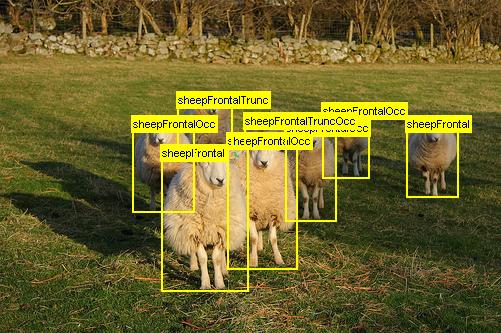
The PASCAL Visual Object Classes (VOC) 2012 dataset contains 20 object categories including vehicles, household, animals, and other: aeroplane, bicycle, boat, bus, car, motorbike, train, bottle, chair, dining table, potted plant, sofa, TV/monitor, bird, cat, cow, dog, horse, sheep, and person. Each image in this dataset has pixel-level segmentation annotations, bounding box annotations, and object class annotations. This dataset has been widely used as a benchmark for object detection, semantic segmentation, and classification tasks. The PASCAL VOC dataset is split into three subsets: 1,464 images for training, 1,449 images for validation and a private testing set. Source: Self-supervised Visual Feature Learning with Deep Neural Networks: A Survey Image Source: http://host.robots.ox.ac.uk/pascal/VOC/voc2012/examples/images/sheep_06.jpg

YouTube-VIS 2019

YouTubeVIS is a new dataset tailored for tasks like simultaneous detection, segmentation and tracking of object instances in videos and is collected based on the current largest video object segmentation dataset YouTubeVOS. Source: YouTubeVIS

Objects365

Objects365 is a large-scale object detection dataset, Objects365, which has 365 object categories over 600K training images. More than 10 million, high-quality bounding boxes are manually labeled through a three-step, carefully designed annotation pipeline. It is the largest object detection dataset (with full annotation) so far and establishes a more challenging benchmark for the community. Source: Objects365: A Large-Scale, High-Quality Dataset for Object Detection Image Source: https://www.objects365.org/overview.html

PartNet

PartNet is a consistent, large-scale dataset of 3D objects annotated with fine-grained, instance-level, and hierarchical 3D part information. The dataset consists of 573,585 part instances over 26,671 3D models covering 24 object categories. This dataset enables and serves as a catalyst for many tasks such as shape analysis, dynamic 3D scene modeling and simulation, affordance analysis, and others. Source: PartNet: A Large-scale Benchmark for Fine-grained and Hierarchical Part-level 3D Object Understanding Image Source: https://cs.stanford.edu/~kaichun/partnet/

출처: Papers with Code · CC BY-SA 4.0. 아카이브 자료와 새로 수집한 논문은 별도로 관리합니다.