Papers with Code · CC BY-SA 4.0

데이터셋 탐색

데이터셋의 설명·홈페이지를 찾고, 관련 태스크의 평가 기록을 살펴보세요.

관련 논문 4편

Drowsiness-Detection

OC
OC 설명 보기

These images were generated using UnityEyes simulator, after including essential eyeball physiology elements and modeling binocular vision dynamics. The images are annotated with head pose and gaze direction information, besides 2D and 3D landmarks of eye's most important features. Additionally, the images are distributed into two classes denoting the status of the eye (Open for open eyes, Closed for closed eyes). This dataset was used to train a DNN model for detecting drowsiness status of a driver. The dataset contains 1,704 training images, 4,232 testing images and additional 4,103 images for improvements.

관련 논문 11,922편

Common Objects in Context

COCO (Common Objects in Context)
COCO (Common Objects in Context) 설명 보기

The COCO (Common Objects in Context) dataset is a large-scale object detection, segmentation, and captioning dataset. It is designed to encourage research on a wide variety of object categories and is commonly used for benchmarking computer vision models. It is an essential dataset for researchers and developers working on object detection, segmentation, and pose estimation tasks.

관련 논문 749편

The Interactive Emotional Dyadic Motion Capture (IEMOCAP) Database

IEMOCAP
IEMOCAP 설명 보기

Multimodal Emotion Recognition IEMOCAP The IEMOCAP dataset consists of 151 videos of recorded dialogues, with 2 speakers per session for a total of 302 videos across the dataset. Each segment is annotated for the presence of 9 emotions (angry, excited, fear, sad, surprised, frustrated, happy, disappointed and neutral) as well as valence, arousal and dominance. The dataset is recorded across 5 sessions with 5 pairs of speakers. Source: Multi-attention Recurrent Network for Human Communication Comprehension Image Source: https://sail.usc.edu/iemocap/Busso_2008_iemocap.pdf

관련 논문 439편

RefCOCO

RefCOCO 설명 보기

The RefCOCO dataset is a referring expression generation (REG) dataset used for tasks related to understanding natural language expressions that refer to specific objects in images. Here are the key details about RefCOCO: 1. Collection Method: The dataset was collected using the ReferitGame, a two-player game. In this game, the first player views an image with a segmented target object and writes a natural language expression referring to that object. The second player sees only the image and the referring expression and must click on the corresponding object. If both players perform correctly, they earn points and switch roles; otherwise, they receive a new object and image for description. 2. Dataset Variants: RefCOCO: Contains 142,209 refer expressions for 50,000 objects across 19,994 images. RefCOCO+: Includes 141,564 expressions for 49,856 objects in 19,992 images. RefCOCOg: This variant has 25,799 images, 95,010 referring expressions, and 49,822 object instances. 3. Language and Restrictions: RefCOCO allows any type of language in the referring expressions. RefCOCO+ disallows location words in expressions to focus purely on appearance-based descriptions (e.g., "the man in the yellow polka-dotted shirt") rather than viewer-dependent descriptions (e.g., "the second man from the left"). These datasets serve as valuable resources for tasks like referring expression segmentation, comprehension, and visual grounding in computer vision research.

관련 논문 340편

Local Light Field Fusion

LLFF
LLFF 설명 보기

Local Light Field Fusion (LLFF) is a practical and robust deep learning solution for capturing and rendering novel views of complex real-world scenes for virtual exploration. The dataset consists of both renderings and real images of natural scenes. The synthetic images are rendered from the SUNCG and UnrealCV where SUNCG contains 45000 simplistic house and room environments with texture-mapped surfaces and low geometric complexity. UnrealCV contains a few large-scale environments modeled and rendered with extreme detail. The real images are 24 scenes captured from a handheld cellphone.

관련 논문 338편

Common Objects in COntext-stuff

COCO-Stuff
COCO-Stuff 설명 보기

The Common Objects in COntext-stuff (COCO-stuff) dataset is a dataset for scene understanding tasks like semantic segmentation, object detection and image captioning. It is constructed by annotating the original COCO dataset, which originally annotated things while neglecting stuff annotations. There are 164k images in COCO-stuff dataset that span over 172 categories including 80 things, 91 stuff, and 1 unlabeled class. Source: Image Colorization: A Survey and Dataset Image Source: https://github.com/nightrome/cocostuff

관련 논문 279편

AudioCaps

AudioCaps 설명 보기

AudioCaps is a dataset of sounds with event descriptions that was introduced for the task of audio captioning, with sounds sourced from the AudioSet dataset. Annotators were provided the audio tracks together with category hints (and with additional video hints if needed). Source: Audio Retrieval with Natural Language Queries Image source: https://audiocaps.github.io/

관련 논문 198편

PASCAL Visual Object Classes Challenge

PASCAL VOC
PASCAL VOC 설명 보기

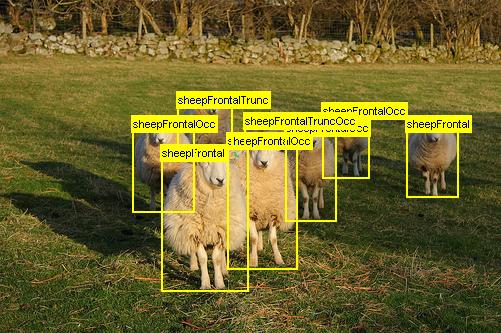
The PASCAL Visual Object Classes (VOC) 2012 dataset contains 20 object categories including vehicles, household, animals, and other: aeroplane, bicycle, boat, bus, car, motorbike, train, bottle, chair, dining table, potted plant, sofa, TV/monitor, bird, cat, cow, dog, horse, sheep, and person. Each image in this dataset has pixel-level segmentation annotations, bounding box annotations, and object class annotations. This dataset has been widely used as a benchmark for object detection, semantic segmentation, and classification tasks. The PASCAL VOC dataset is split into three subsets: 1,464 images for training, 1,449 images for validation and a private testing set. Source: Self-supervised Visual Feature Learning with Deep Neural Networks: A Survey Image Source: http://host.robots.ox.ac.uk/pascal/VOC/voc2012/examples/images/sheep_06.jpg

관련 논문 179편

Form Understanding in Noisy Scanned Documents

FUNSD
FUNSD 설명 보기

Form Understanding in Noisy Scanned Documents (FUNSD) comprises 199 real, fully annotated, scanned forms. The documents are noisy and vary widely in appearance, making form understanding (FoUn) a challenging task. The proposed dataset can be used for various tasks, including text detection, optical character recognition, spatial layout analysis, and entity labeling/linking. Source: FUNSD: A Dataset for Form Understanding in Noisy Scanned Documents Image source: https://guillaumejaume.github.io/FUNSD/

관련 논문 159편

Verbs in COCO

V-COCO
V-COCO 설명 보기

Verbs in COCO (V-COCO) is a dataset that builds off COCO for human-object interaction detection. V-COCO provides 10,346 images (2,533 for training, 2,867 for validating and 4,946 for testing) and 16,199 person instances. Each person has annotations for 29 action categories and there are no interaction labels including objects. Source: Visual Compositional Learning for Human-Object Interaction Detection Image Source: https://www.researchgate.net/figure/Pose-estimation-and-action-recognition-results-on-the-V-COCO-Dataset-16-which-has_fig9_339477856

관련 논문 155편

DocRED

DocRED 설명 보기

DocRED (Document-Level Relation Extraction Dataset) is a relation extraction dataset constructed from Wikipedia and Wikidata. Each document in the dataset is human-annotated with named entity mentions, coreference information, intra- and inter-sentence relations, and supporting evidence. DocRED requires reading multiple sentences in a document to extract entities and infer their relations by synthesizing all information of the document. Along with the human-annotated data, the dataset provides large-scale distantly supervised data. DocRED contains 132,375 entities and 56,354 relational facts annotated on 5,053 Wikipedia documents. In addition to the human-annotated data, the dataset provides large-scale distantly supervised data over 101,873 documents. Source: DocRED: A Large-Scale Document-Level Relation Extraction Dataset Image Source: DocRED: A Large-Scale Document-Level Relation Extraction Dataset

관련 논문 152편

ROCStories

ROCStories 설명 보기

ROCStories is a collection of commonsense short stories. The corpus consists of 100,000 five-sentence stories. Each story logically follows everyday topics created by Amazon Mechanical Turk workers. These stories contain a variety of commonsense causal and temporal relations between everyday events. Writers also develop an additional 3,742 Story Cloze Test stories which contain a four-sentence-long body and two candidate endings. The endings were collected by asking Mechanical Turk workers to write both a right ending and a wrong ending after eliminating original endings of given short stories. Both endings were required to make logical sense and include at least one character from the main story line. The published ROCStories dataset is constructed with ROCStories as a training set that includes 98,162 stories that exclude candidate wrong endings, an evaluation set, and a test set, which have the same structure (1 body + 2 candidate endings) and a size of 1,871. Source: Incorporating Structured Commonsense Knowledge in Story Completion Image Source: https://cs.rochester.edu/nlp/rocstories/

관련 논문 128편

European Parliament Proceedings Parallel Corpus

Europarl
Europarl 설명 보기

A corpus of parallel text in 21 European languages from the proceedings of the European Parliament. The Europarl parallel corpus is extracted from the proceedings of the European Parliament (1996-2011). It includes versions in 21 European languages: Romanic (French, Italian, Spanish, Portuguese, Romanian), Germanic (English, Dutch, German, Danish, Swedish), Slavik (Bulgarian, Czech, Polish, Slovak, Slovene), Finni-Ugric (Finnish, Hungarian, Estonian), Baltic (Latvian, Lithuanian), and Greek. Parallel sentence counts are in the range 400K-2M, depending on the language combination. The goal of the extraction and processing was to generate sentence aligned text for statistical machine translation systems. For this purpose we extracted matching items and labeled them with corresponding document IDs. Using a preprocessor we identified sentence boundaries. We sentence aligned the data using a tool based on the Church and Gale algorithm. The Europarl corpus was collected mainly to aid research in statistical machine translation (training, evaluation), but it has been used for many other natural language problems: word sense disambiguation, anaphora resolution, information extraction, etc. Monolingual datasets are also available for 9 languages. These are supersets of the parallel versions. Monolingual word counts are in the range 7M-54M, depending on the language. Test Sets: Several test sets have been released for the Europarl corpus. In general, the Q4/2000 portion of the data (2000-10 to 2000-12) should be reserved for testing. All released test sets have been selected from this quarter. Source: Europarl website
관련 논문 126편

PASCAL VOC 2007

PASCAL VOC 2007 설명 보기

PASCAL VOC 2007 is a dataset for image recognition. The twenty object classes that have been selected are: Person: person Animal: bird, cat, cow, dog, horse, sheep Vehicle: aeroplane, bicycle, boat, bus, car, motorbike, train Indoor: bottle, chair, dining table, potted plant, sofa, tv/monitor The dataset can be used for image classification and object detection tasks. Image Source: Object Detection and Recognition in Images

관련 논문 120편

Georgia Tech Egocentric Activity

GTEA
GTEA 설명 보기

The Georgia Tech Egocentric Activities (GTEA) dataset contains seven types of daily activities such as making sandwich, tea, or coffee. Each activity is performed by four different people, thus totally 28 videos. For each video, there are about 20 fine-grained action instances such as take bread, pour ketchup, in approximately one minute. Source: TricorNet: A Hybrid Temporal Convolutional and Recurrent Network for Video Action Segmentation Image Source: http://cbs.ic.gatech.edu/fpv/

관련 논문 120편

Social Interaction QA

SIQA
SIQA 설명 보기

Social Interaction QA (SIQA) is a question-answering benchmark for testing social commonsense intelligence. Contrary to many prior benchmarks that focus on physical or taxonomic knowledge, Social IQa focuses on reasoning about people’s actions and their social implications. For example, given an action like "Jesse saw a concert" and a question like "Why did Jesse do this?", humans can easily infer that Jesse wanted "to see their favorite performer" or "to enjoy the music", and not "to see what's happening inside" or "to see if it works". The actions in Social IQa span a wide variety of social situations, and answer candidates contain both human-curated answers and adversarially-filtered machine-generated candidates. Social IQa contains over 37,000 QA pairs for evaluating models’ abilities to reason about the social implications of everyday events and situations. Source: Social IQA Image Source: https://arxiv.org/pdf/1904.09728.pdf

관련 논문 114편

Caltech Occluded Faces in the Wild

COFW
COFW 설명 보기

The Caltech Occluded Faces in the Wild (COFW) dataset is designed to present faces in real-world conditions. Faces show large variations in shape and occlusions due to differences in pose, expression, use of accessories such as sunglasses and hats and interactions with objects (e.g. food, hands, microphones, etc.). All images were hand annotated using the same 29 landmarks as in LFPW. Both the landmark positions as well as their occluded/unoccluded state were annotated. The faces are occluded to different degrees, with large variations in the type of occlusions encountered. COFW has an average occlusion of over 23. Source: http://www.vision.caltech.edu/xpburgos/ICCV13/#dataset Image Source: http://www.vision.caltech.edu/xpburgos/ICCV13/#dataset

관련 논문 103편

Audio-Visual Event Localization

AVE
AVE 설명 보기

To investigate three temporal localization tasks: supervised and weakly-supervised audio-visual event localization, and cross-modality localization. Source: Audio-Visual Event Localization in Unconstrained Videos

관련 논문 100편

Consolidated Receipt Dataset for Post-OCR Parsing

CORD
CORD 설명 보기

OCR is inevitably linked to NLP since its final output is in text. Advances in document intelligence are driving the need for a unified technology that integrates OCR with various NLP tasks, especially semantic parsing. Since OCR and semantic parsing have been studied as separate tasks so far, the datasets for each task on their own are rich, while those for the integrated post-OCR parsing tasks are relatively insufficient. In this study, we publish a consolidated dataset for receipt parsing as the first step towards post-OCR parsing tasks. The dataset consists of thousands of Indonesian receipts, which contains images and box/text annotations for OCR, and multi-level semantic labels for parsing. The proposed dataset can be used to address various OCR and parsing tasks.

관련 논문 90편

MSCOCO

MSCOCO 설명 보기

Click to add a brief description of the dataset (Markdown and LaTeX enabled). Provide: * a high-level explanation of the dataset characteristics * explain motivations and summary of its content * potential use cases of the dataset

관련 논문 89편

COCO-Text

COCO-Text 설명 보기

The COCO-Text dataset is a dataset for text detection and recognition. It is based on the MS COCO dataset, which contains images of complex everyday scenes. The COCO-Text dataset contains non-text images, legible text images and illegible text images. In total there are 22184 training images and 7026 validation images with at least one instance of legible text. Source: Improving Text Proposals for Scene Images with Fully Convolutional Networks Image Source: https://vision.cornell.edu/se3/coco-text-2/

관련 논문 77편

Open Catalyst 2020

OC20
OC20 설명 보기

Open Catalyst 2020 is a dataset for catalysis in chemical engineering. Focusing on molecules that are important in renewable energy applications, the OC20 data set comprises over 1.3 million relaxations of molecular adsorptions onto surfaces, the largest data set of electrocatalyst structures to date.

관련 논문 75편

Occluded Video Instance Segmentation

OVIS
OVIS 설명 보기

OVIS is a new large scale benchmark dataset for video instance segmentation task. It is designed with the philosophy of perceiving object occlusions in videos, which could reveal the complexity and the diversity of real-world scenes. OVIS consists of: * 296k high-quality instance masks * 25 commonly seen semantic categories * 901 videos with severe object occlusions * 5,223 unique instances If the description or image is from a different paper, please refer to it as follows: Source: http://songbai.site/ovis/

관련 논문 67편

InLoc

InLoc 설명 보기

InLoc is a dataset with reference 6DoF poses for large-scale indoor localization. Query photographs are captured by mobile phones at a different time than the reference 3D map, thus presenting a realistic indoor localization scenario. Source: InLoc: Indoor Visual Localization with Dense Matching and View Synthesis

관련 논문 66편

OCHuman

OCHuman 설명 보기

This dataset focuses on heavily occluded human with comprehensive annotations including bounding-box, humans pose and instance mask. This dataset contains 13,360 elaborately annotated human instances within 5081 images. With average 0.573 MaxIoU of each person, OCHuman is the most complex and challenging dataset related to human. Source: https://github.com/liruilong940607/OCHumanApi Image Source: https://github.com/liruilong940607/OCHumanApi

관련 논문 65편

Occluded REID

Occluded REID 설명 보기

Occluded REID is an occluded person dataset captured by mobile cameras, consisting of 2,000 images of 200 occluded persons (see Fig. (c)). Each identity has 5 full-body person images and 5 occluded person images with different types of occlusion. Source: Foreground-aware Pyramid Reconstruction for Alignment-free Occluded Person Re-identification Image Source: https://github.com/tinajia2012/ICME2018_Occluded-Person-Reidentification_datasets

관련 논문 63편

Localized Narratives

Localized Narratives 설명 보기

We propose Localized Narratives, a new form of multimodal image annotations connecting vision and language. We ask annotators to describe an image with their voice while simultaneously hovering their mouse over the region they are describing. Since the voice and the mouse pointer are synchronized, we can localize every single word in the description. This dense visual grounding takes the form of a mouse trace segment per word and is unique to our data. We annotated 849k images with Localized Narratives: the whole COCO, Flickr30k, and ADE20K datasets, and 671k images of Open Images, all of which we make publicly available. We provide an extensive analysis of these annotations showing they are diverse, accurate, and efficient to produce. We also demonstrate their utility on the application of controlled image captioning.

관련 논문 63편

Social Bias Inference Corpus

SBIC
SBIC 설명 보기

To support large-scale modelling and evaluation with 150k structured annotations of social media posts, covering over 34k implications about a thousand demographic groups. Source: Social Bias Frames: Reasoning about Social and Power Implications of Language

관련 논문 60편

VOCASET

VOCASET 설명 보기

VOCASET is a 4D face dataset with about 29 minutes of 4D scans captured at 60 fps and synchronized audio. The dataset has 12 subjects and 480 sequences of about 3-4 seconds each with sentences chosen from an array of standard protocols that maximize phonetic diversity. Source: timzhang642

관련 논문 58편

SoccerNet-v2

SoccerNet-v2 설명 보기

A novel large-scale corpus of manual annotations for the SoccerNet video dataset, along with open challenges to encourage more research in soccer understanding and broadcast production. Source: SoccerNet-v2 : A Dataset and Benchmarks for Holistic Understanding of Broadcast Soccer Videos

관련 논문 57편

Procedurally Generated Matrices (PGM)

PGM
PGM 설명 보기

PGM dataset serves as a tool for studying both abstract reasoning and generalisation in models. Generalisation is a multi-faceted phenomenon; there is no single, objective way in which models can or should generalise beyond their experience. The PGM dataset provides a means to measure the generalization ability of models in different ways, each of which may be more or less interesting to researchers depending on their intended training setup and applications. Source: Measuring abstract reasoning in neural networks Image Source: Barrett et al

관련 논문 53편

Multilingual Document Classification Corpus

MLDoc
MLDoc 설명 보기

Multilingual Document Classification Corpus (MLDoc) is a cross-lingual document classification dataset covering English, German, French, Spanish, Italian, Russian, Japanese and Chinese. It is a subset of the Reuters Corpus Volume 2 selected according to the following design choices: * uniform class coverage: same number of examples for each class and language, * official train / development / test split: for each language a training data of different sizes (1K, 2K, 5K and 10K stories), a development (1K) and a test corpus (4K) are provided (with exception of Spanish and Russian with 9458 and 5216 training documents respectively. Source: A Corpus for Multilingual Document Classification in Eight Languages

관련 논문 53편

SoccerNet

SoccerNet 설명 보기

A benchmark for action spotting in soccer videos. The dataset is composed of 500 complete soccer games from six main European leagues, covering three seasons from 2014 to 2017 and a total duration of 764 hours. A total of 6,637 temporal annotations are automatically parsed from online match reports at a one minute resolution for three main classes of events (Goal, Yellow/Red Card, and Substitution). Source: SoccerNet: A Scalable Dataset for Action Spotting in Soccer Videos

관련 논문 44편

COCO-O

COCO-O 설명 보기

COCO-O(ut-of-distribution) contains 6 domains (sketch, cartoon, painting, weather, handmake, tattoo) of COCO objects which are hard to be detected by most existing detectors. The dataset has a total of 6,782 images and 26,624 labelled bounding boxes.

관련 논문 44편

Original Chinese Natural Language Inference

OCNLI
OCNLI 설명 보기

OCNLI stands for Original Chinese Natural Language Inference. It is corpus for Chinese Natural Language Inference, collected following closely the procedures of MNLI, but with enhanced strategies aiming for more challenging inference pairs. No human/machine translation is used in creating the dataset, and thus the Chinese texts are original and not translated. OCNLI has roughly 50k pairs for training, 3k for development and 3k for test. Only the test data is released but not its labels. OCNLI is part of the CLUE benchmark. Source: OCNLI

관련 논문 44편

Occ3D

Occ3D 설명 보기

Occ3D is a dataset for 3D occupancy prediction, which aims to estimate the detailed occupancy and semantics of objects from multi-view images. To facilitate this task, a label generation pipeline that produces dense, visibility-aware labels for a given scene. This pipeline includes point cloud aggregation, point labeling, and occlusion handling. Source: Occ3D: A Large-Scale 3D Occupancy Prediction Benchmark for Autonomous Driving Image Source: Occ3D - Github Repo

관련 논문 43편

Occluded-DukeMTMC

Occluded-DukeMTMC 설명 보기

Occluded-DukeMTMC contains 15,618 training images, 17,661 gallery images, and 2,210 occluded query images. The experiment results on Occluded-DukeMTMC will demonstrate the superiority of our method in Occluded Person Re-ID problems, let alone that our method does not need any manually cropping procedure as pre-process.