Papers with Code · CC BY-SA 4.0

데이터셋 탐색

데이터셋의 설명·홈페이지를 찾고, 관련 태스크의 평가 기록을 살펴보세요.

관련 논문 362편

Simple Variations on Arithmetic Math word Problems

SVAMP
SVAMP 설명 보기

A challenge set for elementary-level Math Word Problems (MWP). An MWP consists of a short Natural Language narrative that describes a state of the world and poses a question about some unknown quantities. The examples in SVAMP test a model across different aspects of solving MWPs: 1) Is the model question sensitive? 2) Does the model have robust reasoning ability? 3) Is it invariant to structural alterations?

관련 논문 242편

Mathematical Reasoning of in Visual Contexts

MathVista
MathVista 설명 보기

MathVista is a consolidated Mathematical reasoning benchmark within Visual contexts. It consists of three newly created datasets, IQTest, FunctionQA, and PaperQA, which address the missing visual domains and are tailored to evaluate logical reasoning on puzzle test figures, algebraic reasoning over functional plots, and scientific reasoning with academic paper figures, respectively. It also incorporates 9 MathQA datasets and 19 VQA datasets from the literature, which significantly enrich the diversity and complexity of visual perception and mathematical reasoning challenges within our benchmark. In total, MathVista includes 6,141 examples collected from 31 different datasets. - Project: https://mathvista.github.io/ - Visualization: https://mathvista.github.io/#visualization - Leaderboard: https://mathvista.github.io/#leaderboard - Paper: https://arxiv.org/abs/2310.02255 - Data: https://huggingface.co/datasets/AI4Math/MathVista - Code: https://github.com/lupantech/MathVista

관련 논문 122편

MAth Word ProblemS

MAWPS
MAWPS 설명 보기

MAWPS is an online repository of Math Word Problems, to provide a unified testbed to evaluate different algorithms. MAWPS allows for the automatic construction of datasets with particular characteristics, providing tools for tuning the lexical and template overlap of a dataset as well as for filtering ungrammatical problems from web-sourced corpora. The online nature of this repository facilitates easy community contribution. Amassed 3,320 problems, including the full datasets used in several previous works.

관련 논문 107편

Multilingual Grade School Math

MGSM
MGSM 설명 보기

Multilingual Grade School Math Benchmark (MGSM) is a benchmark of grade-school math problems. The same 250 problems from GSM8K are each translated via human annotators in 10 languages. GSM8K (Grade School Math 8K) is a dataset of 8.5K high-quality linguistically diverse grade school math word problems. The dataset was created to support the task of question answering on basic mathematical problems that require multi-step reasoning.

관련 논문 95편

Math23K for Math Word Problem Solving

Math23K
Math23K 설명 보기

Math23K is a dataset created for math word problem solving, contains 23, 162 Chinese problems crawled from the Internet. Refer to our paper for more details: The dataset is originally introduced in the paper Deep Neural Solver for Math Word Problems. The original files are originally split into train/test split, while other research efforts (https://github.com/2003pro/Graph2Tree) perform the train/dev/test split.

관련 논문 82편

MathVerse

MathVerse 설명 보기

MathVerse is an innovative benchmark specifically designed to rigorously evaluate the capabilities of Multi-modal Large Language Models (MLLMs) in interpreting and reasoning with visual information in mathematical problems. Developed by a research team from CUHK MMLab and Shanghai Artificial Intelligence Laboratory, MathVerse offers an equitable and comprehensive assessment of MLLMs' ability to understand and process visual diagrams for mathematical reasoning. The benchmark consists of 2,612 high-quality, multi-subject math problems with diagrams, meticulously collected from publicly available sources. Each problem is then transformed by human annotators into six distinct versions, each offering varying degrees of information content in multi-modality. This approach results in a total of 15K test samples, allowing MathVerse to thoroughly examine whether and how much MLLMs can genuinely comprehend visual diagrams for solving mathematical problems.

관련 논문 53편

MathInstruct

MathInstruct 설명 보기

MathInstruct is a meticulously curated instruction tuning dataset that combines data from 13 mathematical rationale datasets. It uniquely focuses on the hybrid use of chain-of-thought (CoT) and program-of-thought (PoT) rationales, ensuring extensive coverage of diverse mathematical fields¹²³. Here are some key points about the MathInstruct dataset: 1. Compilation: MathInstruct is compiled from 13 math rationale datasets, six of which are newly curated by this work. 2. Instruction Types: It emphasizes both CoT (chain-of-thought) and PoT (program-of-thought) rationales, providing a rich foundation of intermediate reasoning. 3. Coverage: The dataset spans various mathematical topics, making it valuable for training and evaluating models in mathematical reasoning. For more details, you can explore the MathInstruct dataset on Hugging Face or visit the project page¹⁴. 📚🧮 (1) TIGER-Lab/MathInstruct · Datasets at Hugging Face. https://huggingface.co/datasets/TIGER-Lab/MathInstruct. (2) Mathematical Reasoning: Open-Source LLMs with Hybrid Instructional .... https://news.superagi.com/2023/09/12/mathematical-reasoning-mammoth-models-elevate-open-source-llms-with-hybrid-instructional-techniques/. (3) OpenDataLab 引领AI大模型时代的开放数据平台. https://opendatalab.com/OpenDataLab/MathInstruct. (4) MathInstruct. https://www.modelscope.cn/datasets/AI-ModelScope/MathInstruct/summary. (5) undefined. https://tiger-ai-lab.github.io/MAmmoTH/.

관련 논문 19편

Mathematics Dataset

Mathematics Dataset 설명 보기

This dataset code generates mathematical question and answer pairs, from a range of question types at roughly school-level difficulty. This is designed to test the mathematical learning and algebraic reasoning skills of learning models. Source: DeepMind

관련 논문 16편

MathBench: Evaluating the Theory and Application Proficiency of LLMs with a Hierarchical Mathematics Benchmark

MathBench
MathBench 설명 보기

MathBench is an All in One math dataset for language model evaluation, with: A Sophisticated Five-Stage Difficulty Mechanism: Unlike the usual mathematical datasets that can only evaluate a single difficulty level or have a mix of unclear difficulty levels, MathBench provides 3709 questions with a gradient difficulty division by education stages, ranging from basic arithmetic to primary, middle, high school, and college levels, allowing you to get a clear overview of the comprehensive difficulty evaluation results. Bilingual Gradient Evaluation: Apart from the basic calculation part which is language-independent, MathBench provides questions in both Chinese and English for the four-stage difficulty datasets from primary to college. Implementation of the Robust Circular Evaluation (CE) Method: MathBench use CE as the main evaluation method for questions. Compared to the general Accuracy evaluation method, CE requires the model to answer the same multiple-choice question multiple times, with the order of the options changing each time. The model is considered correct on this question only if all answers are correct. The results of CE can reflect the model's capabilities more realistically, providing more valuable evaluation results. Support for Basic Theory Questions: For every stage, MathBench provides questions that cover the basic theory knowledge points of the corresponding stage, to ascertain whether the model has genuinely mastered the fundamental concepts of each stage or merely memorized the answers.

관련 논문 12편

MATH-V

MATH-V 설명 보기

Math-Vision (Math-V) dataset is a meticulously curated collection of 3,040 high-quality mathematical problems with visual contexts sourced from real math competitions. Spanning 16 distinct mathematical disciplines and graded across 5 levels of difficulty, our dataset provides a comprehensive and diverse set of challenges for evaluating the mathematical reasoning abilities of LMMs. Through extensive experimentation, we unveil a notable performance gap between current LMMs and human performance on Math-Vision, underscoring the imperative for further advancements in LMMs. Moreover, our detailed categorization allows for a thorough error analysis of LMMs, offering valuable insights to guide future research and development.

관련 논문 11편

Auxiliary Mathematics Problems and Solutions

AMPS
AMPS 설명 보기

AMPS contains over 100,000 problems pulled from Khan Academy and approximately 5 million problems generated from manually designed Mathematica scripts.

관련 논문 8편

CLEVR-Math

CLEVR-Math 설명 보기

CLEVR-Math is a multi-modal math word problems dataset consisting of simple math word problems involving addition/subtraction, represented partly by a textual description and partly by an image illustrating the scenario. These word problems requires a combination of language, visual and mathematical reasoning.

관련 논문 8편

Formula semantics benchmark

MathMLben
MathMLben 설명 보기

MathMLben is a benchmark to the evaluate tools for mathematical format conversion (LaTeX ↔ MathML ↔ CAS). It comprises semantically annotated and linked formulae extracted from the NTCIR 11/12 arXiv and Wikipedia task / dataset, NIST Digital Library of Mathematical Functions (DLMF) and annotations using the AnnoMathTeX formula and identifier name recommender system (https://annomathtex.wmflabs.org).

관련 논문 6편

Deep Learning for Symbolic Mathematics

Deep Learning for Symbolic Mathematics 설명 보기

Integrals and Differential Equations Dataset using the generators from the paper

관련 논문 3편

Symbolic Mathematics

Symbolic Mathematics 설명 보기

A personalized subset of Symbolic Mathematics dataset, initially introduced in the paper Deep Learning for Symbolic Mathematics (Lample et al.). We used this subset for our paper Pretrained Language Models are Symbolic Mathematics Solvers Too! (Noorbakhsh et al.).

관련 논문 2편

ARQMath

ARQMath 설명 보기

The goal of ARQMath is to advance techniques for mathematical information retrieval, in particular, retrieving answers to mathematical questions (Task 1), and formula retrieval (Task 2). Using the question posts from Math Stack Exchange, participating systems are given a question or a formula from a question and asked to return a ranked list of either potential answers to the question or potentially useful formulae (in the case of a formula query). Relevance is determined by the expected utility of each returned item. These tasks allow participating teams to explore leveraging math notation together with text to improve the quality of retrieval results.

관련 논문 2편

DART-Math-Hard

DART-Math-Hard 설명 보기

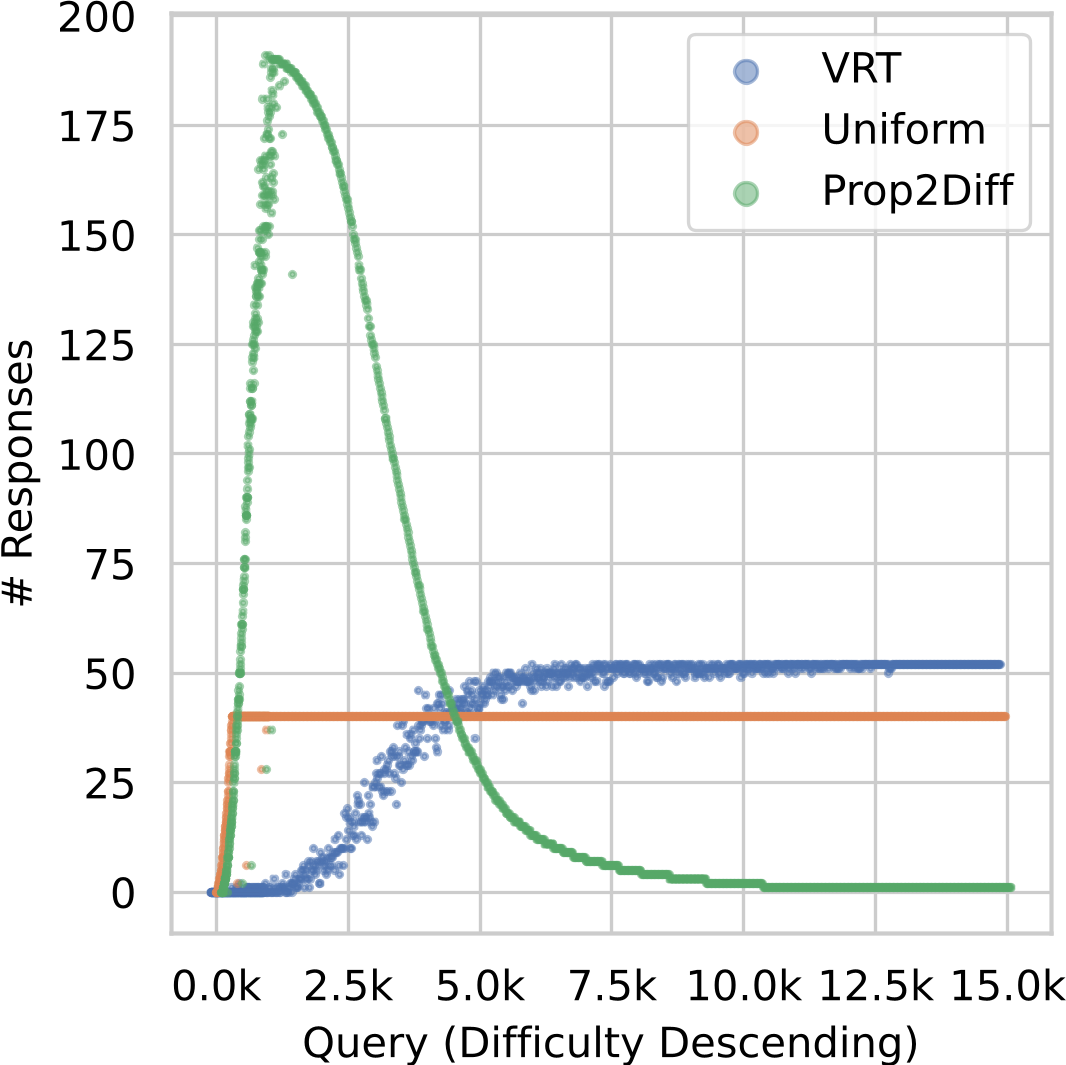
🎯 DART-Math > Difficulty-Aware Rejection Tuning for Mathematical Problem-Solving 📝 Paper@arXiv | 🤗 Datasets&Models@HF | 🐱 Code@GitHub 🐦 Thread@X(Twitter) | 🐶 中文博客@知乎 | 📊 Leaderboard@PapersWithCode | 📑 BibTeX ## Datasets: DART-Math DART-Math datasets are the state-of-the-art and data-efficient open-source instruction tuning datasets for mathematical reasoning. DART-Math-Hard contains ~585k mathematical QA pair samples constructed by applying DARS-Prop2Diff to the query set from MATH and GSK8K training sets, achieves SOTA on many challenging mathematical reasoning benchmarks. It introduces a deliberate bias towards hard queries, opposite to vanilla rejection sampling. Performance produced by DART-Math-Hard is usually but not necessarily slightly better (~1% absolutely) than DART-Math-Uniform, which contains ~591k samples constructed by applying DARS-Uniform. ### Comparison between Mathematical Instruction Tuning Datasets Most of previous datasets are constructed with ChatGPT, and many of them are not open-source, especially for ones of the best performance. | Math SFT Dataset | # of Samples | MATH | GSM8K | College | Synthesis Agent(s) | Open-Source | | :--------------------------------------------------------------------------------- | -----------: | -----------------------------------------------------------------: | ---------------------------------------------: | -----------------------------------------------------------------------------------------------------------: | :---------------------- | :-------------------------------------------------------------------------: | | WizardMath | 96k | 32.3 | 80.4 | 23.1 | GPT-4 | ✗ | | MetaMathQA | 395k | 29.8 | 76.5 | 19.3 | GPT-3.5 | ✓ | | MMIQC | 2294k | 37.4 | 75.4 | 28.5 | GPT-4+GPT-3.5+Human | ✓ | | Orca-Math | 200k | -- | -- | -- | GPT-4 | ✓ | | Xwin-Math-V1.1 | 1440k | 45.5 | 84.9 | 27.6 | GPT-4 | ✗ | | KPMath-Plus | 1576k | 46.8 | 82.1 | -– | GPT-4 | ✗ | | MathScaleQA | 2021k | 35.2 | 74.8 | 21.8 | GPT-3.5+Human | ✗ | | DART-Math-Uniform | 591k | 43.5 | 82.6 | 26.9 | DeepSeekMath-7B-RL | ✓ | | DART-Math-Hard | 585k | 45.5 | 81.1 | 29.4 | DeepSeekMath-7B-RL | ✓ | <sup>MATH and GSM8K are in-domain, while College(Math) is out-of-domain. Performance here are of models fine-tuned from Mistral-7B, except for Xwin-Math-V1.1 based on Llama2-7B. Bold/Italic means the best/second best score here.</sup> ## Dataset Construction: DARS - Difficulty-Aware Rejection Sampling Previous works usually synthesize data from proprietary models to augment existing datasets, followed by instruction tuning to achieve top-tier results. However, our analysis of these datasets reveals severe biases towards easy queries, with frequent failures to generate any correct response for the most challenging queries. Motivated by the observation above, we propose to Difficulty-Aware Rejection Sampling (DARS), to collect more responses for more difficult queries. Specifically, we introduce two strategies to increase the number of correct responses for difficult queries: 1) Uniform, which involves sampling responses for each query until each query accumulates $k_u$ correct responses, where $k_u$ is a preset hyperparameter determined by the desired size of the synthetic dataset; 2) Prop2Diff, where we continue sampling responses until the number of correct responses for each query is proportional to its difficulty score. The most challenging queries will receive $k_p$ responses and kp is a hyperparameter. This method introduces a deliberate bias in the opposite direction to vanilla rejection sampling, towards more difficult queries, inspired by previous works that demonstrate difficult samples can be more effective to enhance model capabilities (Sorscher et al., 2022; Liu et al., 2024b). See Figure 1 (Right) for examples of DART-Math-Uniform by DARS-Uniform and DART-Math-Hard by DARS-Prop2Diff. ## Citation If you find our data, model or code useful for your work, please kindly cite our paper: latex @article{tong2024dartmath, title={DART-Math: Difficulty-Aware Rejection Tuning for Mathematical Problem-Solving}, author={Yuxuan Tong and Xiwen Zhang and Rui Wang and Ruidong Wu and Junxian He}, year={2024}, eprint={2407.13690}, archivePrefix={arXiv}, primaryClass={cs.CL}, url={https://arxiv.org/abs/2407.13690}, }

관련 논문 2편

MathBridge: A Large Corpus Dataset for Translating Spoken Mathematical Expressions into LaTeX Formulas for Improved Readability

MathBridge
MathBridge 설명 보기

Understanding sentences that contain mathematical expressions in text form poses significant challenges. To address this, the importance of converting these expressions into a compiled formula is highlighted. For instance, the expression ``x equals minus b plus or minus the square root of b squared minus four a c, all over two a'' from automatic speech recognition (ASR) is more readily comprehensible when displayed as a compiled formula $x = \frac{-b \pm \sqrt{b^2 - 4ac}}{2a}$. To develop a text-to-formula conversion system, we can break down the process into text-to-LaTeX and LaTeX-to-formula conversions, with the latter managed by various existing LaTeX engines. However, the former approach has been notably hindered by the severe scarcity of text-to-LaTeX paired data, which presents a significant challenge in this field. In this context, we introduce MathBridge, the first extensive dataset for translating mathematical spoken expressions into LaTeX, to establish a robust baseline for future research on text-to-LaTeX translation. MathBridge comprises approximately 23 million LaTeX formulas paired with the corresponding spoken English expressions. Through comprehensive evaluations, including fine-tuning and testing with data, we discovered that MathBridge significantly enhances the capabilities of pretrained language models for text-to-LaTeX translation. Specifically, for the T5-large model, the sacreBLEU score increased from 4.77 to 46.8, demonstrating substantial enhancement.

관련 논문 2편

Paraphrased Math Word Problem Solving Repository

ParaMAWPS
ParaMAWPS 설명 보기

This repository contains the code, data, and models of the paper titled "Math Word Problem Solving by Generating Linguistic Variants of Problem Statements" published in the Proceedings of the 61st Annual Meeting of the Association for Computational Linguistics (Volume 4: Student Research Workshop). The work is outlined in a more detailed and expository manner in our Bachelor of Science (B.Sc.) thesis titled "Variational Mathematical Reasoning: Enhancing Math Word Problem Solvers with Linguistic Variants and Disentangled Attention" which can be accessed from the Islamic University of Technology (IUT) Institutional Repository. arXiv anthology GoogleScholar ResearchGate HuggingFace PDF Slides Video Poster Thesis License: Creative Commons Attribution-NonCommercial-ShareAlike 4.0 International license ## Dataset In order to download our dataset PᴀʀᴀMAWPS, please navigate to the ParaMAWPS folder. We use an $80:10:10$ train-validation-test split for our PᴀʀᴀMAWPS dataset. The splits are available in .json format in the aforementioned folder. ### Data Format Each row consists of a Math Word Problem (MWP). The table below describes what each column signifies. Column Title | Description ------------ | ------------- id | The unique identification number of the sample. Seed problems have id size of $\leq 4$, whereas, variant problems have id size of $> 4$. The last variant of a seed problem (generally with the id "$16000i$", where $i$ is the id of the seed problem) is the inverse variant of the seed problem. original_text | The problem statement of the MWP. The seed problems have the same problem statement as present in the Mᴀᴡᴘs dataset. equation | The equation with a variable \(x\) which solves the MWP quantity_tagged_text | The problem statement of the MWP, where each quantity is replaced with a unique tag \([Q_i]\) quantity_tagged_equation | The equation with a variable \(x\) which solves the MWP, but each quantity is replaced with its unique tag \([Q_i]\) in the problem statement have_constant | Whether the use of a constant value is required to solve the MWP <br> For an MWP sample \(i\) with have_constant label \(C_i\), the boolean label is,<br>$C_i =\begin{cases} \text{FALSE}, & \text{if $i$ requires $0$ constant values}\\\ \text{TRUE}, & \text{if $i$ requires $\geq 1$ constant values}\end{cases}$ ## Types of Variations <img src="https://github.com/Starscream-11813/Variational-Mathematical-Reasoning/raw/main/images/ACLMWP_variationtypes.png" alt="drawing" style="width:1000px;"/> ## Dataset Statistics <img src="https://github.com/Starscream-11813/Variational-Mathematical-Reasoning/raw/main/images/ACLMWP_datasetcomparisontable.png" alt="drawing" style="width:500px;"/> <img src="https://github.com/Starscream-11813/Variational-Mathematical-Reasoning/raw/main/images/ACLMWP_datasetcomparisongraph.png" alt="drawing" style="width:500px;"/> # Methodology <img src="https://github.com/Starscream-11813/Variational-Mathematical-Reasoning/raw/main/images/ACLMWP_architecture2.png" alt="drawing" style="width:1000px;"/> # Results To reproduce the results, please refer to the documentation of MWPToolkit created by Yihuai Lan et al. <img src="https://github.com/Starscream-11813/Variational-Mathematical-Reasoning/raw/main/images/ACLMWP_results.png" alt="drawing" style="width:500px;"/> <img src="https://github.com/Starscream-11813/Variational-Mathematical-Reasoning/raw/main/images/ACLMWP_ablation.png" alt="drawing" style="width:500px;"/> ## Citation If you find this work useful, please cite our paper: bib @inproceedings{raiyan-etal-2023-math, title = "Math Word Problem Solving by Generating Linguistic Variants of Problem Statements", author = "Raiyan, Syed Rifat and Faiyaz, Md Nafis and Kabir, Shah Md. Jawad and Kabir, Mohsinul and Mahmud, Hasan and Hasan, Md Kamrul", booktitle = "Proceedings of the 61st Annual Meeting of the Association for Computational Linguistics (Volume 4: Student Research Workshop)", month = jul, year = "2023", address = "Toronto, Canada", publisher = "Association for Computational Linguistics", url = "https://aclanthology.org/2023.acl-srw.49", doi = "10.18653/v1/2023.acl-srw.49", pages = "362--378", abstract = "The art of mathematical reasoning stands as a fundamental pillar of intellectual progress and is a central catalyst in cultivating human ingenuity. Researchers have recently published a plethora of works centered around the task of solving Math Word Problems (MWP) {---} a crucial stride towards general AI. These existing models are susceptible to dependency on shallow heuristics and spurious correlations to derive the solution expressions. In order to ameliorate this issue, in this paper, we propose a framework for MWP solvers based on the generation of linguistic variants of the problem text. The approach involves solving each of the variant problems and electing the predicted expression with the majority of the votes. We use DeBERTa (Decoding-enhanced BERT with disentangled attention) as the encoder to leverage its rich textual representations and enhanced mask decoder to construct the solution expressions. Furthermore, we introduce a challenging dataset, ParaMAWPS, consisting of paraphrased, adversarial, and inverse variants of selectively sampled MWPs from the benchmark Mawps dataset. We extensively experiment on this dataset along with other benchmark datasets using some baseline MWP solver models. We show that training on linguistic variants of problem statements and voting on candidate predictions improve the mathematical reasoning and robustness of the model. We make our code and data publicly available.", } You can also cite our thesis: bib @phdthesis{raiyan2023variational, type={Bachelor's Thesis}, title={Variational Mathematical Reasoning: Enhancing Math Word Problem Solvers with Linguistic Variants and Disentangled Attention}, author={Raiyan, Syed Rifat and Faiyaz, Md Nafis and Kabir, Shah Md Jawad}, year={2023}, school={Department of Computer Science and Engineering (CSE), Islamic University of Technology}, address={Board Bazar, Gazipur-1704, Dhaka, Bangladesh}, note={Available at \url{http://103.82.172.44:8080/xmlui/handle/123456789/2092}} }
관련 논문 2편

Wikipedia Math Essentials

Wikipedia Math Essentials 설명 보기

Contains Wikipedia pages about popular mathematics topics and edges describe the links from one page to another. Features describe the number of daily visits between 2019 and 2021 March.

관련 논문 1편

ASyMOB: Algebraic Symbolic Mathematical Operations Benchmark

ASyMOB
ASyMOB 설명 보기

ASyMOB (pronounced Asimov, in tribute to the renowned author), is a novel assessment framework focused exclusively on symbolic manipulation, featuring 17,092 unique math challenges, organized by similarity and complexity. ASyMOB enables analysis of LLM failure root-causes and generalization capabilities by comparing performance in problems that differ by simple numerical or symbolic "perturbations".

관련 논문 1편

Concept and Hint-Annotated Math Problems

CHAMP
CHAMP 설명 보기

The Concept and Hint-Annotated Math Problems (CHAMP) consists of high school math competition problems, annotated with concepts, or general math facts, and hints, or problem-specific tricks. These annotations allow us to explore the effects of additional information, such as relevant hints, misleading concepts, or related problems.

관련 논문 1편

DART-Math-Uniform

DART-Math-Uniform 설명 보기

🎯 DART-Math > Difficulty-Aware Rejection Tuning for Mathematical Problem-Solving 📝 Paper@arXiv | 🤗 Datasets&Models@HF | 🐱 Code@GitHub 🐦 Thread@X(Twitter) | 🐶 中文博客@知乎 | 📊 Leaderboard@PapersWithCode | 📑 BibTeX ## Datasets: DART-Math DART-Math datasets are the state-of-the-art and data-efficient open-source instruction tuning datasets for mathematical reasoning. DART-Math-Hard contains ~585k mathematical QA pair samples constructed by applying DARS-Prop2Diff to the query set from MATH and GSK8K training sets, achieves SOTA on many challenging mathematical reasoning benchmarks. It introduces a deliberate bias towards hard queries, opposite to vanilla rejection sampling. Performance produced by DART-Math-Hard is usually but not necessarily slightly better (~1% absolutely) than DART-Math-Uniform, which contains ~591k samples constructed by applying DARS-Uniform. ### Comparison between Mathematical Instruction Tuning Datasets Most of previous datasets are constructed with ChatGPT, and many of them are not open-source, especially for ones of the best performance. | Math SFT Dataset | # of Samples | MATH | GSM8K | College | Synthesis Agent(s) | Open-Source | | :--------------------------------------------------------------------------------- | -----------: | -----------------------------------------------------------------: | ---------------------------------------------: | -----------------------------------------------------------------------------------------------------------: | :---------------------- | :-------------------------------------------------------------------------: | | WizardMath | 96k | 32.3 | 80.4 | 23.1 | GPT-4 | ✗ | | MetaMathQA | 395k | 29.8 | 76.5 | 19.3 | GPT-3.5 | ✓ | | MMIQC | 2294k | 37.4 | 75.4 | 28.5 | GPT-4+GPT-3.5+Human | ✓ | | Orca-Math | 200k | -- | -- | -- | GPT-4 | ✓ | | Xwin-Math-V1.1 | 1440k | 45.5 | 84.9 | 27.6 | GPT-4 | ✗ | | KPMath-Plus | 1576k | 46.8 | 82.1 | -– | GPT-4 | ✗ | | MathScaleQA | 2021k | 35.2 | 74.8 | 21.8 | GPT-3.5+Human | ✗ | | DART-Math-Uniform | 591k | 43.5 | 82.6 | 26.9 | DeepSeekMath-7B-RL | ✓ | | DART-Math-Hard | 585k | 45.5 | 81.1 | 29.4 | DeepSeekMath-7B-RL | ✓ | <sup>MATH and GSM8K are in-domain, while College(Math) is out-of-domain. Performance here are of models fine-tuned from Mistral-7B, except for Xwin-Math-V1.1 based on Llama2-7B. Bold/Italic means the best/second best score here.</sup> ## Dataset Construction: DARS - Difficulty-Aware Rejection Sampling Previous works usually synthesize data from proprietary models to augment existing datasets, followed by instruction tuning to achieve top-tier results. However, our analysis of these datasets reveals severe biases towards easy queries, with frequent failures to generate any correct response for the most challenging queries. Motivated by the observation above, we propose to Difficulty-Aware Rejection Sampling (DARS), to collect more responses for more difficult queries. Specifically, we introduce two strategies to increase the number of correct responses for difficult queries: 1) Uniform, which involves sampling responses for each query until each query accumulates $k_u$ correct responses, where $k_u$ is a preset hyperparameter determined by the desired size of the synthetic dataset; 2) Prop2Diff, where we continue sampling responses until the number of correct responses for each query is proportional to its difficulty score. The most challenging queries will receive $k_p$ responses and kp is a hyperparameter. This method introduces a deliberate bias in the opposite direction to vanilla rejection sampling, towards more difficult queries, inspired by previous works that demonstrate difficult samples can be more effective to enhance model capabilities (Sorscher et al., 2022; Liu et al., 2024b). See Figure 1 (Right) for examples of DART-Math-Uniform by DARS-Uniform and DART-Math-Hard by DARS-Prop2Diff. ## Citation If you find our data, model or code useful for your work, please kindly cite our paper: latex @article{tong2024dartmath, title={DART-Math: Difficulty-Aware Rejection Tuning for Mathematical Problem-Solving}, author={Yuxuan Tong and Xiwen Zhang and Rui Wang and Ruidong Wu and Junxian He}, year={2024}, eprint={2407.13690}, archivePrefix={arXiv}, primaryClass={cs.CL}, url={https://arxiv.org/abs/2407.13690}, }

관련 논문 1편

Educational Grade School Math (EGSM)

Educational Grade School Math (EGSM) 설명 보기

Educational Grade School Math (EGSM) contains 2,093 question/answer pairs generated by MATHWELL, a reference-free educational grade school math word problem generator that outputs a word problem and Program of Thought (PoT) solution based solely on an optional student interest, as introduced in MATHWELL: Generating Educational Math Word Problems Using Teacher Annotations. The question/answer pairs are verified by human experts. EGSM is the first teacher-annotated math word problem training dataset for LLMs. EGSM is designed to train reference-free educational grade school math word problem generators, but can also be used to train math QA models. Please refer to our paper for more information on the dataset.

관련 논문 1편

HARDMath2

HARDMath2 설명 보기

We introduce a challenging benchmark of graduate-level problems in applied mathematics that was fully developed as part of a university class. Problems include boundary-layer analysis, WKB methods, asymptotic solutions of nonlinear partial differential equations, and the asymptotics of oscillatory integrals.

관련 논문 1편

Hyperscanning EEG of Interactive Math Task

HEIMT
HEIMT 설명 보기

Continuous EEG activity was recorded from each member of the dyad using an ActiveTwo head cap and the ActiveTwo Biosemi system (BioSemi, Amsterdam, Netherlands). Recordings were collected from 64 Ag-AgCl scalp electrodes and from bilateral mastoids. Two electrodes were placed next to each other 1 cm below the right eye to record eye-blink responses. A ground electrode was established by BioSemi’s common Mode Sense active electrode and Driven Right Leg passive electrode. EEG activity was digitized with ActiView software (BioSemi) and sampled at 2048 Hz. Data was downsampled post-acquisition and analyzed at 512 Hz.

관련 논문 1편

Keyphrases CS&Math Russian

Keyphrases CS&Math Russian 설명 보기

Dataset contains CS/Math articles abstracts (in Russian) obtained from two online sources. For each article publication year, journal name, authors, title, keyphrases and abstract are provided. Morozov, D. A., Glazkova, A. V., Tyutyulnikov, M. A., & Iomdin, B. L. (2023). Keyphrase generation for abstracts of the Russian-language scientific articles. NSU Vestnik. Series: Linguistics and Intercultural Communication, 21(1), 54-66.

관련 논문 1편

MATHWELL Human Annotation Dataset

MATHWELL Human Annotation Dataset 설명 보기

The MATHWELL Human Annotation Dataset contains 5,084 synthetic word problems and answers generated by MATHWELL, a reference-free educational grade school math word problem generator released in MATHWELL: Generating Educational Math Word Problems Using Teacher Annotations, and comparison models (GPT-4, GPT-3.5, Llama-2, MAmmoTH, and LLEMMA) with expert human annotations for solvability, accuracy, appropriateness, and meets all criteria (MaC). Solvability means the problem is mathematically possible to solve, accuracy means the Program of Thought (PoT) solution arrives at the correct answer, appropriateness means that the mathematical topic is familiar to a grade school student and the question's context is appropriate for a young learner, and MaC denotes questions which are labeled as solvable, accurate, and appropriate. Null values for accuracy and appropriateness indicate a question labeled as unsolvable, which means it cannot have an accurate solution and is automatically inappropriate. Based on our annotations, 82.2% of the question/answer pairs are solvable, 87.3% have accurate solutions, 78.1% are appropriate, and 58.4% meet all criteria. This dataset is designed to train text classifiers to automatically label word problem generator outputs for solvability, accuracy, and appropriateness. More details about the dataset can be found in our paper.

관련 논문 1편

Mathematical Formulas

MF
MF 설명 보기

Mathematical dataset containing formulas based on the AMPS Khan dataset and the ARQMath dataset V1.3. Based on the retrieved LaTeX formulas, more equivalent versions have been generated by applying randomized LaTeX printing with this SymPy fork. The formulas are intended to be well applicable for MLM. For instance, a masking for a formula like (a+b)^2 = a^2 + 2ab + b^2 makes sense (e.g., (a+[MASK])^2 = a^2 + [MASK]ab + b[MASK]2 -> masked tokens are deducable by the context), in contrast, formulas such as f(x) = 3x+1 are not (e.g., [MASK](x) = 3x[MASK]1 -> [MASK] tokens are ambigious).

관련 논문 1편

Mathematical Texts

MT
MT 설명 보기

Mathematical dataset containing mathematical texts, i.e., texts containing LaTeX formulas, based on the AMPS Khan dataset and the ARQMath dataset V1.3. Based on the retrieved LaTeX texts, more mathematically equivalent versions have been generated by applying randomized LaTeX printing with this SymPy fork. A positive id corresponds to the ARQMath post id of the generated text version, a negative id indicates an AMPS text.

관련 논문 1편

mathematical statement equivalence

MathEquiv
MathEquiv 설명 보기

MathEquiv dataset is accompanied to EquivPruner . It is specifically designed for mathematical statement equivalence , serving as a versatile resource applicable to a variety of mathematical tasks and scenarios. It consists of almost 100k math sentences pair with equivalence result and reasoning step generated by GPT-4O. The dataset consists of three splits: - train with 77.6k problems for training. - test with 9.83k samples for testing. - valid with 9.75k samples for validation. We implemented a five-tiered classification system. This granular approach was adopted to enhance the stability of the GPT model's outputs, as preliminary experiments with binary classification (equivalent/non-equivalent) revealed inconsistencies in judgments. The five-tiered system yielded significantly more consistent and reliable assessments: - Level 4 (Exactly Equivalent): The statements are mathematically interchangeable in all respects, exhibiting identical meaning and form. - Level 3 (Likely Equivalent): Minor syntactic differences may be present, but the core mathematical content and logic align. - Level 2 (Indeterminable): Insufficient information is available to make a definitive judgment regarding equivalence. - Level 1 (Unlikely Equivalent): While some partial agreement may exist, critical discrepancies in logic, definition, or mathematical structure are observed. - Level 0 (Not Equivalent): The statements are fundamentally distinct in their mathematical meaning, derivation, or resultant outcomes.

관련 논문 1편

MathMC

MathMC 설명 보기

Existing arithmetic benchmarks have a limited number of multiple-choice questions. To address this gap, MathMC is created including 1,000 Chinese mathematical multiple-choice questions with detailed explanations and focusing on math problems typically encountered in grades 4 to 6. It features a wide range of question types, including arithmetic, algebra, geometry, statistics, reasoning, and more, enhancing the diversity of current Chinese arithmetic datasets.

관련 논문 1편

MathToF

MathToF 설명 보기

Existing arithmetic benchmarks have a limited number of True-or-False questions. To address this gap, MathToF is created including 1,000 Chinese mathematical True-or-False questions with detailed explanations and focusing on math problems typically encountered in grades 4 to 6. It features a wide range of question types, including arithmetic, algebra, geometry, statistics, reasoning, and more, enhancing the diversity of current Chinese arithmetic datasets.

관련 논문 1편

MFR (Mathematical Formula Retrieval)

Mathematical Formula Retrieval
Mathematical Formula Retrieval 설명 보기

Mathematical dataset based on 71 famous mathematical identities. Each entry consists of two identities (in formula or textual form), together with a label, whether the two versions describe the same mathematical identity. The false pairs are not randomly chosen, but intentionally hard by modifying equivalent representations (see ddrg/named_math_formulas for more information). At most 400000 versions are generated per identity. There are ten times more falsified versions than true ones, such that the dataset can be used for a training with changing false examples every epoch.

관련 논문 1편

Mathematical Mathematics Memes

Mathematical Mathematics Memes 설명 보기

Dataset Description This dataset contains +10k math memes. Memes were approved by admins before being shared with group members. Thus all memes follow the community standards. Memes are about college math or above. ### Acknowledgements Thanks to the Mathematical Mathematics Memes community for sharing OC memes. ### Inspiration - Generate more high-quality math memes. - Detect hateful or abusive memes. - Study the popularity of the memes. - Extract text and predict popularity. ### Copyright Copyright of all images kept by their respective owners. All images posted on Facebook are subject to fair use. ** Disclaimer: These memes were collected by blind web scraping, and I have not reviewed the vast majority of them. I do not agree with any of the sentiments contained therein. **

관련 논문 1편

Named Mathematical Formulas

NMF
NMF 설명 보기

Mathematical dataset based on 71 famous mathematical identities. Each entry consists of a name of the identity (name), a representation of that identity (formula), a label whether the representation belongs to the identity (label), and an id of the mathematical identity (formula_name_id). The false pairs are intentionally challenging, e.g., a^2+2^b=c^2as falsified version of the Pythagorean Theorem. All entries have been generated by using data.json as starting point and applying the randomizing and falsifying algorithms from MathMutator (MAMUT). The formulas in the dataset are not just pure mathematical, but contain also textual descriptions of the mathematical identity. At most 400000 versions are generated per identity. There are ten times more falsified versions than true ones, such that the dataset can be used for a training with changing false examples every epoch. This dataset might be used to train a language model based math-retrieval system with a NSP-like task. See also see ddrg/math_formula_retrieval as a derived dataset which associates two formulas.

관련 논문 1편

AI-MO/NuminaMath-7B-TIR

NuminaMath-TIR
NuminaMath-TIR 설명 보기

Model Card for NuminaMath 7B TIR NuminaMath is a series of language models that are trained to solve math problems using tool-integrated reasoning (TIR). NuminaMath 7B TIR won the first progress prize of the AI Math Olympiad (AIMO), with a score of 29/50 on the public and private tests sets.

관련 논문 1편

PolyMATH

PolyMATH 설명 보기

PolyMATH, a challenging benchmark aimed at evaluating the general cognitive reasoning abilities of MLLMs. PolyMATH comprises 5,000 manually collected high-quality images of cognitive textual and visual challenges across 10 distinct categories, including pattern recognition, spatial reasoning, and relative reasoning Paper Code Project

관련 논문 1편

Research-Level Mathematics 2025

RLM25
RLM25 설명 보기

RLM25 is an evaluation benchmark containing 619 paired examples of research-level natural language mathematical statements and their corresponding Lean formalizations. The examples are drawn from six real-world formalization projects, and each entry includes essential context along with timestamp information to ensure freshness and avoid data contamination. Its primary purpose is to serve as a challenging testbed for assessing autoformalization systems, helping researchers measure improvements in translating complex, research-level mathematics into formal code.

관련 논문 1편

ValiMath

ValiMath 설명 보기

ValiMath is a high-quality benchmark consisting of 2,147 carefully curated mathematical questions designed to evaluate an LLM's ability to verify the correctness of math questions based on multiple logic-based and structural criteria.

관련 논문 1편

Vietnamese MATH

ViMATH
ViMATH 설명 보기

Click to add a brief description of the dataset (Markdown and LaTeX enabled). Provide: * a high-level explanation of the dataset characteristics * explain motivations and summary of its content * potential use cases of the dataset

관련 논문 1편

zbMATH Open dataset 2021

zbMATH Open dataset 2021 설명 보기

zbMATH Open contains over 4 million bibliographic entries with reviews or abstracts drawn from more than 3.000 journals and book series and more than 190.000 books.

관련 논문 0편

Math Formula Detection Dataset

Math Formula Detection Dataset 설명 보기

Description: <a href="https://gts.ai/dataset-download/math-formula-detection-dataset/" target="_blank">👉 Download the dataset here</a> Mathematical formula detection is a critical area in AI research, aiding in converting complex mathematical expressions from visual representations to machine-readable formats. This dataset aims to bridge the gap between handwritten or printed mathematical formulas and their digital counterparts, using deep learning models, particularly GANs (Generative Adversarial Networks). Download Dataset Dataset Overview The Math Formula Detection dataset includes images of various mathematical equations and symbols, designed for both printed and handwritten formula detection. The dataset is labeled with corresponding LaTeX or MathML formats for every formula, making it ideal for tasks such as symbol recognition, formula segmentation, and image-to-formula translation. Applications of the Dataset Document Digitization: Automating the process of digitizing textbooks, research papers, and academic documents containing mathematical content. Educational Tools: Assisting online education platforms by converting handwritten notes or scanned documents into searchable and editable digital formats. Scientific Research: Helping researchers in fields like physics, engineering, and economics to quickly search and manipulate mathematical content in large datasets. Text-to-Math Conversion Models: The dataset is also suited for models that convert visual representations of mathematical symbols into structured formats like LaTeX, MathML, or plain text. Key Features High-Resolution Images: The dataset provides clear images of formulas at various resolutions, enabling effective training of neural networks for detection and recognition. Symbol Localization: It includes annotated bounding boxes around each formula or symbol for precise localization, a critical step in formula detection. Multi-Modal Support: The dataset supports various output formats like LaTeX and MathML, making it flexible for different applications. Future Prospects This dataset opens doors to multiple advancements in AI-driven formula detection, including real-time recognition in educational tools and more efficient academic paper digitization. The research possibilities extend beyond formula detection into automatic verification of solutions and advanced educational AI systems. This dataset is sourced from Kaggle.

관련 논문 0편

MathEval

MathEval 설명 보기

MathEval is a benchmark dedicated to a comprehensive evaluation of the mathematical capabilities of large models. It encompasses over 20 evaluation datasets across various mathematical domains, with over 30,000 math problems. The goal is to thoroughly evaluate the performance of large models in tackling problems spanning a wide range of difficulty levels and diverse mathematical subfields (i.e. arithmetic, elementary mathematics, middle and high school competition topics, advanced mathematical, etc.). It serves as a trustworthy reference for cross-model comparisons of mathematical abilities among large models at the current stage and guides how to further enhance the mathematical capabilities of these models in the future.