Papers with Code · CC BY-SA 4.0

데이터셋 탐색

데이터셋의 설명·홈페이지를 찾고, 관련 태스크의 평가 기록을 살펴보세요.

관련 논문 15,430편

ImageNet

ImageNet 설명 보기

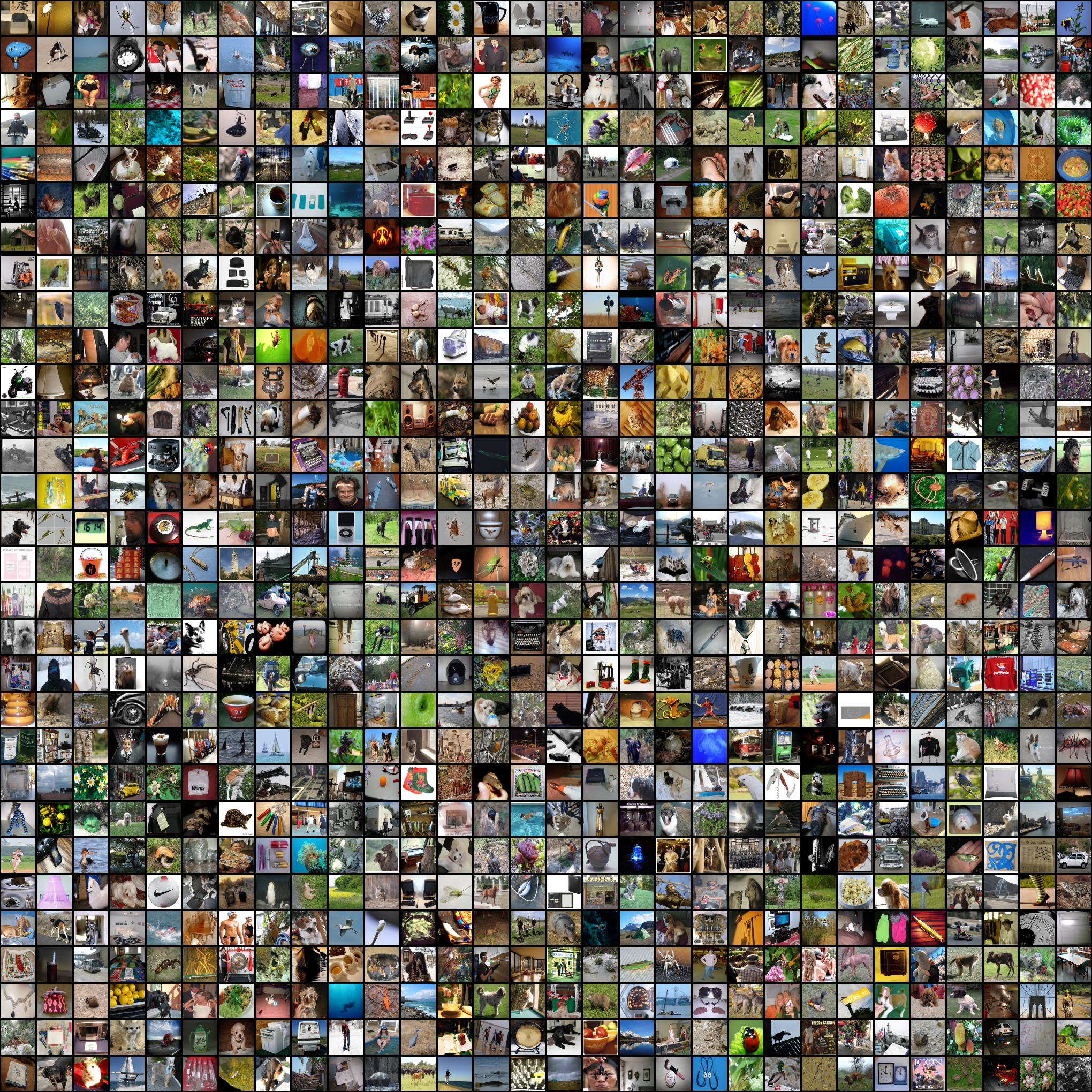
The ImageNet dataset contains 14,197,122 annotated images according to the WordNet hierarchy. Since 2010 the dataset is used in the ImageNet Large Scale Visual Recognition Challenge (ILSVRC), a benchmark in image classification and object detection. The publicly released dataset contains a set of manually annotated training images. A set of test images is also released, with the manual annotations withheld. ILSVRC annotations fall into one of two categories: (1) image-level annotation of a binary label for the presence or absence of an object class in the image, e.g., “there are cars in this image” but “there are no tigers,” and (2) object-level annotation of a tight bounding box and class label around an object instance in the image, e.g., “there is a screwdriver centered at position (20,25) with width of 50 pixels and height of 30 pixels”. The ImageNet project does not own the copyright of the images, therefore only thumbnails and URLs of images are provided. * Total number of non-empty WordNet synsets: 21841 * Total number of images: 14197122 * Number of images with bounding box annotations: 1,034,908 * Number of synsets with SIFT features: 1000 * Number of images with SIFT features: 1.2 million Source: ImageNet Large Scale Visual Recognition Challenge Image Source: https://cs.stanford.edu/people/karpathy/cnnembed/
관련 논문 1,345편

mini-Imagenet

mini-Imagenet 설명 보기

mini-Imagenet is proposed by Matching Networks for One Shot Learning . In NeurIPS, 2016. This dataset consists of 50000 training images and 10000 testing images, evenly distributed across 100 classes.

관련 논문 481편

ImageNet-Rendition

ImageNet-R
ImageNet-R 설명 보기

ImageNet-R(endition) contains art, cartoons, deviantart, graffiti, embroidery, graphics, origami, paintings, patterns, plastic objects, plush objects, sculptures, sketches, tattoos, toys, and video game renditions of ImageNet classes. ImageNet-R has renditions of 200 ImageNet classes resulting in 30,000 images. Source: The Many Faces of Robustness: A Critical Analysis of Out-of-Distribution Generalization

관련 논문 317편

tieredImageNet

tieredImageNet 설명 보기

The tieredImageNet dataset is a larger subset of ILSVRC-12 with 608 classes (779,165 images) grouped into 34 higher-level nodes in the ImageNet human-curated hierarchy. This set of nodes is partitioned into 20, 6, and 8 disjoint sets of training, validation, and testing nodes, and the corresponding classes form the respective meta-sets. As argued in Ren et al. (2018), this split near the root of the ImageNet hierarchy results in a more challenging, yet realistic regime with test classes that are less similar to training classes. Source: tieredImageNet Image Source: https://arxiv.org/pdf/1803.00676.pdf

관련 논문 268편

ImageNet-Sketch

ImageNet-Sketch 설명 보기

ImageNet-Sketch data set consists of 50,889 images, approximately 50 images for each of the 1000 ImageNet classes. The data set is constructed with Google Image queries "sketch of __", where __ is the standard class name. Only within the "black and white" color scheme is searched. 100 images are initially queried for every class, and the pulled images are cleaned by deleting the irrelevant images and images that are for similar but different classes. For some classes, there are less than 50 images after manually cleaning, and then the data set is augmented by flipping and rotating the images. Source: ImageNet-Sketch Image Source: https://github.com/HaohanWang/ImageNet-Sketch

관련 논문 106편

Stylized ImageNet

Stylized ImageNet 설명 보기

The Stylized-ImageNet dataset is created by removing local texture cues in ImageNet while retaining global shape information on natural images via AdaIN style transfer. This nudges CNNs towards learning more about shapes and less about local textures. Source: Adversarial Examples Improve Image Recognition Image Source: https://github.com/rgeirhos/Stylized-ImageNet

관련 논문 89편

ImageNet-O

ImageNet-O 설명 보기

ImageNet-O consists of images from classes that are not found in the ImageNet-1k dataset. It is used to test the robustness of vision models to out-of-distribution samples. It's reported using the AUPR metric.

관련 논문 55편

Tiny-ImageNet-C

Tiny-ImageNet-C 설명 보기

Tiny ImageNet-C is an open-source data set comprising algorithmically generated corruptions applied to the Tiny ImageNet (ImageNet-200) test set comprising 200 classes following the concept of ImageNet-C. It was introduced by Hendrycks et al. ("Benchmarking Neural Network Robustness to Common Corruptions and Perturbations") and comprises 19 different corruptions (15 test corruptions and 4 validation corruptions) spanning 5 severity levels. This results in 200,000 images for the validation set and 750,000 images for the test set. For further information visit the original GitHub repository of ImageNet-C.

관련 논문 43편

ImageNet Semantic Segmentation

ImageNet-S
ImageNet-S 설명 보기

Powered by the ImageNet dataset, unsupervised learning on large-scale data has made significant advances for classification tasks. There are two major challenges to allowing such an attractive learning modality for segmentation tasks: i) a large-scale benchmark for assessing algorithms is missing; ii) unsupervised shape representation learning is difficult. We propose a new problem of large-scale unsupervised semantic segmentation (LUSS) with a newly created benchmark dataset to track the research progress. Based on the ImageNet dataset, we propose the ImageNet-S dataset with 1.2 million training images and 50k high-quality semantic segmentation annotations for evaluation. Our benchmark has a high data diversity and a clear task objective. We also present a simple yet effective baseline method that works surprisingly well for LUSS. In addition, we benchmark related un/weakly/fully supervised methods accordingly, identifying the challenges and possible directions of LUSS.

관련 논문 32편

ImageNet-P

ImageNet-P 설명 보기

ImageNet-P consists of noise, blur, weather, and digital distortions. The dataset has validation perturbations; has difficulty levels; has CIFAR-10, Tiny ImageNet, ImageNet 64 × 64, standard, and Inception-sized editions; and has been designed for benchmarking not training networks. ImageNet-P departs from ImageNet-C by having perturbation sequences generated from each ImageNet validation image. Each sequence contains more than 30 frames, so to counteract an increase in dataset size and evaluation time only 10 common perturbations are used. Source: Benchmarking Neural Network Robustness to Common Corruptions and Perturbations

관련 논문 29편

PartImageNet

PartImageNet 설명 보기

PartImageNet is a large, high-quality dataset with part segmentation annotations. It consists of 158 classes from ImageNet with approximately 24000 images. PartImageNet offers part-level annotations on a general set of classes with non-rigid, articulated objects, while having an order of magnitude larger size compared to existing datasets. It can be utilized in multiple vision tasks including but not limited to: Part Discovery, Semantic Segmentation, Few-shot Learning.

관련 논문 27편

ImageNet-1k vs Textures

ImageNet-1k vs Textures 설명 보기

A benchmark dataset for out-of-distribution detection. ImageNet-1k is in-distribution, while Textures is out-of-distribution.

관련 논문 26편

ImageNet VID

ImageNet VID 설명 보기

ImageNet VID is a large-scale public dataset for video object detection and contains more than 1M frames for training and more than 100k frames for validation.

관련 논문 26편

ImageNet-1k vs iNaturalist

ImageNet-1k vs iNaturalist 설명 보기

A benchmark dataset for out-of-distribution detection. ImageNet-1k is in-distribution, while iNaturalist is out-of-distribution.

관련 논문 23편

ImageNet-Watermark

ImageNet-W
ImageNet-W 설명 보기

ImageNet-W(atermark) is a test set to evaluate models’ reliance on the newly found watermark shortcut in ImageNet, which is used to predict the carton class. ImageNet-W is created by overlaying transparent watermarks on the ImageNet validation set. Two metrics are used to evaluate watermark shortcut reliance: (1) IN-W Gap: the top-1 accuracy drop from ImageNet to ImageNet-W, (2) Carton Gap: carton class accuracy increase from ImageNet to ImageNet-W. Combining ImageNet-W with previous out-of-distribution variants of ImageNet (e.g., Stylized ImageNet, ImageNet-R, ImageNet-9) forms a comprehensive suite of multi-shortcut evaluation on ImageNet.

관련 논문 21편

ImageNet-1k vs Places

ImageNet-1k vs Places 설명 보기

A benchmark dataset for out-of-distribution detection. ImageNet-1k is in-distribution, while Places is out-of-distribution.

관련 논문 19편

ImageNet-1k vs SUN

ImageNet-1k vs SUN 설명 보기

A benchmark dataset for out-of-distribution detection. ImageNet-1k is in-distribution, while SUN is out-of-distribution.

관련 논문 17편

No ImageNet Class Objects

NINCO
NINCO 설명 보기

The NINCO (No ImageNet Class Objects) dataset is introduced in the ICML 2023 paper In or Out? Fixing ImageNet Out-of-Distribution Detection Evaluation. The images in this dataset are free from objects that belong to any of the 1000 classes of ImageNet-1K (ILSVRC2012), which makes NINCO suitable for evaluating out-of-distribution detection on ImageNet-1K . The NINCO main dataset consists of 64 OOD classes with a total of 5879 samples. These OOD classes were selected to have no categorical overlap with any classes of ImageNet-1K. Each sample was inspected individually by the authors to not contain ID objects. Besides NINCO, included are (in the same .tar.gz file) truly OOD versions of 11 popular OOD datasets with in total 2715 OOD samples. Further included are 17 OOD unit-tests, with 400 samples each. Code for loading and evaluating on each of the three datasets is provided at https://github.com/j-cb/NINCO. When using NINCO, please consider citing (besides the bibtex given below) the following data sources that were used to create NINCO: Hendrycks et al.: ”Scaling out-of-distribution detection for real-world settings”, ICML, 2022. Bossard et al.: ”Food-101 – mining discriminative components with random forests”, ECCV 2014. Zhou et al.: ”Places: A 10 million image database for scene recognition”, IEEE PAMI 2017. Huang et al.: ”Mos: Towards scaling out-of-distribution detection for large semantic space”, CVPR 2021. Li et al.: ”Caltech 101 (1.0)”, 2022. Ismail et al.: ”MYNursingHome: A fully-labelled image dataset for indoor object classification.”, Data in Brief (V. 32) 2020. The iNaturalist project: https://www.inaturalist.org/ When using NINCO_popular_datasets_subsamples, additionally to the above, please consider citing: Cimpoi et al.: ”Describing textures in the wild”, CVPR 2014. Hendrycks et al.: ”Natural adversarial examples”, CVPR 2021. Wang et al.: ”Vim: Out-of-distribution with virtual-logit matching”, CVPR 2022. Bendale et al.: ”Towards Open Set Deep Networks”, CVPR 2016. Vaze et al.: ”Open-set Recognition: a Good Closed-set Classifier is All You Need?”, ICLR 2022. Wang et al.: ”Partial and Asymmetric Contrastive Learning for Out-of-Distribution Detection in Long-Tailed Recognition.” ICML, 2022. Galil et al.: “A framework for benchmarking Class-out-of-distribution detection and its application to ImageNet”, ICLR 2023.

관련 논문 15편

Large-Scale Dataset for Event-Based Object Recognition

N-ImageNet
N-ImageNet 설명 보기

The N-ImageNet dataset is an event-camera counterpart for the ImageNet dataset. The dataset is obtained by moving an event camera around a monitor displaying images from ImageNet. N-ImageNet contains approximately 1,300k training samples and 50k validation samples. In addition, the dataset also contains variants of the validation dataset recorded under a wide range of lighting or camera trajectories. Additional details about the dataset are explained in the paper available through this link. Please cite this paper if you make use of the dataset.

관련 논문 12편

ImageNet-100 (TEMI Split)

ImageNet-100 (TEMI Split) 설명 보기

This split was introduced in TEMI (BMVC 2023) Adaloglou, Nikolas, Felix Michels, Hamza Kalisch, and Markus Kollmann. "Exploring the Limits of Deep Image Clustering using Pretrained Models." In BMVC. 2023.

관련 논문 11편

ImageNet-X

ImageNet-X 설명 보기

ImageNet-X is a set of human annotations pinpointing failure types for the popular ImageNet dataset. ImageNet-X labels distinguishing object factors such as pose, size, color, lighting, occlusions, co-occurences, etc. for each image in the validation set and a random subset of 12,000 training samples. It is designed to study the types of mistakes as a function of model's architecture, learning paradigm, and training procedures.

관련 논문 10편

ImageNet-VidVRD

ImageNet-VidVRD 설명 보기

ImageNet-VidVRD dataset contains 1,000 videos selected from ILVSRC2016-VID dataset based on whether the video contains clear visual relations. It is split into 800 training set and 200 test set, and covers common subject/objects of 35 categories and predicates of 132 categories. Ten people contributed to labeling the dataset, which includes object trajectory labeling and relation labeling. Since the ILVSRC2016-VID dataset has the object trajectory annotation for 30 categories already, we supplemented the annotations by labeling the remaining 5 categories. In order to save the labor of relation labeling, we labeled typical segments of the videos in the training set and the whole of the videos in the test set.

관련 논문 7편

ImageNet-9

ImageNet-9 설명 보기

ImageNet-9 consists of images with different amounts of background and foreground signal, which you can use to measure the extent to which your models rely on image backgrounds. This dataset is helpful in testing the robustness of vision models with respect to their dependence on the backgrounds of images.

관련 논문 6편

ImageNet-1k vs OpenImage-O

ImageNet-1k vs OpenImage-O 설명 보기

OpenImage-O is built for the ID dataset ImageNet-1k. It is manually annotated, comes with a naturally diverse distribution, and has a large scale. It is built to overcome several shortcomings of existing OOD benchmarks. OpenImage-O is image-by-image filtered from the test set of OpenImage-V3, which has been collected from Flickr without a predefined list of class names or tags, leading to natural class statistics and avoiding an initial design bias.

관련 논문 6편

XIMAGENET-12: An Explainable AI Benchmark Dataset for Model Robustness Evaluation

XImageNet-12
XImageNet-12 설명 보기

Enlarge the dataset to understand how image background effect the Computer Vision ML model. With the following topics: Blur Background / Segmented Background / AI generated Background/ Bias of tools during annotation/ Color in Background / Dependent Factor in Background/ LatenSpace Distance of Foreground/ Random Background with Real Environment! We introduce XIMAGENET-12, an explainable benchmark dataset with over 200K images and 15,600 manual semantic annotations. Covering 12 categories from ImageNet to represent objects commonly encountered in practical life and simulating six diverse scenarios, including overexposure, blurring, color changing, etc., Our research builds upon the foundation laid by "Noise or Signal: The Role of Image Backgrounds in Object Recognition" (Xiao et al., ICLR 2022), "Explainable AI: Object Recognition With Help From Background" (Qiang et al., ICLR Workshop 2022), reinforced the notion that models trained solely on backgrounds can substantially improve accuracy. One noteworthy discovery highlighted in their studies is that more accurate models tend to rely less on backgrounds.

관련 논문 5편

ImageNet-Hard

ImageNet-Hard 설명 보기

ImageNet-Hard is a new benchmark that comprises 10,980 images collected from various existing ImageNet-scale benchmarks (ImageNet, ImageNet-V2, ImageNet-Sketch, ImageNet-C, ImageNet-R, ImageNet-ReaL, ImageNet-A, and ObjectNet). This dataset poses a significant challenge to state-of-the-art vision models as merely zooming in often fails to improve their ability to classify images correctly. As a result, even the most advanced models, such as CLIP-ViT-L/14@336px, struggle to perform well on this dataset, achieving a mere 2.02% accuracy.

관련 논문 5편

ImageNet-Patch

ImageNet-Patch 설명 보기

ImageNet-Patch: A Dataset for Benchmarking Machine Learning Robustness against Adversarial Patches Adversarial patches are optimized contiguous pixel blocks in an input image that cause a machine-learning model to misclassify it. However, their optimization is computationally demanding, and requires careful hyperparameter tuning, potentially leading to suboptimal robustness evaluations. To overcome these issues, we propose ImageNet-Patch, a dataset to benchmark machine-learning models against adversarial patches. It consists of a set of patches, optimized to generalize across different models, and readily applicable to ImageNet data after preprocessing them with affine transformations. This process enables an approximate yet faster robustness evaluation, leveraging the transferability of adversarial perturbations.

관련 논문 4편

No ImageNet Class Objects

ImageNet-1k vs NINCO
ImageNet-1k vs NINCO 설명 보기

The NINCO (No ImageNet Class Objects) dataset is introduced in the ICML 2023 paper In or Out? Fixing ImageNet Out-of-Distribution Detection Evaluation. The images in this dataset are free from objects that belong to any of the 1000 classes of ImageNet-1K (ILSVRC2012), which makes NINCO suitable for evaluating out-of-distribution detection on ImageNet-1K . The NINCO main dataset consists of 64 OOD classes with a total of 5879 samples. These OOD classes were selected to have no categorical overlap with any classes of ImageNet-1K. Each sample was inspected individually by the authors to not contain ID objects. Besides NINCO, included are (in the same .tar.gz file) truly OOD versions of 11 popular OOD datasets with in total 2715 OOD samples. Further included are 17 OOD unit-tests, with 400 samples each. Code for loading and evaluating on each of the three datasets is provided at https://github.com/j-cb/NINCO. When using NINCO, please consider citing (besides the bibtex given below) the following data sources that were used to create NINCO: Hendrycks et al.: ”Scaling out-of-distribution detection for real-world settings”, ICML, 2022. Bossard et al.: ”Food-101 – mining discriminative components with random forests”, ECCV 2014. Zhou et al.: ”Places: A 10 million image database for scene recognition”, IEEE PAMI 2017. Huang et al.: ”Mos: Towards scaling out-of-distribution detection for large semantic space”, CVPR 2021. Li et al.: ”Caltech 101 (1.0)”, 2022. Ismail et al.: ”MYNursingHome: A fully-labelled image dataset for indoor object classification.”, Data in Brief (V. 32) 2020. The iNaturalist project: https://www.inaturalist.org/ When using NINCO_popular_datasets_subsamples, additionally to the above, please consider citing: Cimpoi et al.: ”Describing textures in the wild”, CVPR 2014. Hendrycks et al.: ”Natural adversarial examples”, CVPR 2021. Wang et al.: ”Vim: Out-of-distribution with virtual-logit matching”, CVPR 2022. Bendale et al.: ”Towards Open Set Deep Networks”, CVPR 2016. Vaze et al.: ”Open-set Recognition: a Good Closed-set Classifier is All You Need?”, ICLR 2022. Wang et al.: ”Partial and Asymmetric Contrastive Learning for Out-of-Distribution Detection in Long-Tailed Recognition.” ICML, 2022. Galil et al.: “A framework for benchmarking Class-out-of-distribution detection and its application to ImageNet”, ICLR 2023.

관련 논문 4편

ImageNet-50 (TEMI Split)

ImageNet-50 (TEMI Split) 설명 보기

The ImageNet-50 dataset split as introduced in TEMI. Adaloglou, Nikolas, Felix Michels, Hamza Kalisch, and Markus Kollmann. "Exploring the Limits of Deep Image Clustering using Pretrained Models." In BMVC. 2023.

관련 논문 4편

ImageNet-D

ImageNet-D 설명 보기

ImageNet-D contains 4835 test images featuring diverse backgrounds (3,764), textures (498), and materials (573). Generated by diffusion models, ImageNet-D achieves superior image fidelity and collection efficiency than prior studies. Evaluation results show that ImageNet-D results in a significant accuracy drop to a range of vision models, from the standard ResNet visual classifier to the latest foundation models like CLIP and MiniGPT-4, significantly reducing their accuracy by up to 60%.

관련 논문 3편

ES-ImageNet

ES-ImageNet 설명 보기

ES-ImageNet is a large-scale event-stream dataset for SNNs and neuromorphic vision. It consists of about 1.3 M samples converted from ILSVRC2012 in 1000 different categories. ES-ImageNet is dozens of times larger than other neuromorphic classification datasets at present and completely generated by the software

관련 논문 3편

Tiny ImageNetV2

Tiny ImageNetV2 설명 보기

Tiny ImageNetv2 is a subset of the ImageNetV2 (matched frequency) dataset by Recht et al. ("Do ImageNet Classifiers Generalize to ImageNet?") with 2,000 images spanning all 200 classes of the Tiny ImageNet dataset. It is a test set achieved by collecting images of joint classes of Tiny ImageNet and ImageNet. The resized images of size 64×64 consist of images collected from Flickr after a decade of progress on the original ImageNet dataset. The data collection process was designed to resemble the original ImageNet dataset distribution. For further information on ImageNetV2 visit the original GitHub repository of ImageNetV2.

관련 논문 2편

CytoImageNet: A large-scale pretraining dataset for bioimage transfer learning

CytoImageNet
CytoImageNet 설명 보기

CytoImageNet is a large-scale pretraining dataset of microscopy images (890K, 894 classes). In the paper, CytoImageNet pretraining yielded features competitive to and different from ImageNet pretrained features on downstream microscopy tasks. * It was constructed from 40 openly available microscopy datasets. * Weak labels (from experimental metadata) were assigned to each image in the dataset. * Images are of varying sizes. The primary purpose of the dataset is to be used for pretraining as a pretext task for learning useful bioimage representations. However, it may be used for validation or exploratory analysis.

관련 논문 2편

ImageNet-100 (GCD split)

ImageNet-100 (GCD split) 설명 보기

This ImageNet-100 dataset was introduced in the following paper, Vaze, S., Han, K., Vedaldi, A. and Zisserman, A., 2022. Generalized category discovery. In Proceedings of the IEEE/CVF conference on computer vision and pattern recognition (pp. 7492-7501).

관련 논문 2편

ImageNet3D

ImageNet3D 설명 보기

ImageNet3D for general-purpose object-level 3D understanding. Tasks include: * Linear probing of object-level 3D awareness * Open-vocabulary pose estimation * Joint image classification and category-level pose estimation

관련 논문 2편

Tiny ImageNet-R

Tiny ImageNet-R 설명 보기

Tiny ImageNet-R is a subset of the ImageNet-R dataset by Hendrycks et al. ("The Many Faces of Robustness: A Critical Analysis of Out-of-Distribution Generalization") with 10,456 images spanning 62 of the 200 Tiny ImageNet dataset. It is a test set achieved by collecting images of joint classes of Tiny ImageNet and ImageNet. The resized images of size 64×64 contain art, cartoons, deviantart, graffiti, embroidery, graphics, origami, paintings, patterns, plastic objects, plush objects, sculptures, sketches, tattoos, toys, and video game renditions of ImageNet classes. For further information on ImageNet-R visit the original GitHub repository of ImageNet-R.