Papers with Code · CC BY-SA 4.0

데이터셋 탐색

데이터셋의 설명·홈페이지를 찾고, 관련 태스크의 평가 기록을 살펴보세요.

관련 논문 1편

Hotel Arabic-Reviews Dataset

HARD
HARD 설명 보기

The Hotel Arabic-Reviews Dataset (HARD) contains 93700 hotel reviews in Arabic language. The hotel reviews were collected from Booking.com website during June/July 2016. The reviews are expressed in Modern Standard Arabic as well as dialectal Arabic. Source: HARD

관련 논문 352편

BIG-Bench Hard

BBH
BBH 설명 보기

BIG-Bench Hard (BBH) is a subset of the BIG-Bench, a diverse evaluation suite for language models. BBH focuses on a suite of 23 challenging tasks from BIG-Bench that were found to be beyond the capabilities of current language models. These tasks are ones where prior language model evaluations did not outperform the average human-rater. The BBH tasks require multi-step reasoning, and it was found that few-shot prompting without Chain-of-Thought (CoT), as done in the BIG-Bench evaluations, substantially underestimates the best performance and capabilities of language models. When CoT prompting was applied to BBH tasks, it enabled PaLM to surpass the average human-rater performance on 10 of the 23 tasks, and Codex to surpass the average human-rater performance on 17 of the 23 tasks.

관련 논문 38편

GSM-Hard

GSM-Hard 설명 보기

Click to add a brief description of the dataset (Markdown and LaTeX enabled). Provide: * a high-level explanation of the dataset characteristics * explain motivations and summary of its content * potential use cases of the dataset

관련 논문 34편

DIHARD II

DIHARD II 설명 보기

The DIHARD II development and evaluation sets draw from a diverse set of sources exhibiting wide variation in recording equipment, recording environment, ambient noise, number of speakers, and speaker demographics. The development set includes reference diarization and speech segmentation and may be used for any purpose including system development or training.

관련 논문 17편

SUN-SEG-Hard (Unseen)

SUN-SEG-Hard (Unseen) 설명 보기

The SUN-SEG dataset is a high-quality per-frame annotated VPS dataset, which includes 158,690 frames from the famous SUN dataset. It extends the labels with diverse types, i.e., object mask, boundary, scribble, polygon, and visual attribute. It also introduces the pathological information from the original SUN dataset, including pathological classification labels, location information, and shape information. Notably, the origin SUN dataset has 113 colonoscopy videos, including 100 positive cases with 49, 136 polyp frames and 13 negative cases with 109, 554 non-polyp frames. It manually trims them into 378 positive and 728 negative short clips, meanwhile maintaining their intrinsic consecutive relationship. Such data pre-processing ensures each clip has around 3~11s duration at a real-time frame rate (i.e., 30 fps), which promotes the fault-tolerant margin for various algorithms and devices. To this end, the re-organized SUN-SEG contains 1, 106 short video clips with 158, 690 video frames totally, offering a solid foundation to build a representative benchmark. As such, it yields the final version of our SUN-SEG dataset, which includes 49,136 polyp frames (i.e., positive part) and 109,554 non-polyp frames (i.e., negative part) taken from different 285 and 728 colonoscopy videos clips, as well as the corresponding annotations.
관련 논문 11편

NPHardEval

NPHardEval 설명 보기

NPHardEval is a dynamic benchmark designed to assess the reasoning abilities of Large Language Models (LLMs) across a broad spectrum of algorithmic questions. Let's delve into the details: 1. Benchmark Purpose: - Complex Reasoning Ability: One of the most crucial features of current LLMs is their ability to handle complex reasoning. This capability plays an integral role in complex decision-making tasks. - Inadequacy of Existing Benchmarks: While several benchmarks exist to evaluate LLMs' reasoning abilities, they fall short in providing a rigorous assessment of the full extent of these abilities. Additionally, publicly accessible and static benchmarks risk overfitting, allowing models to tailor their responses to specific metrics. - Introducing NPHardEval: To address these limitations, NPHardEval was introduced. It aims to rigorously evaluate LLMs' reasoning abilities by extending up to the NP-Hard complexity class. 2. Key Features of NPHardEval: - 900 Algorithmic Questions: NPHardEval includes a diverse set of 900 algorithmic questions, carefully chosen to represent a wide range of complexity classes below NP-Hard. These questions serve as a rigorous measure of LLMs' reasoning abilities. - Dynamic Update Mechanism: Unlike static benchmarks, NPHardEval dynamically updates its datapoints on a monthly basis. Regular updates mitigate the risk of overfitting, ensuring a more accurate and reliable assessment of LLMs' reasoning capabilities. 3. Research Contribution: - Objective Perspective: NPHardEval sheds light on the current state of reasoning in LLMs by comparing their performance across complex classes. - Available Resources: The benchmark dataset and code for NPHardEval are accessible here ¹. In summary, NPHardEval provides a comprehensive evaluation framework for assessing LLMs' reasoning abilities through the lens of computational complexity classes. 🌟 (1) NPHardEval: Dynamic Benchmark on Reasoning Ability of Large Language .... https://arxiv.org/abs/2312.14890. (2) NPHardEval/README.md at main · casmlab/NPHardEval · GitHub. https://github.com/casmlab/NPHardEval/blob/main/README.md. (3) NPHardEval: Benchmarking Reasoning Ability of Large Language Models via .... https://frankling2020.github.io/publication/nphardeval/. (4) undefined. https://doi.org/10.48550/arXiv.2312.14890.

관련 논문 10편

Hard and Soft Skill Extraction from English Job Postings

SkillSpan
SkillSpan 설명 보기

SkillSpan is a dataset for Skill Extraction (SE). It is an important and widely-studied task useful to gain insights into labor market dynamics. However, there is a lacuna of datasets and annotation guidelines; available datasets are few and contain crowd-sourced labels on the span-level or labels from a predefined skill inventory. To address this gap, the authors introduce SkillSpan, a novel SE dataset consisting of 14.5K sentences and over 12.5K annotated spans.

관련 논문 9편

Deep Learning Hard

DL-HARD
DL-HARD 설명 보기

Deep Learning Hard (DL-HARD) is an annotated dataset designed to more effectively evaluate neural ranking models on complex topics. It builds on TREC Deep Learning (DL) questions extensively annotated with query intent categories, answer types, wikified entities, topic categories, and result type metadata from a leading web search engine. DL-HARD contains 50 queries from the official 2019/2020 evaluation benchmark, half of which are newly and independently assessed. Overall, DL-HARD is a new resource that promotes research on neural ranking methods by focusing on challenging and complex queries.

관련 논문 8편

Arena-Hard-Auto

Arena-Hard-Auto 설명 보기

The Arena-Hard-Auto benchmark is an automatic evaluation tool for instruction-tuned Language Learning Models (LLMs)¹. It was developed to provide a cheaper and faster approximation to human preference¹. Here are some key features of the Arena-Hard-Auto benchmark: - It contains 500 challenging user queries¹. - It uses GPT-4-Turbo as a judge to compare the models' responses against a baseline model (default: GPT-4-0314)¹. - It employs an automatic judge as a cheaper and faster approximator to human preference¹. - It has the highest correlation and separability to Chatbot Arena among popular open-ended LLM benchmarks¹. - If you are curious to see how well your model might perform on Chatbot Arena, Arena-Hard-Auto is recommended¹. The benchmark is built from live data in Chatbot Arena, which is a popular crowd-sourced platform for LLM evaluations⁴. It offers significantly stronger separability against other benchmarks with tighter confidence intervals². (1) GitHub - lm-sys/arena-hard-auto: Arena-Hard-Auto: An automatic LLM .... https://github.com/lm-sys/arena-hard-auto. (2) Arena Hard – UC Berkeley Sky Computing. https://sky.cs.berkeley.edu/project/arena-hard/. (3) From Live Data to High-Quality Benchmarks: The Arena-Hard Pipeline .... https://lmsys.org/blog/2024-04-19-arena-hard/. (4) GitHub - lm-sys/arena-hard-auto: Arena-Hard-Auto: An automatic LLM .... https://github.com/lm-sys/arena-hard-auto. (5) Arena-Hard:开源高质量大模型评估基准-CSDN博客. https://blog.csdn.net/weixin_57291105/article/details/138132998.

관련 논문 8편

SMAC+_Off_Hard_parallel_20

Off_Hard_parallel
Off_Hard_parallel 설명 보기

smac+ offensive hard scenario with 20 parallel episodic buffer.

관련 논문 8편

SMAC+_Off_Superhard_parallel_20

Off_Superhard_parallel
Off_Superhard_parallel 설명 보기

smac+ offensive scenario with 20 parallel episodic buffer.

관련 논문 5편

ImageNet-Hard

ImageNet-Hard 설명 보기

ImageNet-Hard is a new benchmark that comprises 10,980 images collected from various existing ImageNet-scale benchmarks (ImageNet, ImageNet-V2, ImageNet-Sketch, ImageNet-C, ImageNet-R, ImageNet-ReaL, ImageNet-A, and ObjectNet). This dataset poses a significant challenge to state-of-the-art vision models as merely zooming in often fails to improve their ability to classify images correctly. As a result, even the most advanced models, such as CLIP-ViT-L/14@336px, struggle to perform well on this dataset, achieving a mere 2.02% accuracy.

관련 논문 5편

Off_Superhard_sequential

Off_Superhard_sequential 설명 보기

SMAC+ offensive superhard scenario with sequential episodic buffer

관련 논문 4편

LeetCode-Hard

LeetCode-Hard 설명 보기

LeetCode-Hard is a benchmark dataset for code generation, consisting of 40 challenging LeetCode "hard-level" questions across 19 programming languages. It is designed to evaluate the problem-solving and functional correctness capabilities of large language models (LLMs), particularly in handling complex algorithmic tasks. This dataset was used to assess the Reflexion framework, which leverages verbal reinforcement learning to improve LLM performance on difficult coding problems.

관련 논문 4편

NPHardEval4V

NPHardEval4V 설명 보기

NPHardEval4V is a dynamic reasoning benchmark designed to evaluate the reasoning capabilities of Multimodal Large Language Models (MLLMs). Let me provide you with more details: 1. Purpose and Gap Addressed: - The benchmark aims to address existing gaps in evaluating the pure reasoning abilities of MLLMs. - It provides a venue to disentangle the effects of various factors (such as image recognition and instruction following) from the overall performance of the models. - By focusing solely on reasoning abilities, NPHardEval4V helps researchers understand and guide further development in this area. 2. Construction and Features: - NPHardEval4V is built by converting textual descriptions of questions from the existing NPHardEval dataset into image representations. - Unlike traditional benchmarks that primarily focus on static evaluations, NPHardEval4V is dynamic. It is updated monthly to prevent overfitting and ensure authentic and fine-grained model evaluation. - The benchmark evaluates MLLMs across three problem classes: polynomial time, NP-complete, and NP-hard problems. - It assesses performance in three dimensions: - Recognition (RA): Ability to understand image and video modalities. - Instruction-following (ER): How well the model follows instructions. - Reasoning (AA): Pure reasoning abilities. 3. Findings and Impact: - Significant discrepancies in reasoning abilities exist across different models. - MLLMs exhibit relatively weak performance compared to Large Language Models (LLMs) in terms of reasoning. - Investigating different prompting styles (visual, text, and combined) reveals varying impacts of multimodal inputs on model performance. In summary, NPHardEval4V provides a valuable resource for assessing reasoning abilities in MLLMs and contributes to advancing research in this domain. 🌟

관련 논문 2편

DART-Math-Hard

DART-Math-Hard 설명 보기

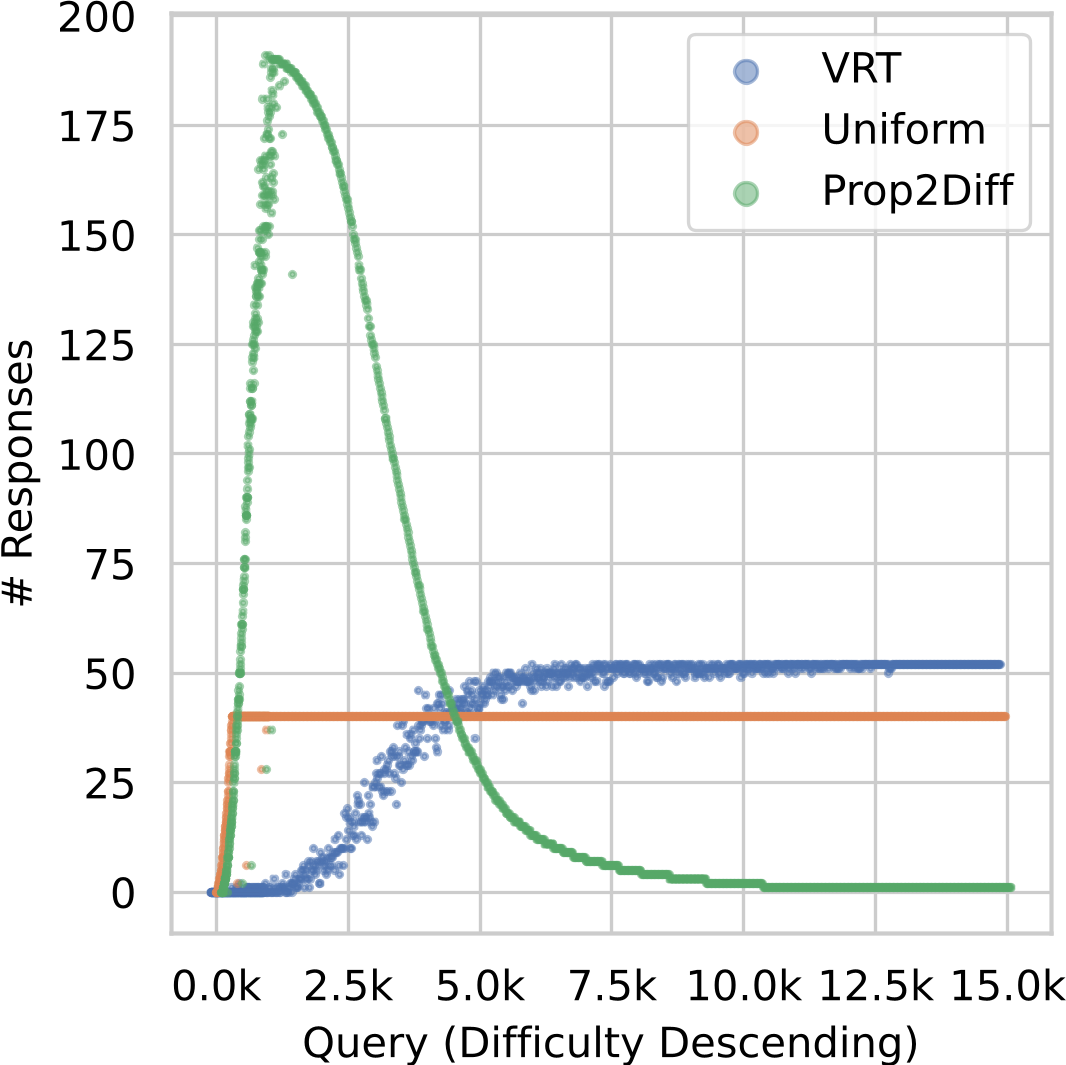
🎯 DART-Math > Difficulty-Aware Rejection Tuning for Mathematical Problem-Solving 📝 Paper@arXiv | 🤗 Datasets&Models@HF | 🐱 Code@GitHub 🐦 Thread@X(Twitter) | 🐶 中文博客@知乎 | 📊 Leaderboard@PapersWithCode | 📑 BibTeX ## Datasets: DART-Math DART-Math datasets are the state-of-the-art and data-efficient open-source instruction tuning datasets for mathematical reasoning. DART-Math-Hard contains ~585k mathematical QA pair samples constructed by applying DARS-Prop2Diff to the query set from MATH and GSK8K training sets, achieves SOTA on many challenging mathematical reasoning benchmarks. It introduces a deliberate bias towards hard queries, opposite to vanilla rejection sampling. Performance produced by DART-Math-Hard is usually but not necessarily slightly better (~1% absolutely) than DART-Math-Uniform, which contains ~591k samples constructed by applying DARS-Uniform. ### Comparison between Mathematical Instruction Tuning Datasets Most of previous datasets are constructed with ChatGPT, and many of them are not open-source, especially for ones of the best performance. | Math SFT Dataset | # of Samples | MATH | GSM8K | College | Synthesis Agent(s) | Open-Source | | :--------------------------------------------------------------------------------- | -----------: | -----------------------------------------------------------------: | ---------------------------------------------: | -----------------------------------------------------------------------------------------------------------: | :---------------------- | :-------------------------------------------------------------------------: | | WizardMath | 96k | 32.3 | 80.4 | 23.1 | GPT-4 | ✗ | | MetaMathQA | 395k | 29.8 | 76.5 | 19.3 | GPT-3.5 | ✓ | | MMIQC | 2294k | 37.4 | 75.4 | 28.5 | GPT-4+GPT-3.5+Human | ✓ | | Orca-Math | 200k | -- | -- | -- | GPT-4 | ✓ | | Xwin-Math-V1.1 | 1440k | 45.5 | 84.9 | 27.6 | GPT-4 | ✗ | | KPMath-Plus | 1576k | 46.8 | 82.1 | -– | GPT-4 | ✗ | | MathScaleQA | 2021k | 35.2 | 74.8 | 21.8 | GPT-3.5+Human | ✗ | | DART-Math-Uniform | 591k | 43.5 | 82.6 | 26.9 | DeepSeekMath-7B-RL | ✓ | | DART-Math-Hard | 585k | 45.5 | 81.1 | 29.4 | DeepSeekMath-7B-RL | ✓ | <sup>MATH and GSM8K are in-domain, while College(Math) is out-of-domain. Performance here are of models fine-tuned from Mistral-7B, except for Xwin-Math-V1.1 based on Llama2-7B. Bold/Italic means the best/second best score here.</sup> ## Dataset Construction: DARS - Difficulty-Aware Rejection Sampling Previous works usually synthesize data from proprietary models to augment existing datasets, followed by instruction tuning to achieve top-tier results. However, our analysis of these datasets reveals severe biases towards easy queries, with frequent failures to generate any correct response for the most challenging queries. Motivated by the observation above, we propose to Difficulty-Aware Rejection Sampling (DARS), to collect more responses for more difficult queries. Specifically, we introduce two strategies to increase the number of correct responses for difficult queries: 1) Uniform, which involves sampling responses for each query until each query accumulates $k_u$ correct responses, where $k_u$ is a preset hyperparameter determined by the desired size of the synthetic dataset; 2) Prop2Diff, where we continue sampling responses until the number of correct responses for each query is proportional to its difficulty score. The most challenging queries will receive $k_p$ responses and kp is a hyperparameter. This method introduces a deliberate bias in the opposite direction to vanilla rejection sampling, towards more difficult queries, inspired by previous works that demonstrate difficult samples can be more effective to enhance model capabilities (Sorscher et al., 2022; Liu et al., 2024b). See Figure 1 (Right) for examples of DART-Math-Uniform by DARS-Uniform and DART-Math-Hard by DARS-Prop2Diff. ## Citation If you find our data, model or code useful for your work, please kindly cite our paper: latex @article{tong2024dartmath, title={DART-Math: Difficulty-Aware Rejection Tuning for Mathematical Problem-Solving}, author={Yuxuan Tong and Xiwen Zhang and Rui Wang and Ruidong Wu and Junxian He}, year={2024}, eprint={2407.13690}, archivePrefix={arXiv}, primaryClass={cs.CL}, url={https://arxiv.org/abs/2407.13690}, }

관련 논문 1편

ACFR Orchard Fruit Dataset

ACFR Orchard Fruit Dataset 설명 보기

ACFR Orchard Fruit Dataset is an agricultural dataset containing images and annotations for different fruits, collected at different farms across Australia. The dataset was gathered by the agriculture team at the Australian Centre for Field Robotics, The University of Sydney, Australia. Source: ACFR Orchard Fruit Dataset

관련 논문 1편

CD-HARD

CD-HARD 설명 보기

CD-HARD comprises 102 images featuring vehicles with oblique license plates sourced from the Cars dataset. Each image within this dataset exclusively depicts a single vehicle and was captured during daylight hours. While the dataset encompasses images from diverse geographic regions, it predominantly consists of images seemingly taken in European locales. The dataset was presented in the 'License Plate Detection and Recognition in Unconstrained Scenarios' research paper.

관련 논문 1편

HARDMath2

HARDMath2 설명 보기

We introduce a challenging benchmark of graduate-level problems in applied mathematics that was fully developed as part of a university class. Problems include boundary-layer analysis, WKB methods, asymptotic solutions of nonlinear partial differential equations, and the asymptotics of oscillatory integrals.

관련 논문 1편

Industrial Human Action Recognition Dataset in the Context of Industrial Collaborative Robotics

InHARD
InHARD 설명 보기

We introduce a RGB+S dataset named “Industrial Human Action Recognition Dataset” (InHARD) from a real-world setting for industrial human action recognition with over 2 million frames, collected from 16 distinct subjects. This dataset contains 13 different industrial action classes and over 4800 action samples. The introduction of this dataset should allow us the study and development of various learning techniques for the task of human actions analysis inside industrial environments involving human robot collaborations. More details on the dataset at Zenodo: https://zenodo.org/records/4003541 Github: https://github.com/vhavard/InHARD Publication: https://doi.org/10.1109/ICHMS49158.2020.9209531

관련 논문 1편

MQuAKE-hard

MQuAKE-hard 설명 보기

A new knowledge editing benchmark including the challenging instances collected from MQuAKE.

관련 논문 1편

MetaGraspNet difficulty 3 - hard 1

MetaGraspNet 3
MetaGraspNet 3 설명 보기

There has been increasing interest in smart factories powered by robotics systems to tackle repetitive, laborious tasks. One particular impactful yet challenging task in robotics-powered smart factory applications is robotic grasping: using robotic arms to grasp objects autonomously in different settings. Robotic grasping requires a variety of computer vision tasks such as object detection, segmentation, grasp prediction, pick planning, etc. While significant progress has been made in leveraging of machine learning for robotic grasping, particularly with deep learning, a big challenge remains in the need for large-scale, high-quality RGBD datasets that cover a wide diversity of scenarios and permutations. To tackle this big, diverse data problem, we are inspired by the recent rise in the concept of metaverse, which has greatly closed the gap between virtual worlds and the physical world. In particular, metaverses allow us to create digital twins of real-world manufacturing scenarios and to virtually create different scenarios from which large volumes of data can be generated for training models. We present MetaGraspNet: a large-scale benchmark dataset for vision-driven robotic grasping via physics-based metaverse synthesis. The proposed dataset contains 100,000 images and 25 different object types, and is split into 5 difficulties to evaluate object detection and segmentation model performance in different grasping scenarios. We also propose a new layout-weighted performance metric alongside the dataset for evaluating object detection and segmentation performance in a manner that is more appropriate for robotic grasp applications compared to existing general-purpose performance metrics. This repository contains the first phase of MetaGraspNet benchmark dataset which includes detailed object detection, segmentation, layout annotations, and a script for layout-weighted performance metric (https://github.com/y2863/MetaGraspNet ).

관련 논문 1편

MetaGraspNet difficulty 4 - hard 2

MetaGraspNet 4
MetaGraspNet 4 설명 보기

There has been increasing interest in smart factories powered by robotics systems to tackle repetitive, laborious tasks. One particular impactful yet challenging task in robotics-powered smart factory applications is robotic grasping: using robotic arms to grasp objects autonomously in different settings. Robotic grasping requires a variety of computer vision tasks such as object detection, segmentation, grasp prediction, pick planning, etc. While significant progress has been made in leveraging of machine learning for robotic grasping, particularly with deep learning, a big challenge remains in the need for large-scale, high-quality RGBD datasets that cover a wide diversity of scenarios and permutations. To tackle this big, diverse data problem, we are inspired by the recent rise in the concept of metaverse, which has greatly closed the gap between virtual worlds and the physical world. In particular, metaverses allow us to create digital twins of real-world manufacturing scenarios and to virtually create different scenarios from which large volumes of data can be generated for training models. We present MetaGraspNet: a large-scale benchmark dataset for vision-driven robotic grasping via physics-based metaverse synthesis. The proposed dataset contains 100,000 images and 25 different object types, and is split into 5 difficulties to evaluate object detection and segmentation model performance in different grasping scenarios. We also propose a new layout-weighted performance metric alongside the dataset for evaluating object detection and segmentation performance in a manner that is more appropriate for robotic grasp applications compared to existing general-purpose performance metrics. This repository contains the first phase of MetaGraspNet benchmark dataset which includes detailed object detection, segmentation, layout annotations, and a script for layout-weighted performance metric (https://github.com/y2863/MetaGraspNet ).

관련 논문 1편

MetaGraspNet difficulty 5 - very hard

MetaGraspNet 5
MetaGraspNet 5 설명 보기

There has been increasing interest in smart factories powered by robotics systems to tackle repetitive, laborious tasks. One particular impactful yet challenging task in robotics-powered smart factory applications is robotic grasping: using robotic arms to grasp objects autonomously in different settings. Robotic grasping requires a variety of computer vision tasks such as object detection, segmentation, grasp prediction, pick planning, etc. While significant progress has been made in leveraging of machine learning for robotic grasping, particularly with deep learning, a big challenge remains in the need for large-scale, high-quality RGBD datasets that cover a wide diversity of scenarios and permutations. To tackle this big, diverse data problem, we are inspired by the recent rise in the concept of metaverse, which has greatly closed the gap between virtual worlds and the physical world. In particular, metaverses allow us to create digital twins of real-world manufacturing scenarios and to virtually create different scenarios from which large volumes of data can be generated for training models. We present MetaGraspNet: a large-scale benchmark dataset for vision-driven robotic grasping via physics-based metaverse synthesis. The proposed dataset contains 100,000 images and 25 different object types, and is split into 5 difficulties to evaluate object detection and segmentation model performance in different grasping scenarios. We also propose a new layout-weighted performance metric alongside the dataset for evaluating object detection and segmentation performance in a manner that is more appropriate for robotic grasp applications compared to existing general-purpose performance metrics. This repository contains the first phase of MetaGraspNet benchmark dataset which includes detailed object detection, segmentation, layout annotations, and a script for layout-weighted performance metric (https://github.com/y2863/MetaGraspNet ).

관련 논문 1편

A Benchmark For Measuring Systematic Generalization of Multi-Hierarchical Reasoning

Orchard
Orchard 설명 보기

Orchard is a diagnostic dataset for systematically evaluating hierarchical reasoning in state-of-the-art neural sequence models

관련 논문 1편

SRSD-Feynman (Hard set)

SRSD-Feynman (Hard set) 설명 보기

Our SRSD (Feynman) datasets are designed to discuss the performance of Symbolic Regression for Scientific Discovery. We carefully reviewed the properties of each formula and its variables in the Feynman Symbolic Regression Database to design reasonably realistic sampling range of values so that our SRSD datasets can be used for evaluating the potential of SRSD such as whether or not an SR method con (re)discover physical laws from such datasets. This is the Hard set of our SRSD-Feynman datasets.

관련 논문 0편

Arena-Hard

Arena-Hard 설명 보기

The Arena-Hard benchmark is a high-quality benchmarking tool for Language Learning Models (LLMs) developed by LMSYS Org¹. It was designed to address the limitations of traditional benchmarks, which are often static or close-ended¹. Key features of the Arena-Hard benchmark include¹²: - Robustly separates model capability: It can differentiate the capabilities of various models. - Reflects human preference in real-world use cases: The benchmark score has a high agreement with human preference. - Frequently updates to avoid over-fitting or test set leakage: It uses new, unseen prompts to ensure the benchmark remains challenging and relevant. The Arena-Hard benchmark is built from live data in the Chatbot Arena, a crowd-sourced platform for LLM evaluations¹. It contains 500 challenging user queries². The benchmark uses GPT-4-Turbo as a judge to compare the responses of different models against a baseline model². The Arena-Hard benchmark has been found to offer significantly stronger separability against other benchmarks, with tighter confidence intervals¹. It also has a higher agreement (89.1%) with the human preference ranking by Chatbot Arena¹. (1) From Live Data to High-Quality Benchmarks: The Arena-Hard Pipeline .... https://lmsys.org/blog/2024-04-19-arena-hard/. (2) GitHub - lm-sys/arena-hard: Arena-Hard benchmark. https://github.com/lm-sys/arena-hard. (3) From Live Data to High-Quality Benchmarks: The Arena-Hard Pipeline .... https://lmsys.org/blog/2024-04-19-arena-hard/. (4) GitHub - lm-sys/arena-hard: Arena-Hard benchmark. https://github.com/lm-sys/arena-hard. (5) undefined. https://github.com/lm-sys/arena-hard.git. (6) undefined. https://huggingface.co/spaces/lmsys/arena-hard-browser.

관련 논문 0편

Hardpicks dataset

Hardpicks dataset 설명 보기

This dataset comprises the raw data of four three-dimensional seismic surveys acquired in Canadian mining camps. They include first-break picks in the trace headers. Please see all details on the github repo.