Papers with Code · CC BY-SA 4.0
데이터셋 탐색
데이터셋의 설명·홈페이지를 찾고, 관련 태스크의 평가 기록을 살펴보세요.
CelebFaces Attributes Dataset
CelebA 설명 보기
CelebFaces Attributes dataset contains 202,599 face images of the size 178×218 from 10,177 celebrities, each annotated with 40 binary labels indicating facial attributes like hair color, gender and age. Source: Show, Attend and Translate: Unpaired Multi-Domain Image-to-Image Translation with Visual Attention Image Source: http://mmlab.ie.cuhk.edu.hk/projects/CelebA.html
Stanford Sentiment Treebank
SST 설명 보기
The Stanford Sentiment Treebank is a corpus with fully labeled parse trees that allows for a complete analysis of the compositional effects of sentiment in language. The corpus is based on the dataset introduced by Pang and Lee (2005) and consists of 11,855 single sentences extracted from movie reviews. It was parsed with the Stanford parser and includes a total of 215,154 unique phrases from those parse trees, each annotated by 3 human judges. Each phrase is labelled as either negative, somewhat negative, neutral, somewhat positive or positive. The corpus with all 5 labels is referred to as SST-5 or SST fine-grained. Binary classification experiments on full sentences (negative or somewhat negative vs somewhat positive or positive with neutral sentences discarded) refer to the dataset as SST-2 or SST binary.
Penn Treebank
Penn Treebank 설명 보기
The English Penn Treebank (PTB) corpus, and in particular the section of the corpus corresponding to the articles of Wall Street Journal (WSJ), is one of the most known and used corpus for the evaluation of models for sequence labelling. The task consists of annotating each word with its Part-of-Speech tag. In the most common split of this corpus, sections from 0 to 18 are used for training (38 219 sentences, 912 344 tokens), sections from 19 to 21 are used for validation (5 527 sentences, 131 768 tokens), and sections from 22 to 24 are used for testing (5 462 sentences, 129 654 tokens). The corpus is also commonly used for character-level and word-level Language Modelling. Source: Seq2Biseq: Bidirectional Output-wise Recurrent Neural Networks for Sequence Modelling Image Source: https://dl.acm.org/doi/10.5555/972470.972475
CelebA-HQ
CelebA-HQ 설명 보기
The CelebA-HQ dataset is a high-quality version of CelebA that consists of 30,000 images at 1024×1024 resolution. Source: IntroVAE: Introspective Variational Autoencoders for Photographic Image Synthesis Image Source: https://github.com/tkarras/progressive_growing_of_gans
Describable Textures Dataset
DTD 설명 보기
The Describable Textures Dataset (DTD) contains 5640 texture images in the wild. They are annotated with human-centric attributes inspired by the perceptual properties of textures. Source: Where is the Fake? Patch-Wise Supervised GANs for Texture Inpainting Image Source: https://www.robots.ox.ac.uk/~vgg/data/dtd/
The Interactive Emotional Dyadic Motion Capture (IEMOCAP) Database
IEMOCAP 설명 보기
Multimodal Emotion Recognition IEMOCAP The IEMOCAP dataset consists of 151 videos of recorded dialogues, with 2 speakers per session for a total of 302 videos across the dataset. Each segment is annotated for the presence of 9 emotions (angry, excited, fear, sad, surprised, frustrated, happy, disappointed and neutral) as well as valence, arousal and dominance. The dataset is recorded across 5 sessions with 5 pairs of speakers. Source: Multi-attention Recurrent Network for Human Communication Comprehension Image Source: https://sail.usc.edu/iemocap/Busso_2008_iemocap.pdf
Mostly Basic Python Programming
MBPP 설명 보기
The benchmark consists of around 1,000 crowd-sourced Python programming problems, designed to be solvable by entry-level programmers, covering programming fundamentals, standard library functionality, and so on. Each problem consists of a task description, code solution and 3 automated test cases.
Freebase 15K
FB15k 설명 보기
The FB15k dataset contains knowledge base relation triples and textual mentions of Freebase entity pairs. It has a total of 592,213 triplets with 14,951 entities and 1,345 relationships. FB15K-237 is a variant of the original dataset where inverse relations are removed, since it was found that a large number of test triplets could be obtained by inverting triplets in the training set. Source: https://www.microsoft.com/en-us/download/details.aspx?id=52312 Image Source: http://papers.nips.cc/paper/5071-translating-embeddings-for-modeling-multi-relational-data.pdf
Urban100
Urban100 설명 보기
The Urban100 dataset contains 100 images of urban scenes. It commonly used as a test set to evaluate the performance of super-resolution models. Image Source: http://vllab.ucmerced.edu/wlai24/LapSRN/
LAMBADA
LAMBADA 설명 보기
The LAMBADA (LAnguage Modeling Broadened to Account for Discourse Aspects) benchmark is an open-ended cloze task which consists of about 10,000 passages from BooksCorpus where a missing target word is predicted in the last sentence of each passage. The missing word is constrained to always be the last word of the last sentence and there are no candidate words to choose from. Examples were filtered by humans to ensure they were possible to guess given the context, i.e., the sentences in the passage leading up to the last sentence. Examples were further filtered to ensure that missing words could not be guessed without the context, ensuring that models attempting the dataset would need to reason over the entire paragraph to answer questions. Source: Recent Advances in Natural Language Inference:A Survey of Benchmarks, Resources, and Approaches Image Source: https://arxiv.org/pdf/1606.06031.pdf
Joint-annotated Human Motion Data Base
JHMDB 설명 보기
JHMDB is an action recognition dataset that consists of 960 video sequences belonging to 21 actions. It is a subset of the larger HMDB51 dataset collected from digitized movies and YouTube videos. The dataset contains video and annotation for puppet flow per frame (approximated optimal flow on the person), puppet mask per frame, joint positions per frame, action label per clip and meta label per clip (camera motion, visible body parts, camera viewpoint, number of people, video quality). Source: Unsupervised Deep Metric Learning via Orthogonality based Probabilistic Loss Image Source: https://arxiv.org/pdf/1712.06316.pdf
Cambridge-driving Labeled Video Database
CamVid 설명 보기
CamVid (Cambridge-driving Labeled Video Database) is a road/driving scene understanding database which was originally captured as five video sequences with a 960×720 resolution camera mounted on the dashboard of a car. Those sequences were sampled (four of them at 1 fps and one at 15 fps) adding up to 701 frames. Those stills were manually annotated with 32 classes: void, building, wall, tree, vegetation, fence, sidewalk, parking block, column/pole, traffic cone, bridge, sign, miscellaneous text, traffic light, sky, tunnel, archway, road, road shoulder, lane markings (driving), lane markings (non-driving), animal, pedestrian, child, cart luggage, bicyclist, motorcycle, car, SUV/pickup/truck, truck/bus, train, and other moving object Source: A Review on Deep Learning TechniquesApplied to Semantic Segmentation Image Source: http://mi.eng.cam.ac.uk/research/projects/VideoRec/CamVid/
Distinct Describable Moments
DiDeMo 설명 보기
The Distinct Describable Moments (DiDeMo) dataset is one of the largest and most diverse datasets for the temporal localization of events in videos given natural language descriptions. The videos are collected from Flickr and each video is trimmed to a maximum of 30 seconds. The videos in the dataset are divided into 5-second segments to reduce the complexity of annotation. The dataset is split into training, validation and test sets containing 8,395, 1,065 and 1,004 videos respectively. The dataset contains a total of 26,892 moments and one moment could be associated with descriptions from multiple annotators. The descriptions in DiDeMo dataset are detailed and contain camera movement, temporal transition indicators, and activities. Moreover, the descriptions in DiDeMo are verified so that each description refers to a single moment. Source: Weakly Supervised Video Moment Retrieval From Text Queries Image Source: https://www.di.ens.fr/~miech/datasetviz/
CelebAMask-HQ
CelebAMask-HQ 설명 보기
CelebAMask-HQ is a large-scale face image dataset that has 30,000 high-resolution face images selected from the CelebA dataset by following CelebA-HQ. Each image has segmentation mask of facial attributes corresponding to CelebA. Source: https://github.com/switchablenorms/CelebAMask-HQ Image Source: https://github.com/switchablenorms/CelebAMask-HQ
Freesound Database 50K
FSD50K 설명 보기
Freesound Dataset 50k (or FSD50K for short) is an open dataset of human-labeled sound events containing 51,197 Freesound clips unequally distributed in 200 classes drawn from the AudioSet Ontology. FSD50K has been created at the Music Technology Group of Universitat Pompeu Fabra. It consists mainly of sound events produced by physical sound sources and production mechanisms, including human sounds, sounds of things, animals, natural sounds, musical instruments and more. Source: https://zenodo.org/record/4060432 Image Source: https://labs.freesound.org/datasets/
UrbanSound8K
UrbanSound8K 설명 보기
Urban Sound 8K is an audio dataset that contains 8732 labeled sound excerpts (<=4s) of urban sounds from 10 classes: air_conditioner, car_horn, children_playing, dog_bark, drilling, enginge_idling, gun_shot, jackhammer, siren, and street_music. The classes are drawn from the urban sound taxonomy. All excerpts are taken from field recordings uploaded to www.freesound.org. Source: https://zenodo.org/record/401395 Image Source: https://urbansounddataset.weebly.com/urbansound8k.html
BANKING77
BANKING77 설명 보기
Dataset composed of online banking queries annotated with their corresponding intents. BANKING77 dataset provides a very fine-grained set of intents in a banking domain. It comprises 13,083 customer service queries labeled with 77 intents. It focuses on fine-grained single-domain intent detection.
Our Database of Faces
ORL 설명 보기
The ORL Database of Faces contains 400 images from 40 distinct subjects. For some subjects, the images were taken at different times, varying the lighting, facial expressions (open / closed eyes, smiling / not smiling) and facial details (glasses / no glasses). All the images were taken against a dark homogeneous background with the subjects in an upright, frontal position (with tolerance for some side movement). The size of each image is 92x112 pixels, with 256 grey levels per pixel. Source: https://cam-orl.co.uk/facedatabase.html Download dataset from Kaggle: https://www.kaggle.com/datasets/kasikrit/att-database-of-faces Image Source: https://www.researchgate.net/publication/221786184_PCA_and_LDA_Based_Neural_Networks_for_Human_Face_Recognition
MSRA Text Detection 500 Database
MSRA-TD500 설명 보기
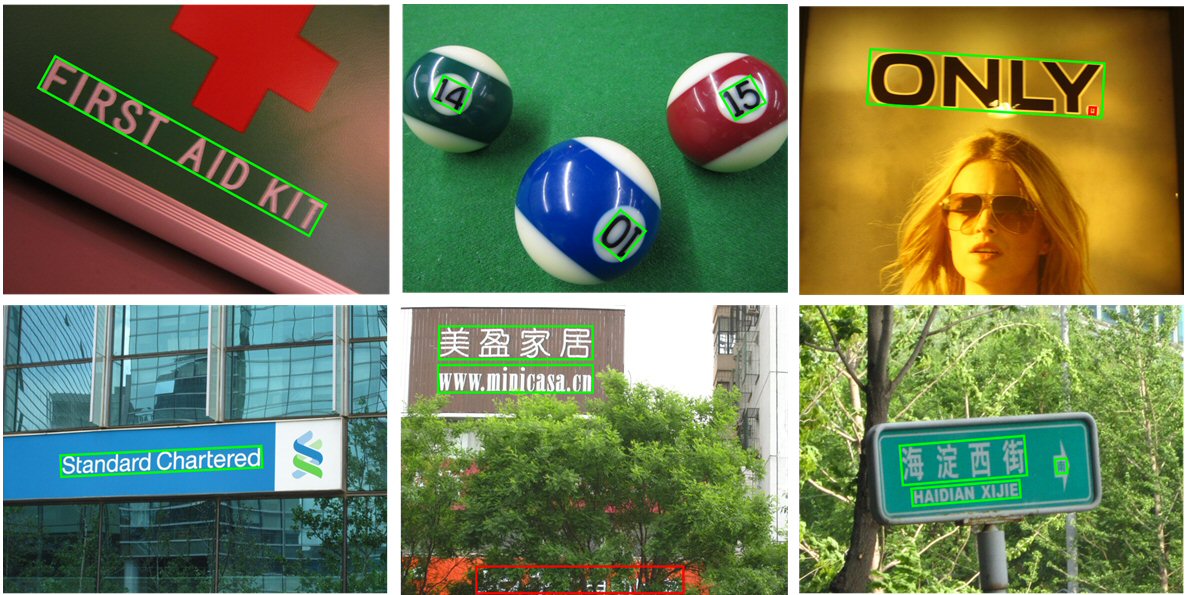
The MSRA-TD500 dataset is a text detection dataset that contains 300 training images and 200 test images. Text regions are arbitrarily orientated and annotated at sentence level. Different from the other datasets, it contains both English and Chinese text. Source: Detecting Text in the Wild with Deep Character Embedding Network Image Source: http://www.iapr-tc11.org/mediawiki/images/MSRA-TD500_Example.jpg
Swarm Heuristics based Adaptive and Penalized Estimation of Splines
SHAPES 설명 보기
SHAPES is a dataset of synthetic images designed to benchmark systems for understanding of spatial and logical relations among multiple objects. The dataset consists of complex questions about arrangements of colored shapes. The questions are built around compositions of concepts and relations, e.g. Is there a red shape above a circle? or Is a red shape blue?. Questions contain between two and four attributes, object types, or relationships. There are 244 questions and 15,616 images in total, with all questions having a yes and no answer (and corresponding supporting image). This eliminates the risk of learning biases. Each image is a 30×30 RGB image depicting a 3×3 grid of objects. Each object is characterized by shape (circle, square, triangle), colour (red, green, blue) and size (small, big). Source: Visual Question Answering: A Survey of Methods and Datasets Image Source: https://github.com/ronghanghu/n2nmn#train-and-evaluate-on-the-shapes-dataset
Konstanz Image Quality 10k Database
KonIQ-10k 설명 보기
KonIQ-10k is a large-scale IQA dataset consisting of 10,073 quality scored images. This is the first in-the-wild database aiming for ecological validity, with regard to the authenticity of distortions, the diversity of content, and quality-related indicators. Through the use of crowdsourcing, we obtained 1.2 million reliable quality ratings from 1,459 crowd workers, paving the way for more general IQA models.
Douban Conversation Corpus
Douban 설명 보기
We release Douban Conversation Corpus, comprising a training data set, a development set and a test set for retrieval based chatbot. The statistics of Douban Conversation Corpus are shown in the following table. | |Train|Val| Test | | ------------- |:-------------:|:-------------:|:-------------:| | session-response pairs | 1m|50k| 10k | | Avg. positive response per session | 1|1| 1.18 | | Fless Kappa | N\A|N\A|0.41 | | Min turn per session | 3|3| 3 | | Max ture per session | 98|91|45 | | Average turn per session | 6.69|6.75|5.95 | | Average Word per utterance | 18.56|18.50|20.74 | The test data contains 1000 dialogue context, and for each context we create 10 responses as candidates. We recruited three labelers to judge if a candidate is a proper response to the session. A proper response means the response can naturally reply to the message given the context. Each pair received three labels and the majority of the labels was taken as the final decision. <br> As far as we known, this is the first human-labeled test set for retrieval-based chatbots. The entire corpus link https://www.dropbox.com/s/90t0qtji9ow20ca/DoubanConversaionCorpus.zip?dl=0
Radboud Faces Database
RaFD 설명 보기
The Radboud Faces Database (RaFD) is a set of pictures of 67 models (both adult and children, males and females) displaying 8 emotional expressions. Source: http://www.socsci.ru.nl:8180/RaFD2/RaFD Image Source: http://www.socsci.ru.nl:8180/RaFD2/RaFD
Light Field Saliency Database
LFSD 설명 보기
The Light Field Saliency Database (LFSD) contains 100 light fields with 360×360 spatial resolution. A rough focal stack and an all-focus image are provided for each light field. The images in this dataset usually have one salient foreground object and a background with good color contrast. Source: Light Field Saliency Detection with Deep Convolutional Networks Image Source: https://sites.duke.edu/nianyi/publication/saliency-detection-on-light-field/
Oulu-CASIA NIR&VIS facial expression database
Oulu-CASIA 설명 보기
The Oulu-CASIA NIR&VIS facial expression database consists of six expressions (surprise, happiness, sadness, anger, fear and disgust) from 80 people between 23 and 58 years old. 73.8% of the subjects are males. The subjects were asked to sit on a chair in the observation room in a way that he/ she is in front of camera. Camera-face distance is about 60 cm. Subjects were asked to make a facial expression according to an expression example shown in picture sequences. The imaging hardware works at the rate of 25 frames per second and the image resolution is 320 × 240 pixels. Source: Facial expression recognition from near-infrared videos Image Source: https://arxiv.org/abs/1712.03474
Volleyball
Volleyball 설명 보기
Volleyball is a video action recognition dataset. It has 4830 annotated frames that were handpicked from 55 videos with 9 player action labels and 8 team activity labels. It contains group activity annotations as well as individual activity annotations. Source: https://github.com/mostafa-saad/deep-activity-rec#dataset Image Source: https://github.com/mostafa-saad/deep-activity-rec#dataset
Wikipedia-based Image Text
WIT 설명 보기
Wikipedia-based Image Text (WIT) Dataset is a large multimodal multilingual dataset. WIT is composed of a curated set of 37.6 million entity rich image-text examples with 11.5 million unique images across 108 Wikipedia languages. Its size enables WIT to be used as a pretraining dataset for multimodal machine learning models. Key Advantages A few unique advantages of WIT: - The largest multimodal dataset (time of this writing) by the number of image-text examples. - A massively multilingual (first of its kind) with coverage for over 100+ languages. - A collection of diverse set of concepts and real world entities. - Brings forth challenging real-world test sets.
extension to the EventCorefBank
ECB+ 설명 보기
The ECB+ corpus is an extension to the EventCorefBank (ECB, Bejan and Harabagiu, 2010). A newly added corpus component consists of 502 documents that belong to the 43 topics of the ECB but that describe different seminal events than those already captured in the ECB. All corpus texts were found through Google Search and were annotated with mentions of events and their times, locations, human and non-human participants as well as with within- and cross-document event and entity coreference information. The 2012 version of annotation of the ECB corpus (Lee et al., 2012) was used as a starting point for re-annotation of the ECB according to the ECB+ annotation guideline. The major differences with respect to the 2012 version of annotation of the ECB are: (a) five event components are annotated in text: actions (annotation tags starting with ACTION and NEG) times (annotation tags starting with TIME) locations (annotation tags starting with LOC) human participants (annotation tags starting with HUMAN) non-human participants (annotation tags starting with NON_HUMAN) (b) specific action classes and entity subtypes are distinguished for each of the five main event components resulting in a total tagset of 30 annotation tags based on ACE annotation guidelines (LDC 2008), TimeML (Pustejovsky et al., 2003 and Sauri et al., 2005) (c) intra- and cross-document coreference relations between mentions of the five event components were established: INTRA_DOC_COREF tag captures within document coreference chains that do not participate in cross-document relations; within document coreference was annotated by means of the CAT tool (Bartalesi et al., 2012) CROSS_DOC_COREF tag indicates cross-document coreference relations created in the CROMER tool (Girardi et al., 2014); all coreference branches refer by means of relation target IDs to the so called TAG_DESCRIPTORS, pointing to human friendly instance names (assigned by coders) and also to instance_id-s (d) events are annotated from an “event-centric” perspective, i.e. annotation tags are assigned depending on the role a mention plays in an event (for more information see ECB+ references).
BABEL
BABEL 설명 보기
BABEL is a large dataset with language labels describing the actions being performed in mocap sequences. BABEL consists of action labels for about 43 hours of mocap sequences from AMASS. Action labels are at two levels of abstraction -- sequence labels describe the overall action in the sequence, and frame labels describe all actions in every frame of the sequence. Each frame label is precisely aligned with the duration of the corresponding action in the mocap sequence, and multiple actions can overlap. There are over 28k sequence labels, and 63k frame labels in BABEL, which belong to over 250 unique action categories. Labels from BABEL can be leveraged for tasks like action recognition, temporal action localization, motion synthesis, etc.
Bank Marketing
Bank Marketing 설명 보기
The data is related with direct marketing campaigns (phone calls) of a Portuguese banking institution. The classification goal is to predict if the client will subscribe a term deposit (variable y).
Dongguk Body-based Person Recognition Database (DBPerson-Recog-DB1)
RegDB 설명 보기
RegDB is used for Visible-Infrared Re-ID which handles the cross-modality matching between the daytime visible and night-time infrared images. The dataset contains images of 412 people. It includes 10 color and 10 thermal images for each person. Source: Person Recognition System Based on a Combination of Body Images from Visible Light and Thermal Cameras
LIVE Video Quality Challenge (VQC) Database
LIVE-VQC 설명 보기
The great variations of videographic skills in videography, camera designs, compression and processing protocols, communication and bandwidth environments, and displays leads to an enormous variety of video impairments. Current no-reference (NR) video quality models are unable to handle this diversity of distortions. This is true in part because available video quality assessment databases contain very limited content, fixed resolutions, were captured using a small number of camera devices by a few videographers and have been subjected to a modest number of distortions. As such, these databases fail to adequately represent real world videos, which contain very different kinds of content obtained under highly diverse imaging conditions and are subject to authentic, complex and often commingled distortions that are difficult or impossible to simulate. As a result, NR video quality predictors tested on real-world video data often perform poorly. Towards advancing NR video quality prediction, we have constructed a large-scale video quality assessment database containing 585 videos of unique content , captured using 101 different devices (43 device models) by 80 different users with wide ranges of levels of complex, authentic distortions. We collected a large number of subjective video quality scores via crowdsourcing. A total of 4776 unique participants took part in the study, yielding more than 205000 opinion scores , resulting in an average of 240 recorded human opinions per video . This study is the largest video quality assessment study ever conducted along several key dimensions: number of unique contents, capture devices, distortion types and combinations of distortions, study participants, and recorded subjective scores.
Compositional Freebase Questions
CFQ 설명 보기
A large and realistic natural language question answering dataset. Source: Measuring Compositional Generalization: A Comprehensive Method on Realistic Data
MMI Facial Expression Database
MMI 설명 보기
The MMI Facial Expression Database consists of over 2900 videos and high-resolution still images of 75 subjects. It is fully annotated for the presence of AUs in videos (event coding), and partially coded on frame-level, indicating for each frame whether an AU is in either the neutral, onset, apex or offset phase. A small part was annotated for audio-visual laughters. Source: https://mmifacedb.eu/ Image Source: https://mmifacedb.eu/
Emotional Speech Database
ESD 설명 보기
ESD is an Emotional Speech Database for voice conversion research. The ESD database consists of 350 parallel utterances spoken by 10 native English and 10 native Chinese speakers and covers 5 emotion categories (neutral, happy, angry, sad and surprise). More than 29 hours of speech data were recorded in a controlled acoustic environment. The database is suitable for multi-speaker and cross-lingual emotional voice conversion studies.
Materials in Context Database
MINC 설명 보기
MINC is a large-scale, open dataset of materials in the wild. Source: Material Recognition in the Wild with the Materials in Context Database Image Source: Bell et al
Bamboogle
Bamboogle 설명 보기
The Bamboogle dataset is a collection of questions that was constructed to investigate the ability of language models to perform compositional reasoning tasks. The dataset is made up of questions that Google answers incorrectly. It covers many different types of questions on various areas, written in unique ways.
Probably Asked Questions
PAQ 설명 보기
Probably Asked Questions (PAQ) is a very large resource of 65M automatically-generated QA-pairs. PAQ is a semi-structured Knowledge Base (KB) of 65M natural language QA-pairs, which models can memorise and/or learn to retrieve from. PAQ differs from traditional KBs in that questions and answers are stored in natural language, and that questions are generated such that they are likely to appear in ODQA datasets. PAQ is automatically constructed using a question generation model and Wikipedia. Source: Lewis et al. Image source: Lewis et al.
Noisy speech database for training speech enhancement algorithms and TTS models
VoiceBank + DEMAND 설명 보기
VoiceBank+DEMAND is a noisy speech database for training speech enhancement algorithms and TTS models. The database was designed to train and test speech enhancement methods that operate at 48kHz. A more detailed description can be found in the paper associated with the database. Some of the noises were obtained from the Demand database, available here: http://parole.loria.fr/DEMAND/ . The speech database was obtained from the Voice Banking Corpus, available here: http://homepages.inf.ed.ac.uk/jyamagis/release/VCTK-Corpus.tar.gz .
EntailmentBank
EntailmentBank 설명 보기
EntailmentBank is a dataset that contains multistep entailment trees. At each node in the tree (typically) two or more facts compose together to produce a new conclusion. Given a hypothesis (question + answer), three increasingly difficult explanation tasks are defined: generate a valid entailment tree given (a) all relevant sentences (the leaves of the gold entailment tree) (b) all relevant and some irrelevant sentences (c) a corpus.
NomBank
NomBank 설명 보기
NomBank is an annotation project at New York University that is related to the PropBank project at the University of Colorado. The goal is to mark the sets of arguments that cooccur with nouns in the PropBank Corpus (the Wall Street Journal Corpus of the Penn Treebank), just as PropBank records such information for verbs. As a side effect of the annotation process, the authors are producing a number of other resources including various dictionaries, as well as PropBank style lexical entries called frame files. These resources help the user label the various arguments and adjuncts of the head nouns with roles (sets of argument labels for each sense of each noun). NYU and U of Colorado are making a coordinated effort to insure that, when possible, role definitions are consistent across parts of speech. For example, PropBank's frame file for the verb "decide" was used in the annotation of the noun "decision". Source: Nombank Image Source: https://nlp.cs.nyu.edu/meyers/NomBank.html
BA-2motifs
BA-2motifs 설명 보기
It's a synthetic dataset, which contains 1000 graphs divided into two classes according to the motif they contain: either a “house” or a five-node cycle.
Standford Background Dataset
Stanford Background 설명 보기
The Stanford Background dataset contains 715 RGB images and the corresponding label images. Images are approximately 240×320 pixels in size and pixels are classified into eight different categories Source: Unsupervised Total Variation Loss for Semi-supervised Deep Learning of Semantic Segmentation Image Source: http://dags.stanford.edu/projects/scenedataset.html
Real Scenario Text-based Person Re-identification
RSTPReid 설명 보기
RSTPReid contains 20505 images of 4,101 persons from 15 cameras. Each person has 5 corresponding images taken by different cameras with complex both indoor and outdoor scene transformations and backgrounds in various periods of time, which makes RSTPReid much more challenging and more adaptable to real scenarios. Each image is annotated with 2 textual descriptions. For data division, 3701 (index < 18505), 200 (18505 <= index < 19505) and 200 (index >= 19505) identities are utilized for training, validation and testing, respectively (Marked by item 'split' in the JSON file). Each sentence is no shorter than 23 words.
Real World Computing Music Database
RWC 설명 보기
The RWC (Real World Computing) Music Database is a copyright-cleared music database (DB) that is available to researchers as a common foundation for research. It contains around 100 complete songs with manually labeled section boundaries. For the 50 instruments, individual sounds at half-tone intervals were captured with several variations of playing styles, dynamics, instrument manufacturers and musicians. Source: https://staff.aist.go.jp/m.goto/RWC-MDB/ Image Source: http://www.cs.tut.fi/sgn/arg/matti/demos/basstrans/
English Web Treebank
English Web Treebank 설명 보기
English Web Treebank is a dataset containing 254,830 word-level tokens and 16,624 sentence-level tokens of webtext in 1174 files annotated for sentence- and word-level tokenization, part-of-speech, and syntactic structure. The data is roughly evenly divided across five genres: weblogs, newsgroups, email, reviews, and question-answers. The files were manually annotated following the sentence-level tokenization guidelines for web text and the word-level tokenization guidelines developed for English treebanks in the DARPA GALE project. Only text from the subject line and message body of posts, articles, messages and question-answers were collected and annotated. Source: https://catalog.ldc.upenn.edu/LDC2012T13
Query-based Video Highlights
QVHighlights 설명 보기
The Query-based Video Highlights (QVHighlights) dataset is a dataset for detecting customized moments and highlights from videos given natural language (NL). It consists of over 10,000 YouTube videos, covering a wide range of topics, from everyday activities and travel in lifestyle vlog videos to social and political activities in news videos. Each video in the dataset is annotated with: (1) a human-written free-form NL query, (2) relevant moments in the video w.r.t. the query, and (3) five-point scale saliency scores for all query-relevant clips.
Tatoeba
Tatoeba 설명 보기
Tatoeba is a free collection of example sentences with translations geared towards foreign language learners. It is available in more than 400 languages. Its name comes from the Japanese phrase “tatoeba” (例えば), meaning “for example”. It is written and maintained by a community of volunteers through a model of open collaboration. Individual contributors are known as Tatoebans.
DocBank
DocBank 설명 보기
A benchmark dataset that contains 500K document pages with fine-grained token-level annotations for document layout analysis. DocBank is constructed using a simple yet effective way with weak supervision from the \LaTeX{} documents available on the arXiv.com. Source: DocBank: A Benchmark Dataset for Document Layout Analysis