Papers with Code 아카이브

Question Answering

태스크의 하위 분류와 논문·코드·평가·기법·데이터셋을 탐색하세요.

하위 태스크
19
평가표
153
보존된 평가 기록
1,781

Question answering can be segmented into domain-specific tasks like community question answering and knowledge-base question answering. Popular benchmark datasets for evaluation question answering systems include SQuAD, HotPotQA, bAbI, TriviaQA, WikiQA, and many others. Models for question answering are typically evaluated on metrics like EM and F1. Some recent top performing models are T5 and XLNet.

( Image credit: SQuAD )

데이터셋

출처에 같은 태스크 이름으로 연결된 데이터셋입니다. 동명 태스크가 포함될 수 있으므로, 비교할 때는 평가 결과의 조건도 확인하세요.

XorQA-IN:

Given a question in an Indic language and a passage in English, generate a short answer span. We provide both an English and target language answer span in the annotations.

XQuAD-IN

Given a question and passage in an Indic language, generate a short answer span from the passage as the answer.

60k Stack Overflow Questions

The dataset contains 60,000 Stack Overflow questions from 2016-2020, classified into three categories: 1. HQ: High-quality posts without a single edit. 2. LQ_EDIT: Low-quality posts with a negative score, and multiple community edits. However, they still remain open after those changes. 3. LQ_CLOSE: Low-quality posts that were closed by the community without a single edit. ## Notes - Questions are sorted according to Question Id. - Question body is in HTML format. - All dates are in UTC format. - The dataset is also accessible at https://www.kaggle.com/imoore/60k-stack-overflow-questions-with-quality-rate ## How to cite This is an original dataset, published under MIT License. Please cite the dataset for your usage as the following: @article{annamoradnejad2022multiview, title={Multi-View Approach to Suggest Moderation Actions in Community Question Answering Sites}, author={Annamoradnejad, Issa and Habibi, Jafar and Fazli, Mohammadamin}, journal = {Information Sciences}, volume = {600}, pages = {144-154}, year = {2022}, issn = {0020-0255}, doi = {https://doi.org/10.1016/j.ins.2022.03.085}, url = {https://www.sciencedirect.com/science/article/pii/S0020025522003127} }

ACCESS DENIED INC

A benchmark environment based on the datasets "Adult" and "Names", which allows researchers to test how well their language model can abide by pre-defined access rights rules. Researchers can either directly use the datasets we generated for our ACL 2025 Findings paper or generate their own custom dataset.

ACCORD CSQA 0-5

ACCORD CSQA is an extension of the popular CommonsenseQA (CSQA) dataset using ACCORD, a scalable framework for disentangling the commonsense grounding and reasoning abilities of large language models (LLMs) through controlled, multi-hop counterfactuals. ACCORD closes the measurability gap between commonsense and formal reasoning tasks for LLMs. A detailed understanding of LLMs' commonsense reasoning abilities is severely lagging compared to our understanding of their formal reasoning abilities, since commonsense benchmarks are difficult to construct in a manner that is rigorously quantifiable. Specifically, prior commonsense reasoning benchmarks and datasets are limited to one- or two-hop reasoning or include an unknown (i.e., non-measurable) number of reasoning hops and/or distractors. Arbitrary scalability via compositional construction is also typical of formal reasoning tasks but lacking in commonsense reasoning. Finally, most prior commonsense benchmarks either are limited to a single reasoning skill or do not control skills. ACCORD aims to address all these gaps by introducing formal elements to commonsense reasoning to explicitly control and quantify reasoning complexity beyond the typical 1 or 2 reasoning hops. Uniquely, ACCORD can automatically generate benchmarks of arbitrary reasoning complexity, and so it scales with future LLM improvements. ACCORD CSQA is a benchmark suite comprising problem with 6 levels of reasoning difficulty, ACCORD CSQA 0 to ACCORD CSQA 5. Experiments on state-of-the-art LLMs show performance degrading to random chance with only moderate scaling, leaving substantial headroom for improvement.

Alpaca Data Galician

Click to add a brief description of the dataset (Markdown and LaTeX enabled). Provide: * a high-level explanation of the dataset characteristics * explain motivations and summary of its content * potential use cases of the dataset

AviationQA

AviationQA is introduced in the paper titled- There is No Big Brother or Small Brother: Knowledge Infusion in Language Models for Link Prediction and Question Answering The paper is accepted in the main conference of ICON 2022. We create a synthetic dataset, AviationQA, a set of 1 million factoid QA pairs from 12,000 National Transportation Safety Board (NTSB) reports using templates. These QA pairs contain questions such that answers to them are entities occurring in the AviationKG (Agarwal et al., 2022). AviationQA will be helpful to researchers in finding insights into aircraft accidents and their prevention. Examples from dataset: 1. What was the Aircraft Damage of the accident no. ERA22LA162? Answer: Substantial 2. Where was the Destination of the accident no. ERA22LA162?, Answer: Naples, GA (APH)

BDD-QA

BDD-QA is distinguished by its encompassing range of traffic actions, crafted to rigorously evaluate a model's decision-making abilities in traffic scenario. This makes it a potent tool for high-level decision-making research within traffic contexts, including autonomous driving developments.

BioFuelQR

BioFuelQR is a dataset consisting of complex reasoning questions related to catalyst discovery in biofuels. This dataset is aimed at benchmarking scientific question answering methods, particularly for search based text generation.

catbAbI LM-mode

We aim to improve the bAbI benchmark as a means of developing intelligent dialogue agents. To this end, we propose concatenated-bAbI (catbAbI): an infinite sequence of bAbI stories. catbAbI is generated from the bAbI dataset and during training, a random sample/story from any task is drawn without replacement and concatenated to the ongoing story. The preprocessig for catbAbI addresses several issues: it removes the supporting facts, leaves the questions embedded in the story, inserts the correct answer after the question mark, and tokenises the full sample into a single sequence of words. As such, catbAbI is designed to be trained in an autoregressive way and analogous to closed-book question answering. catbAbI models can be trained in two different ways: language modelling mode (LM-mode) or question-answering mode (QA-mode). In LM-mode, the catbAbI models are trained like autoregressive word-level language models. In QA-mode, the catbAbI models are only trained to predict the tokens that are answers to questions—making it more similar to regular bAbI. QA-mode is simply implemented by masking out losses on non-answer predictions. In both training modes, the model performance is solely measured by its accuracy and perplexity when answering the questions.

catbAbI QA-mode

We aim to improve the bAbI benchmark as a means of developing intelligent dialogue agents. To this end, we propose concatenated-bAbI (catbAbI): an infinite sequence of bAbI stories. catbAbI is generated from the bAbI dataset and during training, a random sample/story from any task is drawn without replacement and concatenated to the ongoing story. The preprocessig for catbAbI addresses several issues: it removes the supporting facts, leaves the questions embedded in the story, inserts the correct answer after the question mark, and tokenises the full sample into a single sequence of words. As such, catbAbI is designed to be trained in an autoregressive way and analogous to closed-book question answering. catbAbI models can be trained in two different ways: language modelling mode (LM-mode) or question-answering mode (QA-mode). In LM-mode, the catbAbI models are trained like autoregressive word-level language models. In QA-mode, the catbAbI models are only trained to predict the tokens that are answers to questions—making it more similar to regular bAbI. QA-mode is simply implemented by masking out losses on non-answer predictions. In both training modes, the model performance is solely measured by its accuracy and perplexity when answering the questions.

CC-Riddle

CC-Riddle is a Chinese character riddle dataset covering the majority of common simplified Chinese characters by crawling riddles from the Web and generating brand new ones. In the generation stage, the authors provide the Chinese phonetic alphabet, decomposition and explanation of the solution character for the generation model and get multiple riddle descriptions for each tested character. Then the generated riddles are manually filtered and the final dataset, CCRiddle is composed of both human-written riddles and filtered generated riddle. Source: CC-Riddle: A Question Answering Dataset of Chinese Character Riddles Image Source: https://arxiv.org/pdf/2206.13778v1.pdf

ChAII - Hindi and Tamil Question Answering

The dataset covers Hindi and Tamil, collected without the use of translation. It provides a realistic information-seeking task with questions written by native-speaking expert data annotators.

ChiQA

ChiQA is a dataset designed for visual question answering tasks that not only measures the relatedness but also measures the answerability, which demands more fine-grained vision and language reasoning. It contains more than 40K questions and more than 200K question-images pairs. The questions are real-world image-independent queries that are more various and unbiased.

CinePile: A Long Video Question Answering Dataset and Benchmark

CinePile is a question-answering-based, long-form video understanding dataset. It has been created using advanced large language models (LLMs) with human-in-the-loop pipeline leveraging existing human-generated raw data. It consists of approximately 300,000 training data points and 5,000 test data points.

CompMix-IR

CompMix-IR Dataset Overview: Characteristics: CompMix-IR is a heterogeneous knowledge retrieval benchmark dataset, featuring four knowledge types (text, knowledge graphs, tables, and infoboxes), 9,400+ QA pairs, and a corpus of 10 million entries. It supports two retrieval scenarios: retrieving across all knowledge types or retrieving specific types based on user instructions. Motivation: It addresses the limitations of existing benchmarks by providing a more comprehensive and realistic dataset that reflects real-world retrieval needs with diverse knowledge sources and user intents. Potential Use Cases: Ideal for developing and evaluating heterogeneous IR models, instruction-aware retrieval systems, and open-domain QA systems. It can also be used for benchmarking, cross-domain IR research, and enhancing the adaptability and robustness of retrieval models.

COPA-HR

The COPA-HR dataset (Choice of plausible alternatives in Croatian) is a translation of the English COPA dataset by following the XCOPA dataset translation methodology. The dataset consists of 1000 premises (My body cast a shadow over the grass), each given a question (What is the cause?), and two choices (The sun was rising; The grass was cut), with a label encoding which of the choices is more plausible given the annotator or translator (The sun was rising). Source: Choice of plausible alternatives dataset in Croatian COPA-HR

CRSB

The Official dataset proposed int the paper Context Awareness Gate For Retrieval Augmented Generation

CUHK-QA

CUHK-QA is a dataset for natural language-based person search using iterative questioning. The dataset consists of 400 images of 360 people, and 20 participants answered 5 specific questions about the appearance of each person. So, each person has labelled 20 images. Average length of combined description for each image is 39.15. All the images have been taken from the test set of CUHK-PEDES dataset. Source: Interactive Natural Language-based Person Search

DARai

Daily Activity Recordings for Artificial Intelligence (DARai, pronounced "Dahr-ree") is a multimodal, hierarchically annotated dataset constructed to understand human activities in real-world settings. DARai consists of continuous scripted and unscripted recordings of 50 participants in 10 different environments, totaling over 200 hours of data from 20 sensors including multiple camera views, depth and radar sensors, wearable inertial measurement units (IMUs), electromyography (EMG), insole pressure sensors, biomonitor sensors, and gaze tracker. To capture the complexity in human activities, DARai is annotated at three levels of hierarchy: (i) high-level activities (L1) that are independent tasks, (ii) lower-level actions (L2) that are patterns shared between activities, and (iii) fine-grained procedures (L3) that detail the exact execution steps for actions. The dataset annotations and recordings are designed so that 22.7% of L2 actions are shared between L1 activities and 14.2% of L3 procedures are shared between L2 actions. The overlap and unscripted nature of DARai allows counterfactual activities in the dataset. Experiments with various machine learning models showcase the value of DARai in uncovering important challenges in human-centered applications. Specifically, we conduct unimodal and multimodal sensor fusion experiments for recognition, temporal localization, and future action anticipation across all hierarchical annotation levels. To highlight the limitations of individual sensors, we also conduct domain-variant experiments that are enabled by DARai's multi-sensor and counterfactual activity design setup. The code, documentation, and dataset are available at the dedicated DARai website.
DART-Math-Uniform

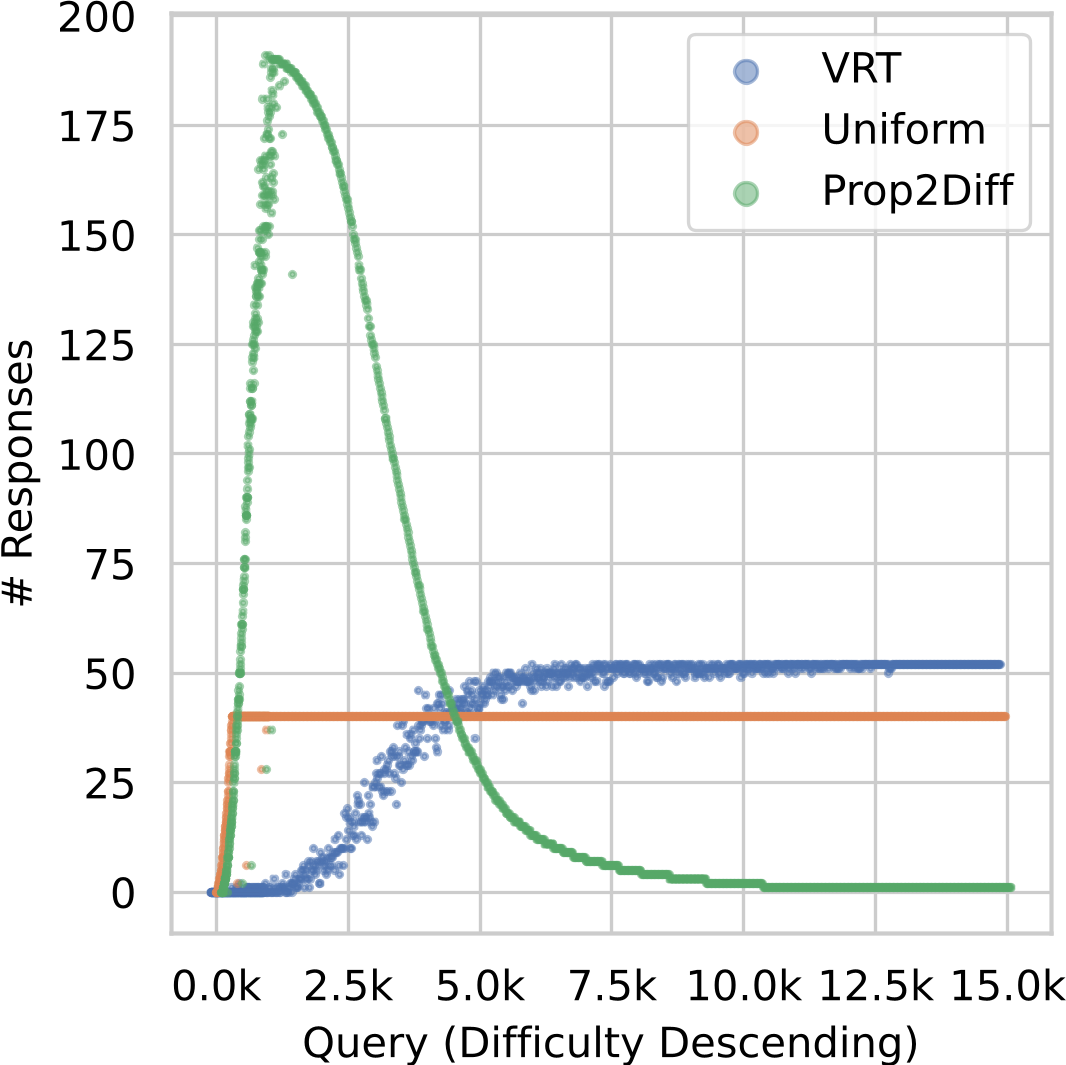
🎯 DART-Math > Difficulty-Aware Rejection Tuning for Mathematical Problem-Solving 📝 Paper@arXiv | 🤗 Datasets&Models@HF | 🐱 Code@GitHub 🐦 Thread@X(Twitter) | 🐶 中文博客@知乎 | 📊 Leaderboard@PapersWithCode | 📑 BibTeX ## Datasets: DART-Math DART-Math datasets are the state-of-the-art and data-efficient open-source instruction tuning datasets for mathematical reasoning. DART-Math-Hard contains ~585k mathematical QA pair samples constructed by applying DARS-Prop2Diff to the query set from MATH and GSK8K training sets, achieves SOTA on many challenging mathematical reasoning benchmarks. It introduces a deliberate bias towards hard queries, opposite to vanilla rejection sampling. Performance produced by DART-Math-Hard is usually but not necessarily slightly better (~1% absolutely) than DART-Math-Uniform, which contains ~591k samples constructed by applying DARS-Uniform. ### Comparison between Mathematical Instruction Tuning Datasets Most of previous datasets are constructed with ChatGPT, and many of them are not open-source, especially for ones of the best performance. | Math SFT Dataset | # of Samples | MATH | GSM8K | College | Synthesis Agent(s) | Open-Source | | :--------------------------------------------------------------------------------- | -----------: | -----------------------------------------------------------------: | ---------------------------------------------: | -----------------------------------------------------------------------------------------------------------: | :---------------------- | :-------------------------------------------------------------------------: | | WizardMath | 96k | 32.3 | 80.4 | 23.1 | GPT-4 | ✗ | | MetaMathQA | 395k | 29.8 | 76.5 | 19.3 | GPT-3.5 | ✓ | | MMIQC | 2294k | 37.4 | 75.4 | 28.5 | GPT-4+GPT-3.5+Human | ✓ | | Orca-Math | 200k | -- | -- | -- | GPT-4 | ✓ | | Xwin-Math-V1.1 | 1440k | 45.5 | 84.9 | 27.6 | GPT-4 | ✗ | | KPMath-Plus | 1576k | 46.8 | 82.1 | -– | GPT-4 | ✗ | | MathScaleQA | 2021k | 35.2 | 74.8 | 21.8 | GPT-3.5+Human | ✗ | | DART-Math-Uniform | 591k | 43.5 | 82.6 | 26.9 | DeepSeekMath-7B-RL | ✓ | | DART-Math-Hard | 585k | 45.5 | 81.1 | 29.4 | DeepSeekMath-7B-RL | ✓ | <sup>MATH and GSM8K are in-domain, while College(Math) is out-of-domain. Performance here are of models fine-tuned from Mistral-7B, except for Xwin-Math-V1.1 based on Llama2-7B. Bold/Italic means the best/second best score here.</sup> ## Dataset Construction: DARS - Difficulty-Aware Rejection Sampling Previous works usually synthesize data from proprietary models to augment existing datasets, followed by instruction tuning to achieve top-tier results. However, our analysis of these datasets reveals severe biases towards easy queries, with frequent failures to generate any correct response for the most challenging queries. Motivated by the observation above, we propose to Difficulty-Aware Rejection Sampling (DARS), to collect more responses for more difficult queries. Specifically, we introduce two strategies to increase the number of correct responses for difficult queries: 1) Uniform, which involves sampling responses for each query until each query accumulates $k_u$ correct responses, where $k_u$ is a preset hyperparameter determined by the desired size of the synthetic dataset; 2) Prop2Diff, where we continue sampling responses until the number of correct responses for each query is proportional to its difficulty score. The most challenging queries will receive $k_p$ responses and kp is a hyperparameter. This method introduces a deliberate bias in the opposite direction to vanilla rejection sampling, towards more difficult queries, inspired by previous works that demonstrate difficult samples can be more effective to enhance model capabilities (Sorscher et al., 2022; Liu et al., 2024b). See Figure 1 (Right) for examples of DART-Math-Uniform by DARS-Uniform and DART-Math-Hard by DARS-Prop2Diff. ## Citation If you find our data, model or code useful for your work, please kindly cite our paper: latex @article{tong2024dartmath, title={DART-Math: Difficulty-Aware Rejection Tuning for Mathematical Problem-Solving}, author={Yuxuan Tong and Xiwen Zhang and Rui Wang and Ruidong Wu and Junxian He}, year={2024}, eprint={2407.13690}, archivePrefix={arXiv}, primaryClass={cs.CL}, url={https://arxiv.org/abs/2407.13690}, }

diaforge-utc-r-0725

Dataset for our paper Disambiguation-Centric Finetuning Makes Enterprise Tool-Calling LLMs More Realistic and Less Risky which includes 5000 enterprise tools and the corresponding dialogues generated using DiaFORGE UTC data engine. The dataset is generated with the data generation engine. The engine simulates a user agent and an assistant agent in a dialogue, where the user agent has a persona and the assistant agent has access to a set of tools. Detailed information about the data generation process can be found in the paper. Each entry in the dataset contains: - seed: Gold tool for the generated dialogue. - user_persona: Persona of the simulated user agent. - messages: List of messages in the dialogue, where each message is a dictionary containing: - distractor_tools: List of distractor tools that are not the gold tool but are relevant to the dialogue. These tools are used by user agent to generate utterances that are hard to disambiguate from the gold tool. - retrieved_tools: List of tools retrieved by the assistant agent and used by the assistant agent in order to ask clarifying questions to the user agent.

DynToM

As Large Language Models (LLMs) increasingly participate in human-AI interactions, evaluating their Theory of Mind (ToM) capabilities - particularly their ability to track dynamic mental states - becomes crucial. While existing benchmarks assess basic ToM abilities, they predominantly focus on static snapshots of mental states, overlooking the temporal evolution that characterizes real-world social interactions. We present DynToM, a novel benchmark specifically designed to evaluate LLMs' ability to understand and track the temporal progression of mental states across interconnected scenarios. Through a systematic four-step framework, we generate 1,100 social contexts encompassing 5,500 scenarios and 78,100 questions, each validated for realism and quality. Our comprehensive evaluation of ten state-of-the-art LLMs reveals that their average performance underperforms humans by 44.7%, with performance degrading significantly when tracking and reasoning about the shift of mental states. This performance gap highlights fundamental limitations in current LLMs' ability to model the dynamic nature of human mental states.

Educational Grade School Math (EGSM)

Educational Grade School Math (EGSM) contains 2,093 question/answer pairs generated by MATHWELL, a reference-free educational grade school math word problem generator that outputs a word problem and Program of Thought (PoT) solution based solely on an optional student interest, as introduced in MATHWELL: Generating Educational Math Word Problems Using Teacher Annotations. The question/answer pairs are verified by human experts. EGSM is the first teacher-annotated math word problem training dataset for LLMs. EGSM is designed to train reference-free educational grade school math word problem generators, but can also be used to train math QA models. Please refer to our paper for more information on the dataset.

EpiK-Eval

Benchmark to evaluate the capability of LMs to consolidate and recall information from multiple training documents.

Event-QA

Contains 1000 semantic queries and the corresponding English, German and Portuguese verbalizations for EventKG - an event-centric knowledge graph with more than 970 thousand events. Source: Event-QA: A Dataset for Event-Centric Question Answering over Knowledge Graphs

Financial Language Understanding Evaluation

Financial Language Understanding Evaluation is an open-source comprehensive suite of benchmarks for the financial domain. It contains benchmarks across 5 NLP tasks in financial domain as well as common benchmarks used in the previous research. The tasks are financial sentiment analysis, news headline classification, named entity recognition, structure boundary detection and question answering.

GeoQuestions1089

GeoQuestions1089 is a crowdsourced geospatial question-answering dataset that targets the Knowledge Graph YAGO2geo. It contains 1089 triples of geospatial questions, their answers, and the respective SPARQL/GeoSPARQL queries. It has been used to benchmark two state of the art Question Answering engines, GeoQA2 and the engine of Hamzei et al.

ILSP Greek Evaluation Suite

A collection of test sets for evaluating base and chat LLMs (incl. VLMs) on Greek generation and understanding capabilities.

JustLogic

JustLogic is a natural language deductive reasoning dataset. JustLogic is (i) highly complex, capable of generating a diverse range of linguistic patterns, vocabulary, and argument structures; (ii) prior knowledge independent, eliminating the advantage of models possessing prior knowledge and ensuring that only deductive reasoning is used to answer questions; and (iii) capable of in-depth error analysis on the heterogeneous effects of reasoning depth and argument form on model accuracy.

LitMind Dictionary

An open-source online generative dictionary that takes a word and context containing the word as input and automatically generates a definition as output. Incorporating state-of-the-art definition generation models, it supports not only Chinese and English, but also Chinese-English cross-lingual queries. Moreover, it has a user-friendly front-end design that can help users understand the query words quickly and easily.

MapEval

MapEval contains 700 question-answer pairs.

MapEval-API

MapEval-Textual contains 300 question-answer pairs. The task is to answer question by fetching necessary informations using external Map APIs.

출처: Papers with Code · CC BY-SA 4.0. 아카이브 자료와 새로 수집한 논문은 별도로 관리합니다.