Papers with Code 아카이브

10-shot image generation

태스크의 하위 분류와 논문·코드·평가·기법·데이터셋을 탐색하세요.

하위 태스크
21
평가표
6
보존된 평가 기록
12

Generate 10 image of famous arts

데이터셋

출처에 같은 태스크 이름으로 연결된 데이터셋입니다. 동명 태스크가 포함될 수 있으므로, 비교할 때는 평가 결과의 조건도 확인하세요.

Conceptual Captions

Automatic image captioning is the task of producing a natural-language utterance (usually a sentence) that correctly reflects the visual content of an image. Up to this point, the resource most used for this task was the MS-COCO dataset, containing around 120,000 images and 5-way image-caption annotations (produced by paid annotators). Google's Conceptual Captions dataset has more than 3 million images, paired with natural-language captions. In contrast with the curated style of the MS-COCO images, Conceptual Captions images and their raw descriptions are harvested from the web, and therefore represent a wider variety of styles. The raw descriptions are harvested from the Alt-text HTML attribute associated with web images. The authors developed an automatic pipeline that extracts, filters, and transforms candidate image/caption pairs, with the goal of achieving a balance of cleanliness, informativeness, fluency, and learnability of the resulting captions. Source: Conceptual Captions Image Source: Sharma et al
COCO-Stuff

The Common Objects in COntext-stuff (COCO-stuff) dataset is a dataset for scene understanding tasks like semantic segmentation, object detection and image captioning. It is constructed by annotating the original COCO dataset, which originally annotated things while neglecting stuff annotations. There are 164k images in COCO-stuff dataset that span over 172 categories including 80 things, 91 stuff, and 1 unlabeled class. Source: Image Colorization: A Survey and Dataset Image Source: https://github.com/nightrome/cocostuff

PASCAL Context

The PASCAL Context dataset is an extension of the PASCAL VOC 2010 detection challenge, and it contains pixel-wise labels for all training images. It contains more than 400 classes (including the original 20 classes plus backgrounds from PASCAL VOC segmentation), divided into three categories (objects, stuff, and hybrids). Many of the object categories of this dataset are too sparse and; therefore, a subset of 59 frequent classes are usually selected for use. Source: Image Segmentation Using Deep Learning:A Survey Image Source: https://cs.stanford.edu/~roozbeh/pascal-context/

Manga109

Manga109 has been compiled by the Aizawa Yamasaki Matsui Laboratory, Department of Information and Communication Engineering, the Graduate School of Information Science and Technology, the University of Tokyo. The compilation is intended for use in academic research on the media processing of Japanese manga. Manga109 is composed of 109 manga volumes drawn by professional manga artists in Japan. These manga were commercially made available to the public between the 1970s and 2010s, and encompass a wide range of target readerships and genres (see the table in Explore for further details.) Most of the manga in the compilation are available at the manga library “Manga Library Z” (formerly the “Zeppan Manga Toshokan” library of out-of-print manga). Source: Manga109 Image Source: https://arxiv.org/pdf/1510.04389v1.pdf

BSDS500

Berkeley Segmentation Data Set 500 (BSDS500) is a standard benchmark for contour detection. This dataset is designed for evaluating natural edge detection that includes not only object contours but also object interior boundaries and background boundaries. It includes 500 natural images with carefully annotated boundaries collected from multiple users. The dataset is divided into three parts: 200 for training, 100 for validation and the rest 200 for test. Source: Object Contour Detection with a Fully Convolutional Encoder-Decoder Network Image Source: https://www2.eecs.berkeley.edu/Research/Projects/CS/vision/grouping/resources.html

ActivityNet Captions

The ActivityNet Captions dataset is built on ActivityNet v1.3 which includes 20k YouTube untrimmed videos with 100k caption annotations. The videos are 120 seconds long on average. Most of the videos contain over 3 annotated events with corresponding start/end time and human-written sentences, which contain 13.5 words on average. The number of videos in train/validation/test split is 10024/4926/5044, respectively. Source: Bidirectional Attentive Fusion with Context Gating for Dense Video Captioning Image Source: https://cs.stanford.edu/people/ranjaykrishna/densevid/

KITTI-360

KITTI-360 is a large-scale dataset that contains rich sensory information and full annotations. It is the successor of the popular KITTI dataset, providing more comprehensive semantic/instance labels in 2D and 3D, richer 360 degree sensory information (fisheye images and pushbroom laser scans), very accurate and geo-localized vehicle and camera poses, and a series of new challenging benchmarks.

SIDD

SIDD is an image denoising dataset containing 30,000 noisy images from 10 scenes under different lighting conditions using five representative smartphone cameras. Ground truth images are provided along with the noisy images. Source: A High-Quality Denoising Dataset for Smartphone Cameras

ChestX-ray14

ChestX-ray14 is a medical imaging dataset which comprises 112,120 frontal-view X-ray images of 30,805 (collected from the year of 1992 to 2015) unique patients with the text-mined fourteen common disease labels, mined from the text radiological reports via NLP techniques. It expands on ChestX-ray8 by adding six additional thorax diseases: Edema, Emphysema, Fibrosis, Pleural Thickening and Hernia. Source: https://nihcc.app.box.com/v/ChestXray-NIHCC/file/220660789610 Image Source: https://nihcc.app.box.com/v/ChestXray-NIHCC

Charades-STA

Charades-STA is a new dataset built on top of Charades by adding sentence temporal annotations. Source: TALL: Temporal Activity Localization via Language Query

CamVid

CamVid (Cambridge-driving Labeled Video Database) is a road/driving scene understanding database which was originally captured as five video sequences with a 960×720 resolution camera mounted on the dashboard of a car. Those sequences were sampled (four of them at 1 fps and one at 15 fps) adding up to 701 frames. Those stills were manually annotated with 32 classes: void, building, wall, tree, vegetation, fence, sidewalk, parking block, column/pole, traffic cone, bridge, sign, miscellaneous text, traffic light, sky, tunnel, archway, road, road shoulder, lane markings (driving), lane markings (non-driving), animal, pedestrian, child, cart luggage, bicyclist, motorcycle, car, SUV/pickup/truck, truck/bus, train, and other moving object Source: A Review on Deep Learning TechniquesApplied to Semantic Segmentation Image Source: http://mi.eng.cam.ac.uk/research/projects/VideoRec/CamVid/

FlyingThings3D

FlyingThings3D is a synthetic dataset for optical flow, disparity and scene flow estimation. It consists of everyday objects flying along randomized 3D trajectories. We generated about 25,000 stereo frames with ground truth data. Instead of focusing on a particular task (like KITTI) or enforcing strict naturalism (like Sintel), we rely on randomness and a large pool of rendering assets to generate orders of magnitude more data than any existing option, without running a risk of repetition or saturation.

HumanML3D

HumanML3D is a 3D human motion-language dataset that originates from a combination of HumanAct12 and Amass dataset. It covers a broad range of human actions such as daily activities (e.g., 'walking', 'jumping'), sports (e.g., 'swimming', 'playing golf'), acrobatics (e.g., 'cartwheel') and artistry (e.g., 'dancing'). Overall, HumanML3D dataset consists of 14,616 motions and 44,970 descriptions composed by 5,371 distinct words. The total length of motions amounts to 28.59 hours. The average motion length is 7.1 seconds, while average description length is 12 words.

Kvasir-SEG

Kvasir-SEG is an open-access dataset of gastrointestinal polyp images and corresponding segmentation masks, manually annotated by a medical doctor and then verified by an experienced gastroenterologist. Source: Kvasir-SEG: A Segmented Polyp Dataset Image Source: https://datasets.simula.no/kvasir-seg/

PASCAL VOC

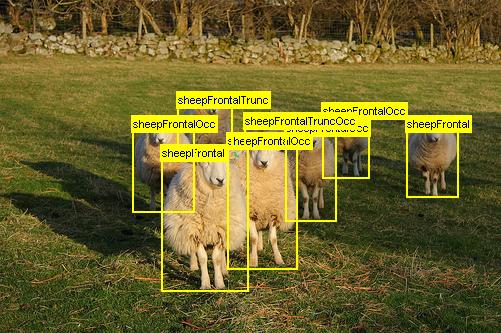
The PASCAL Visual Object Classes (VOC) 2012 dataset contains 20 object categories including vehicles, household, animals, and other: aeroplane, bicycle, boat, bus, car, motorbike, train, bottle, chair, dining table, potted plant, sofa, TV/monitor, bird, cat, cow, dog, horse, sheep, and person. Each image in this dataset has pixel-level segmentation annotations, bounding box annotations, and object class annotations. This dataset has been widely used as a benchmark for object detection, semantic segmentation, and classification tasks. The PASCAL VOC dataset is split into three subsets: 1,464 images for training, 1,449 images for validation and a private testing set. Source: Self-supervised Visual Feature Learning with Deep Neural Networks: A Survey Image Source: http://host.robots.ox.ac.uk/pascal/VOC/voc2012/examples/images/sheep_06.jpg

LRW

The Lip Reading in the Wild (LRW) dataset a large-scale audio-visual database that contains 500 different words from over 1,000 speakers. Each utterance has 29 frames, whose boundary is centered around the target word. The database is divided into training, validation and test sets. The training set contains at least 800 utterances for each class while the validation and test sets contain 50 utterances. Source: Towards Pose-invariant Lip-Reading Image Source: https://www.robots.ox.ac.uk/~vgg/data/lip_reading/lrw1.html

YouTube-VIS 2019

YouTubeVIS is a new dataset tailored for tasks like simultaneous detection, segmentation and tracking of object instances in videos and is collected based on the current largest video object segmentation dataset YouTubeVOS. Source: YouTubeVIS

Objects365

Objects365 is a large-scale object detection dataset, Objects365, which has 365 object categories over 600K training images. More than 10 million, high-quality bounding boxes are manually labeled through a three-step, carefully designed annotation pipeline. It is the largest object detection dataset (with full annotation) so far and establishes a more challenging benchmark for the community. Source: Objects365: A Large-Scale, High-Quality Dataset for Object Detection Image Source: https://www.objects365.org/overview.html

PartNet

PartNet is a consistent, large-scale dataset of 3D objects annotated with fine-grained, instance-level, and hierarchical 3D part information. The dataset consists of 573,585 part instances over 26,671 3D models covering 24 object categories. This dataset enables and serves as a catalyst for many tasks such as shape analysis, dynamic 3D scene modeling and simulation, affordance analysis, and others. Source: PartNet: A Large-scale Benchmark for Fine-grained and Hierarchical Part-level 3D Object Understanding Image Source: https://cs.stanford.edu/~kaichun/partnet/

2D-3D-S

The 2D-3D-S dataset provides a variety of mutually registered modalities from 2D, 2.5D and 3D domains, with instance-level semantic and geometric annotations. It covers over 6,000 m2 collected in 6 large-scale indoor areas that originate from 3 different buildings. It contains over 70,000 RGB images, along with the corresponding depths, surface normals, semantic annotations, global XYZ images (all in forms of both regular and 360° equirectangular images) as well as camera information. It also includes registered raw and semantically annotated 3D meshes and point clouds. The dataset enables development of joint and cross-modal learning models and potentially unsupervised approaches utilizing the regularities present in large-scale indoor spaces. Source: https://github.com/alexsax/2D-3D-Semantics Image Source: https://github.com/alexsax/2D-3D-Semantics

CBSD68

Color BSD68 dataset for image denoising benchmarks is part of The Berkeley Segmentation Dataset and Benchmark. It is used for measuring image denoising algorithms performance. It contains 68 images. Source: https://github.com/clausmichele/CBSD68-dataset

Virtual KITTI

Virtual KITTI is a photo-realistic synthetic video dataset designed to learn and evaluate computer vision models for several video understanding tasks: object detection and multi-object tracking, scene-level and instance-level semantic segmentation, optical flow, and depth estimation. Virtual KITTI contains 50 high-resolution monocular videos (21,260 frames) generated from five different virtual worlds in urban settings under different imaging and weather conditions. These worlds were created using the Unity game engine and a novel real-to-virtual cloning method. These photo-realistic synthetic videos are automatically, exactly, and fully annotated for 2D and 3D multi-object tracking and at the pixel level with category, instance, flow, and depth labels (cf. below for download links). Source: https://europe.naverlabs.com/research/computer-vision/proxy-virtual-worlds-vkitti-1/ Image Source: https://arxiv.org/pdf/1605.06457.pdf

DeepGlobe

We observe that satellite imagery is a powerful source of information as it contains more structured and uniform data, compared to traditional images. Although computer vision community has been accomplishing hard tasks on everyday image datasets using deep learning, satellite images are only recently gaining attention for maps and population analysis. This workshop aims at bringing together a diverse set of researchers to advance the state-of-the-art in satellite image analysis. To direct more attention to such approaches, we propose DeepGlobe Satellite Image Understanding Challenge, structured around three different satellite image understanding tasks. The datasets created and released for this competition may serve as reference benchmarks for future research in satellite image analysis. Furthermore, since the challenge tasks will involve "in the wild" forms of classic computer vision problems, these datasets have the potential to become valuable testbeds for the design of robust vision algorithms, beyond the area of remote sensing.

DFDC

The DFDC (Deepfake Detection Challenge) is a dataset for deepface detection consisting of more than 100,000 videos. The DFDC dataset consists of two versions: - Preview dataset. with 5k videos. Featuring two facial modification algorithms. - Full dataset, with 124k videos. Featuring eight facial modification algorithms Source: The Deepfake Detection Challenge (DFDC) Preview Dataset

출처: Papers with Code · CC BY-SA 4.0. 아카이브 자료와 새로 수집한 논문은 별도로 관리합니다.