Papers with Code 아카이브

2D Classification

태스크의 하위 분류와 논문·코드·평가·기법·데이터셋을 탐색하세요.

하위 태스크
27
평가표
0
보존된 평가 기록
0

데이터셋

출처에 같은 태스크 이름으로 연결된 데이터셋입니다. 동명 태스크가 포함될 수 있으므로, 비교할 때는 평가 결과의 조건도 확인하세요.

MPI Sintel

MPI (Max Planck Institute) Sintel is a dataset for optical flow evaluation that has 1064 synthesized stereo images and ground truth data for disparity. Sintel is derived from open-source 3D animated short film Sintel. The dataset has 23 different scenes. The stereo images are RGB while the disparity is grayscale. Both have resolution of 1024×436 pixels and 8-bit per channel. Source: Fast Disparity Estimation using Dense Networks*

PASCAL VOC

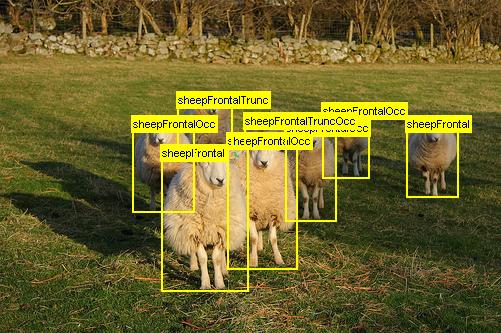
The PASCAL Visual Object Classes (VOC) 2012 dataset contains 20 object categories including vehicles, household, animals, and other: aeroplane, bicycle, boat, bus, car, motorbike, train, bottle, chair, dining table, potted plant, sofa, TV/monitor, bird, cat, cow, dog, horse, sheep, and person. Each image in this dataset has pixel-level segmentation annotations, bounding box annotations, and object class annotations. This dataset has been widely used as a benchmark for object detection, semantic segmentation, and classification tasks. The PASCAL VOC dataset is split into three subsets: 1,464 images for training, 1,449 images for validation and a private testing set. Source: Self-supervised Visual Feature Learning with Deep Neural Networks: A Survey Image Source: http://host.robots.ox.ac.uk/pascal/VOC/voc2012/examples/images/sheep_06.jpg

Argoverse 2

Argoverse 2 (AV2) is a collection of three datasets for perception and forecasting research in the self-driving domain. The annotated Sensor Dataset contains 1,000 sequences of multimodal data, encompassing high-resolution imagery from seven ring cameras, and two stereo cameras in addition to lidar point clouds, and 6-DOF map-aligned pose. Sequences contain 3D cuboid annotations for 26 object categories, all of which are sufficiently-sampled to support training and evaluation of 3D perception models. The Lidar Dataset contains 20,000 sequences of unlabeled lidar point clouds and map-aligned pose. This dataset is the largest ever collection of lidar sensor data and supports self-supervised learning and the emerging task of point cloud forecasting. Finally, the Motion Forecasting Dataset contains 250,000 scenarios mined for interesting and challenging interactions be- tween the autonomous vehicle and other actors in each local scene. Models are tasked with the prediction of future motion for “scored actors" in each scenario and are provided with track histories that capture object location, heading, velocity, and category. In all three datasets, each scenario contains its own HD Map with 3D lane and crosswalk geometry — sourced from data captured in six distinct cities. We believe these datasets will support new and existing machine learning research problems in ways that existing datasets do not. All datasets are released under the CC BY-NC-SA 4.0 license.

HICO-DET

HICO-DET is a dataset for detecting human-object interactions (HOI) in images. It contains 47,776 images (38,118 in train set and 9,658 in test set), 600 HOI categories constructed by 80 object categories and 117 verb classes. HICO-DET provides more than 150k annotated human-object pairs. V-COCO provides 10,346 images (2,533 for training, 2,867 for validating and 4,946 for testing) and 16,199 person instances. Each person has annotations for 29 action categories and there are no interaction labels including objects. Source: Visual Compositional Learning for Human-Object Interaction Detection Image Source: http://www-personal.umich.edu/~ywchao/hico/

NoCaps

The nocaps benchmark consists of 166,100 human-generated captions describing 15,100 images from the OpenImages validation and test sets. Source: nocaps: novel object captioning at scale Image Source: https://nocaps.org/

COD10K

Sensory ecologists have found that this s background matching camouflage strategy works by deceiving the visual perceptual system of the observer. Naturally, addressing concealed object detection (COD) requires a significant amount of visual perception knowledge. Understanding COD has not only scientific value in itself, but it also important for applications in many fundamental fields, such as computer vision (e.g., for search-and-rescue work, or rare species discovery), medicine (e.g., polyp segmentation, lung infection segmentation), agriculture (e.g., locust detection to prevent invasion), and art (e.g., recreational art). The high intrinsic similarities between the targets and non-targets make COD far more challenging than traditional object segmentation/detection. Although it has gained increased attention recently, studies on COD still remain scarce, mainly due to the lack of a sufficiently large dataset and a standard benchmark like Pascal-VOC, ImageNet, MS-COCO, ADE20K, and DAVIS. To build the large-scale COD dataset, we build the COD10K, which contains 10,000 images (5,066 camouflaged, 3,000 background, 1,934 noncamouflaged), divided into 10 super-classes, and 78 sub-classes (69 camouflaged, nine non-camouflaged) which are collected from multiple photography websites.
CrowdHuman

CrowdHuman is a large and rich-annotated human detection dataset, which contains 15,000, 4,370 and 5,000 images collected from the Internet for training, validation and testing respectively. The number is more than 10× boosted compared with previous challenging pedestrian detection dataset like CityPersons. The total number of persons is also noticeably larger than the others with ∼340k person and ∼99k ignore region annotations in the CrowdHuman training subset. Source: SADet: Learning An Efficient and Accurate Pedestrian Detector Image Source: http://www.crowdhuman.org/

Objects365

Objects365 is a large-scale object detection dataset, Objects365, which has 365 object categories over 600K training images. More than 10 million, high-quality bounding boxes are manually labeled through a three-step, carefully designed annotation pipeline. It is the largest object detection dataset (with full annotation) so far and establishes a more challenging benchmark for the community. Source: Objects365: A Large-Scale, High-Quality Dataset for Object Detection Image Source: https://www.objects365.org/overview.html

fMoW

Functional Map of the World (fMoW) is a dataset that aims to inspire the development of machine learning models capable of predicting the functional purpose of buildings and land use from temporal sequences of satellite images and a rich set of metadata features. Source: Functional Map of the World Image Source: Christie et al

CAMO

Camouflaged Object (CAMO) dataset specifically designed for the task of camouflaged object segmentation. We focus on two categories, i.e., naturally camouflaged objects and artificially camouflaged objects, which usually correspond to animals and humans in the real world, respectively. Camouflaged object images consists of 1250 images (1000 images for the training set and 250 images for the testing set). Non-camouflaged object images are collected from the MS-COCO dataset (1000 images for the training set and 250 images for the testing set). CAMO has objectness mask ground-truth.

Cholec80

Cholec80 is an endoscopic video dataset containing 80 videos of cholecystectomy surgeries performed by 13 surgeons. The videos are captured at 25 fps and downsampled to 1 fps for processing. The whole dataset is labeled with the phase and tool presence annotations. The phases have been defined by a senior surgeon in Strasbourg hospital, France. Since the tools are sometimes hardly visible in the images and thus difficult to be recognized visually, a tool is defined as present in an image if at least half of the tool tip is visible. Source: EndoNet: A Deep Architecture for Recognition Tasks on Laparoscopic Videos[https://arxiv.org/pdf/1602.03012.pdf]

Virtual KITTI

Virtual KITTI is a photo-realistic synthetic video dataset designed to learn and evaluate computer vision models for several video understanding tasks: object detection and multi-object tracking, scene-level and instance-level semantic segmentation, optical flow, and depth estimation. Virtual KITTI contains 50 high-resolution monocular videos (21,260 frames) generated from five different virtual worlds in urban settings under different imaging and weather conditions. These worlds were created using the Unity game engine and a novel real-to-virtual cloning method. These photo-realistic synthetic videos are automatically, exactly, and fully annotated for 2D and 3D multi-object tracking and at the pixel level with category, instance, flow, and depth labels (cf. below for download links). Source: https://europe.naverlabs.com/research/computer-vision/proxy-virtual-worlds-vkitti-1/ Image Source: https://arxiv.org/pdf/1605.06457.pdf

PASCAL VOC 2007

PASCAL VOC 2007 is a dataset for image recognition. The twenty object classes that have been selected are: Person: person Animal: bird, cat, cow, dog, horse, sheep Vehicle: aeroplane, bicycle, boat, bus, car, motorbike, train Indoor: bottle, chair, dining table, potted plant, sofa, tv/monitor The dataset can be used for image classification and object detection tasks. Image Source: Object Detection and Recognition in Images

PubLayNet

PubLayNet is a dataset for document layout analysis by automatically matching the XML representations and the content of over 1 million PDF articles that are publicly available on PubMed Central. The size of the dataset is comparable to established computer vision datasets, containing over 360 thousand document images, where typical document layout elements are annotated. Source: PubLayNet: largest dataset ever for document layout analysis

Kvasir

The KVASIR Dataset was released as part of the medical multimedia challenge presented by MediaEval. It is based on images obtained from the GI tract via an endoscopy procedure. The dataset is composed of images that are annotated and verified by medical doctors, and captures 8 different classes. The classes are based on three anatomical landmarks (z-line, pylorus, cecum), three pathological findings (esophagitis, polyps, ulcerative colitis) and two other classes (dyed and lifted polyps, dyed resection margins) related to the polyp removal process. Overall, the dataset contains 8,000 endoscopic images, with 1,000 image examples per class. Source: Two-Stream Deep Feature Modelling for Automated Video Endoscopy Data Analysis Image Source: https://datasets.simula.no/kvasir/

LLVIP

  • Visible-infrared Paired Dataset for Low-light Vision * 30976 images (15488 pairs) * 24 dark scenes, 2 daytime scenes * Support for image-to-image translation (visible to infrared, or infrared to visible), visible and infrared image fusion, low-light pedestrian detection, and infrared pedestrian detection * (The original image and video pairs (before registration) of LLVIP are also released!)

Hypersim

For many fundamental scene understanding tasks, it is difficult or impossible to obtain per-pixel ground truth labels from real images. Hypersim is a photorealistic synthetic dataset for holistic indoor scene understanding. It contains 77,400 images of 461 indoor scenes with detailed per-pixel labels and corresponding ground truth geometry. Source: https://github.com/apple/ml-hypersim Image Source: https://github.com/apple/ml-hypersim

ABC Dataset

The ABC Dataset is a collection of one million Computer-Aided Design (CAD) models for research of geometric deep learning methods and applications. Each model is a collection of explicitly parametrized curves and surfaces, providing ground truth for differential quantities, patch segmentation, geometric feature detection, and shape reconstruction. Sampling the parametric descriptions of surfaces and curves allows generating data in different formats and resolutions, enabling fair comparisons for a wide range of geometric learning algorithms.

GYAFC

Grammarly’s Yahoo Answers Formality Corpus (GYAFC) is the largest dataset for any style containing a total of 110K informal / formal sentence pairs. Yahoo Answers is a question answering forum, contains a large number of informal sentences and allows redistribution of data. The authors used the Yahoo Answers L6 corpus to create the GYAFC dataset of informal and formal sentence pairs. In order to ensure a uniform distribution of data, they removed sentences that are questions, contain URLs, and are shorter than 5 words or longer than 25. After these preprocessing steps, 40 million sentences remain. The Yahoo Answers corpus consists of several different domains like Business, Entertainment & Music, Travel, Food, etc. Pavlick and Tetreault formality classifier (PT16) shows that the formality level varies significantly across different genres. In order to control for this variation, the authors work with two specific domains that contain the most informal sentences and show results on training and testing within those categories. The authors use the formality classifier from PT16 to identify informal sentences and train this classifier on the Answers genre of the PT16 corpus which consists of nearly 5,000 randomly selected sentences from Yahoo Answers manually annotated on a scale of -3 (very informal) to 3 (very formal). They find that the domains of Entertainment & Music and Family & Relationships contain the most informal sentences and create the GYAFC dataset using these domains. Source: Dear Sir or Madam, May I Introduce the GYAFC Dataset: Corpus, Benchmarks and Metrics for Formality Style Transfer

Real Blur Dataset

The dataset consists of 4,738 pairs of images of 232 different scenes including reference pairs. All images were captured both in the camera raw and JPEG formats, hence generating two datasets: RealBlur-R from the raw images, and RealBlur-J from the JPEG images. Each training set consists of 3,758 image pairs, while each test set consists of 980 image pairs. The deblurring result is first aligned to its ground truth sharp image using a homography estimated by the enhanced correlation coefficients method, and PSNR or SSIM is computed in sRGB color space.

UAVDT

UAVDT is a large scale challenging UAV Detection and Tracking benchmark (i.e., about 80, 000 representative frames from 10 hours raw videos) for 3 important fundamental tasks, i.e., object DETection (DET), Single Object Tracking (SOT) and Multiple Object Tracking (MOT). The dataset is captured by UAVs in various complex scenarios. The objects of interest in this benchmark are vehicles. The frames are manually annotated with bounding boxes and some useful attributes, e.g., vehicle category and occlusion. The UAVDT benchmark consists of 100 video sequences, which are selected from over 10 hours of videos taken with an UAV platform at a number of locations in urban areas, representing various common scenes including squares, arterial streets, toll stations, highways, crossings and T-junctions. The videos are recorded at 30 frames per seconds (fps), with the JPEG image resolution of 1080 × 540 pixels.

HIDE

Consists of 8,422 blurry and sharp image pairs with 65,784 densely annotated FG human bounding boxes. Source: Human-Aware Motion Deblurring

NC4K

As far as we know, there only exists one large camouflaged object testing dataset, the COD10K, while the sizes of other testing datasets are less than 300. We then contribute another camouflaged object testing dataset, namely NC4K, which includes 4,121 images downloaded from the Internet. The new testing dataset can be used to evaluate the generalization ability of existing models.

xView

xView is one of the largest publicly available datasets of overhead imagery. It contains images from complex scenes around the world, annotated using bounding boxes. It contains over 1M object instances from 60 different classes. Source: xView dataset

MSCOCO

Click to add a brief description of the dataset (Markdown and LaTeX enabled). Provide: * a high-level explanation of the dataset characteristics * explain motivations and summary of its content * potential use cases of the dataset

ONCE

ONCE (One millioN sCenEs) is a dataset for 3D object detection in the autonomous driving scenario. The ONCE dataset consists of 1 million LiDAR scenes and 7 million corresponding camera images. The data is selected from 144 driving hours, which is 20x longer than other 3D autonomous driving datasets available like nuScenes and Waymo, and it is collected across a range of different areas, periods and weather conditions. Consists of: * 1 Million LiDAR frames, 7 Million camera images * 200 km² driving regions, 144 driving hours * 15k fully annotated scenes with 5 classes (Car, Bus, Truck, Pedestrian, Cyclist) * Diverse environments (day/night, sunny/rainy, urban/suburban areas)

출처: Papers with Code · CC BY-SA 4.0. 아카이브 자료와 새로 수집한 논문은 별도로 관리합니다.