Papers with Code 아카이브

Image Classification

태스크의 하위 분류와 논문·코드·평가·기법·데이터셋을 탐색하세요.

하위 태스크
33
평가표
177
보존된 평가 기록
2,906

Image Classification is a fundamental task in vision recognition that aims to understand and categorize an image as a whole under a specific label. Unlike object detection, which involves classification and location of multiple objects within an image, image classification typically pertains to single-object images. When the classification becomes highly detailed or reaches instance-level, it is often referred to as image retrieval, which also involves finding similar images in a large database.

Source: Metamorphic Testing for Object Detection Systems

데이터셋

출처에 같은 태스크 이름으로 연결된 데이터셋입니다. 동명 태스크가 포함될 수 있으므로, 비교할 때는 평가 결과의 조건도 확인하세요.

Kuzushiji-MNIST

Kuzushiji-MNIST is a drop-in replacement for the MNIST dataset (28x28 grayscale, 70,000 images). Since MNIST restricts us to 10 classes, the authors chose one character to represent each of the 10 rows of Hiragana when creating Kuzushiji-MNIST. Kuzushiji is a Japanese cursive writing style. Source: Deep Learning for Classical Japanese Literature Image Source: https://github.com/rois-codh/kmnist

Indian Pines

Indian Pines is a Hyperspectral image segmentation dataset. The input data consists of hyperspectral bands over a single landscape in Indiana, US, (Indian Pines data set) with 145×145 pixels. For each pixel, the data set contains 220 spectral reflectance bands which represent different portions of the electromagnetic spectrum in the wavelength range 0.4−2.5⋅10−6. Source: Layer-Parallel Training of Deep Residual Neural Networks Image Source: http://www.ehu.eus/ccwintco/index.php/Hyperspectral_Remote_Sensing_Scenes#Indian_Pines

MSCOCO

Click to add a brief description of the dataset (Markdown and LaTeX enabled). Provide: * a high-level explanation of the dataset characteristics * explain motivations and summary of its content * potential use cases of the dataset

ImageNet-O

ImageNet-O consists of images from classes that are not found in the ImageNet-1k dataset. It is used to test the robustness of vision models to out-of-distribution samples. It's reported using the AUPR metric.

AbstractReasoning

AbstractReasoning is a dataset for abstract reasoning, where the goal is to infer the correct answer from the context panels based on abstract reasoning. Image Source: Barrett et al

BigEarthNet

BigEarthNet consists of 590,326 Sentinel-2 image patches, each of which is a section of i) 120x120 pixels for 10m bands; ii) 60x60 pixels for 20m bands; and iii) 20x20 pixels for 60m bands. Source: BigEarthNet: A Large-Scale Benchmark Archive For Remote Sensing Image Understanding

Places-LT

Places-LT has an imbalanced training set with 62,500 images for 365 classes from Places-2. The class frequencies follow a natural power law distribution with a maximum number of 4,980 images per class and a minimum number of 5 images per class. The validation and testing sets are balanced and contain 20 and 100 images per class respectively. Source: Long-Tailed Recognition Using Class-Balanced Experts

CompCars

The Comprehensive Cars (CompCars) dataset contains data from two scenarios, including images from web-nature and surveillance-nature. The web-nature data contains 163 car makes with 1,716 car models. There are a total of 136,726 images capturing the entire cars and 27,618 images capturing the car parts. The full car images are labeled with bounding boxes and viewpoints. Each car model is labeled with five attributes, including maximum speed, displacement, number of doors, number of seats, and type of car. The surveillance-nature data contains 50,000 car images captured in the front view. The dataset can be used for the tasks of: - Fine-grained classification - Attribute prediction - Car model verification The dataset can be also used for other tasks such as image ranking, multi-task learning, and 3D reconstruction.

PlantVillage

The PlantVillage dataset consists of 54303 healthy and unhealthy leaf images divided into 38 categories by species and disease.

CIFAR-100N

This work presents two new benchmark datasets (CIFAR-10N, CIFAR-100N), equipping the training dataset of CIFAR-10 and CIFAR-100 with human-annotated real-world noisy labels that we collect from Amazon Mechanical Turk.

Places365

The Places365 dataset is a scene recognition dataset. It is composed of 10 million images comprising 434 scene classes. There are two versions of the dataset: Places365-Standard with 1.8 million train and 36000 validation images from K=365 scene classes, and Places365-Challenge-2016, in which the size of the training set is increased up to 6.2 million extra images, including 69 new scene classes (leading to a total of 8 million train images from 434 scene classes). Source: Semantic-Aware Scene Recognition Image Source: Places

Oxford-IIIT Pets

The Oxford-IIIT Pet Dataset is a 37-category pet dataset with roughly 200 images for each class. The images have large variations in scale, pose, and lighting. All images have an associated ground truth annotation of breed, head ROI, and pixel-level trimap segmentation.

WOS

Web of Science (WOS) is a document classification dataset that contains 46,985 documents with 134 categories which include 7 parents categories. Source: HDLTex: Hierarchical Deep Learning for Text Classification

PGM

PGM dataset serves as a tool for studying both abstract reasoning and generalisation in models. Generalisation is a multi-faceted phenomenon; there is no single, objective way in which models can or should generalise beyond their experience. The PGM dataset provides a means to measure the generalization ability of models in different ways, each of which may be more or less interesting to researchers depending on their intended training setup and applications. Source: Measuring abstract reasoning in neural networks Image Source: Barrett et al

Tiny-ImageNet-C

Tiny ImageNet-C is an open-source data set comprising algorithmically generated corruptions applied to the Tiny ImageNet (ImageNet-200) test set comprising 200 classes following the concept of ImageNet-C. It was introduced by Hendrycks et al. ("Benchmarking Neural Network Robustness to Common Corruptions and Perturbations") and comprises 19 different corruptions (15 test corruptions and 4 validation corruptions) spanning 5 severity levels. This results in 200,000 images for the validation set and 750,000 images for the test set. For further information visit the original GitHub repository of ImageNet-C.

MultiMNIST

The MultiMNIST dataset is generated from MNIST. The training and tests are generated by overlaying a digit on top of another digit from the same set (training or test) but different class. Each digit is shifted up to 4 pixels in each direction resulting in a 36×36 image. Considering a digit in a 28×28 image is bounded in a 20×20 box, two digits bounding boxes on average have 80% overlap. For each digit in the MNIST dataset 1,000 MultiMNIST examples are generated, so the training set size is 60M and the test set size is 10M. Source: https://arxiv.org/pdf/1710.09829.pdf Image Source: Sabour et al

Pavia University

The Pavia University dataset is a hyperspectral image dataset which gathered by a sensor known as the reflective optics system imaging spectrometer (ROSIS-3) over the city of Pavia, Italy. The image consists of 610×340 pixels with 115 spectral bands. The image is divided into 9 classes with a total of 42,776 labelled samples, including the asphalt, meadows, gravel, trees, metal sheet, bare soil, bitumen, brick, and shadow. Source: Diversity in Machine Learning Image Source: http://www.ehu.eus/ccwintco/index.php/Hyperspectral_Remote_Sensing_Scenes#Pavia_Centre_and_University

CARS196

CARS196 is composed of 16,185 car images of 196 classes.

JFT-3B

JFT-3B is an internal Google dataset and a larger version of the JFT-300M dataset. It consists of nearly 3 billion images, annotated with a class-hierarchy of around 30k labels via a semi-automatic pipeline. In other words, the data and associated labels are noisy.

Million-AID

Million-AID is a large-scale benchmark dataset containing a million instances for RS scene classification. There are 51 semantic scene categories in Million-AID. And the scene categories are customized to match the land-use classification standards, which greatly enhance the practicability of the constructed Million-AID. Different form the existing scene classification datasets of which categories are organized with parallel or uncertain relationships, scene categories in Million-AID are organized with systematic relationship architecture, giving it superiority in management and scalability. Specifically, the scene categories in Million-AID are organized by the hierarchical category network of a three-level tree: 51 leaf nodes fall into 28 parent nodes at the second level which are grouped into 8 nodes at the first level, representing the 8 underlying scene categories of agriculture land, commercial land, industrial land, public service land, residential land, transportation land, unutilized land, and water area. The scene category network provides the dataset with excellent organization of relationship among different scene categories and also the property of scalability. The number of images in each scene category ranges from 2,000 to 45,000, endowing the dataset with the property of long tail distribution. Besides, Million-AID has superiorities over the existing scene classification datasets owing to its high spatial resolution, large scale, and global distribution. Source: DiRS: On Creating Benchmark Datasets for Remote Sensing Image Interpretation Image Source: https://captain-whu.github.io/DiRS/
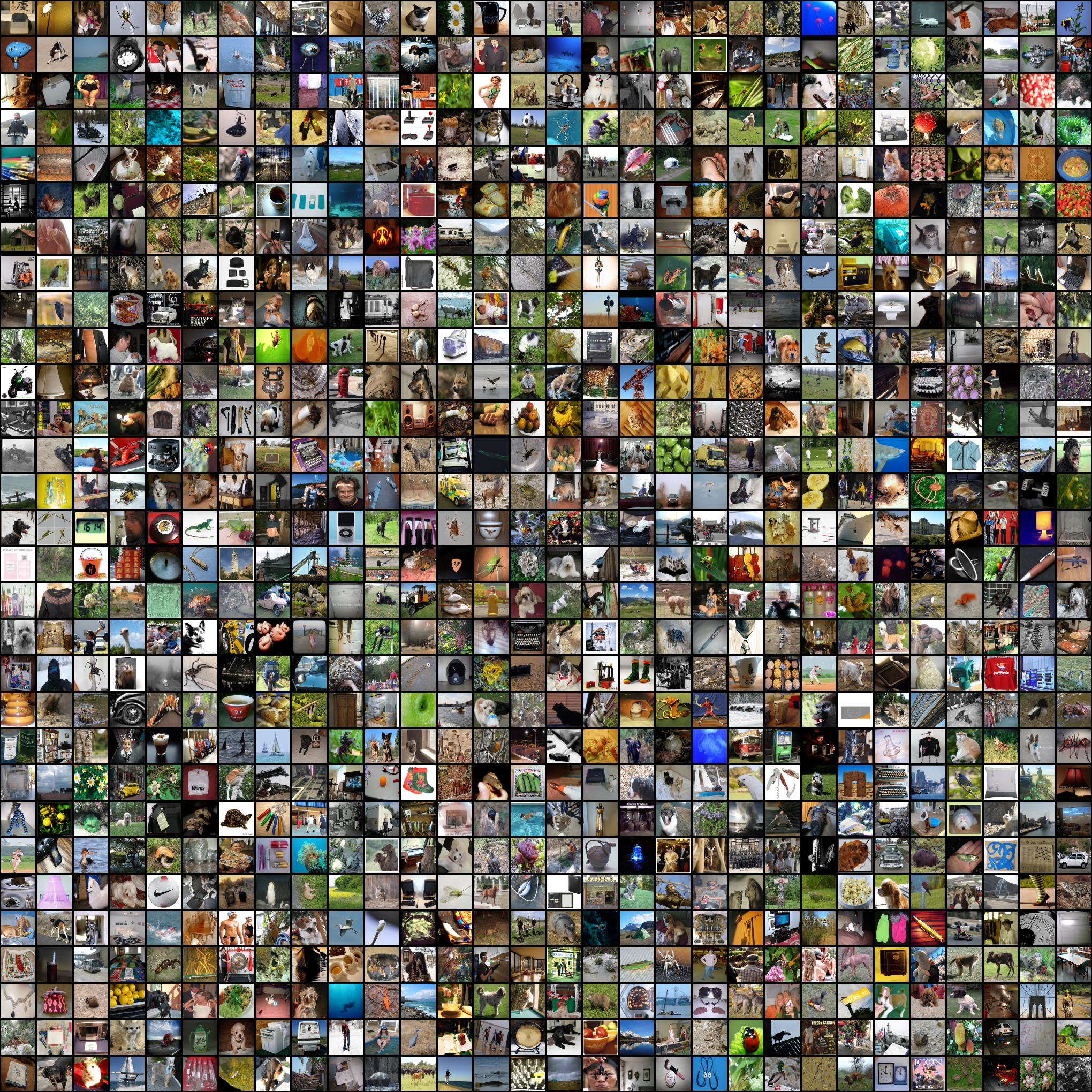
Open Images V4

Open Images V4 offers large scale across several dimensions: 30.1M image-level labels for 19.8k concepts, 15.4M bounding boxes for 600 object classes, and 375k visual relationship annotations involving 57 classes. For object detection in particular, 15x more bounding boxes than the next largest datasets (15.4M boxes on 1.9M images) are provided. The images often show complex scenes with several objects (8 annotated objects per image on average). Visual relationships between them are annotated, which support visual relationship detection, an emerging task that requires structured reasoning. Source: The Open Images Dataset V4: Unified image classification, object detection, and visual relationship detection at scale Image Source: https://storage.googleapis.com/openimages/web/index.html

ImageNet-P

ImageNet-P consists of noise, blur, weather, and digital distortions. The dataset has validation perturbations; has difficulty levels; has CIFAR-10, Tiny ImageNet, ImageNet 64 × 64, standard, and Inception-sized editions; and has been designed for benchmarking not training networks. ImageNet-P departs from ImageNet-C by having perturbation sequences generated from each ImageNet validation image. Each sequence contains more than 30 frames, so to counteract an increase in dataset size and evaluation time only 10 common perturbations are used. Source: Benchmarking Neural Network Robustness to Common Corruptions and Perturbations

UT Zappos50K

UT Zappos50K is a large shoe dataset consisting of 50,025 catalog images collected from Zappos.com. The images are divided into 4 major categories — shoes, sandals, slippers, and boots — followed by functional types and individual brands. The shoes are centered on a white background and pictured in the same orientation for convenient analysis. Source: UT Zappos50K

SUN

When glancing at a magazine, or browsing the Internet, we are continuously being exposed to photographs. Despite of this overflow of visual information, humans are extremely good at remembering thousands of pictures along with some of their visual details. But not all images are equal in memory. Some stitch to our minds, and other are forgotten. In this paper we focus on the problem of predicting how memorable an image will be. We show that memorability is a stable property of an image that is shared across different viewers. We introduce a database for which we have measured the probability that each picture will be remembered after a single view. We analyze image features and labels that contribute to making an image memorable, and we train a predictor based on global image descriptors. We find that predicting image memorability is a task that can be addressed with current computer vision techniques. Whereas making memorable images is a challenging task in visualization and photography, this work is a first attempt to quantify this useful quality of images.

OmniBenchmark

Omni-Realm Benchmark (OmniBenchmark) is a diverse (21 semantic realm-wise datasets) and concise (realm-wise datasets have no concepts overlapping) benchmark for evaluating pre-trained model generalization across semantic super-concepts/realms, e.g. across mammals to aircraft. [ECCV2022]

OpenImage-O

It is manually annotated, comes with a naturally diverse distribution, and has a large scale. It is built to overcome several shortcomings of existing OOD benchmarks. OpenImage-O is image-by-image filtered from the test set of OpenImage-V3, which has been collected from Flickr without a predefined list of class names or tags, leading to natural class statistics and avoiding an initial design bias.

출처: Papers with Code · CC BY-SA 4.0. 아카이브 자료와 새로 수집한 논문은 별도로 관리합니다.