DaN+
DaN+ is a new multi-domain corpus and annotation guidelines for Danish nested named entities (NEs) and lexical normalization to support research on cross-lingual cross-domain learning for a less-resourced language.
태스크의 하위 분류와 논문·코드·평가·기법·데이터셋을 탐색하세요.
Named Entity Recognition (NER) is a task of Natural Language Processing (NLP) that involves identifying and classifying named entities in a text into predefined categories such as person names, organizations, locations, and others. The goal of NER is to extract structured information from unstructured text data and represent it in a machine-readable format. Approaches typically use BIO notation, which differentiates the beginning (B) and the inside (I) of entities. O is used for non-entity tokens.
Example:
| Mark | Watney | visited | Mars |
|---|---|---|---|
| B-PER | I-PER | O | B-LOC |
<span style="color:grey; opacity: 0.6">( Image credit: Zalando )</span>
출처에 같은 태스크 이름으로 연결된 데이터셋입니다. 동명 태스크가 포함될 수 있으므로, 비교할 때는 평가 결과의 조건도 확인하세요.
DaN+ is a new multi-domain corpus and annotation guidelines for Danish nested named entities (NEs) and lexical normalization to support research on cross-lingual cross-domain learning for a less-resourced language.
Europeana Newspapers consists of four datasets with 100 pages each for the languages Dutch, French, German (including Austrian) as part of the Europeana Newspapers project is expected to contribute to the further development and improvement of named entity recognition systems with a focus on historical content. Source: An Open Corpus for Named Entity Recognition in Historic Newspapers
fine-grained location names extraction from disaster-related tweets
LINNAEUS is a general-purpose dictionary matching software, capable of processing multiple types of document formats in the biomedical domain (MEDLINE, PMC, BMC, OTMI, text, etc.). It can produce multiple types of output (XML, HTML, tab-separated-value file, or save to a database). It also contains methods for acting as a server (including load balancing across several servers), allowing clients to request matching over a network. A package with files for recognizing and identifying species names is available for LINNAEUS, showing 94% recall and 97% precision compared to LINNAEUS-species-corpus. Source: LINNAEUS
Knowledge about software used in scientific investigations is important for several reasons, for instance, to enable an understanding of provenance and methods involved in data handling. However, software is usually not formally cited, but rather mentioned informally within the scholarly description of the investigation, raising the need for automatic information extraction and disambiguation. Given the lack of reliable ground truth data, we present SoMeSci - Software Mentions in Science - a gold standard knowledge graph of software mentions in scientific articles. It contains high quality annotations (IRR: κ = .82) of 3756 software mentions in 1367 PubMed Central articles. Besides the plain mention of the software, we also provide relation labels for additional information, such as the version, the developer, a URL or citations. Moreover, we distinguish between different types, such as application, plugin or programming environment, as well as different types of mentions, such as usage or creation. To the best of our knowledge, SoMeSci is the most comprehensive corpus about software mentions in scientific articles, providing training samples for Named Entity Recognition, Relation Extraction, Entity Disambiguation, and Entity Linking. Finally, we sketch potential use cases and provide baseline results for the different tasks.
Species-800 is a corpus for species entities, which is based on manually annotated abstracts. It comprises 800 PubMed abstracts that contain identified organism mentions. To increase the corpus taxonomic mention diversity the 800 abstracts were collected by selecting 100 abstracts from the following 8 categories: bacteriology, botany, entomology, medicine, mycology, protistology, virology and zoology. 800 has been annotated with a focus at the species level; however, higher taxa mentions (such as genera, families and orders) have also been considered.
The Chilean Waiting List corpus comprises de-identified referrals from the waiting list in Chilean public hospitals. A subset of 10,000 referrals (including medical and dental notes) was manually annotated with ten entity types with clinical relevance, keeping 1,000 annotations for a future shared task. A trained medical doctor or dentist annotated these referrals and then, together with three other researchers, consolidated each of the annotations. The annotated corpus has more than 48% of entities embedded in other entities or containing another. This corpus can be a useful resource to build new models for Nested Named Entity Recognition (NER). This work constitutes the first annotated corpus using clinical narratives from Chile and one of the few in Spanish. Hugging Face datasets: https://huggingface.co/plncmm. After predicting over each entity type, merge the prediction to obtain your final micro f1-score. This is for a fair comparison with actual state-of-the-art models.
The first NER dataset in the field of traffic, which is to extract the characteristics and attributes of the vehicle on the road. * Both flat and overlapped named entities annotation. * Both coarse-grained and fine-grained named entities. * It contains 8 kinds of coarse-grained entities and 12 kinds of fine-grained entities. (It includes 65 vehicle brands and 4793 vehicle models all over the world.)
Finnish News Corpus for Named Entity Recognition (Finer) is a corpus that consists of 953 articles (193,742 word tokens) with six named entity classes (organization, location, person, product, event,and date). The articles are extracted from the archives of Digitoday, a Finnish online technology news source.
FiNER-139 is comprised of 1.1M sentences annotated with eXtensive Business Reporting Language (XBRL) tags extracted from annual and quarterly reports of publicly-traded companies in the US. Unlike other entity extraction tasks, like named entity recognition (NER) or contract element extraction, which typically require identifying entities of a small set of common types (e.g., persons, organizations), FiNER-139 uses a much larger label set of 139 entity types. Another important difference from typical entity extraction is that FiNER focuses on numeric tokens, with the correct tag depending mostly on context, not the token itself.
This dataset contains 1304 de-identified longitudinal medical records describing 296 patients.
LegalNERo is a manually annotated corpus for named entity recognition in the Romanian legal domain. It provides gold annotations for organizations, locations, persons, time and legal resources mentioned in legal documents. Additionally it offers GEONAMES codes for the named entities annotated as location (where a link could be established). The LegalNERo corpus is available in different formats: span-based, token-based and RDF. The Linguistic Linked Open Data (LLOD) version is provided in RDF-Turtle format.
The dataset used to pre-train NuNER from the NuNER: Entity Recognition Encoder Pre-training via LLM-Annotated Data Contains AI-extracted entities, their concepts, and descriptions from the given text
Romanian Named Entity Corpus is a named entity corpus for the Romanian language. The corpus contains over 26000 entities in ~5000 annotated sentences, belonging to 16 distinct classes. The sentences have been extracted from a copy-right free newspaper, covering several styles. This corpus represents the first initiative in the Romanian language space specifically targeted for named entity recognition. Source: Introducing RONEC -- the Romanian Named Entity Corpus
A growing number of papers are published in the area of superconducting materials science. However, novel text and data mining (TDM) processes are still needed to efficiently access and exploit this accumulated knowledge, paving the way towards data-driven materials design. Herein, we present SuperMat (Superconductor Materials), an annotated corpus of linked data derived from scientific publications on superconductors, which comprises 142 articles, 16052 entities, and 1398 links that are characterised into six categories: the names, classes, and properties of materials; links to their respective superconducting critical temperature (Tc); and parametric conditions such as applied pressure or measurement methods. The construction of SuperMat resulted from a fruitful collaboration between computer scientists and material scientists, and its high quality is ensured through validation by domain experts. The quality of the annotation guidelines was ensured by satisfactory Inter Annotator Agreement (IAA) between the annotators and the domain experts.
BUSiness Transaction Entity Recognition dataset. BUSTER is an Entity Recognition (ER) benchmark for entities related to business transactions. It consists of a gold corpus of 3779 manually annotated documents on financial transactions that were randomly divided into 5 folds, plus an additional silver corpus of 6196 automatically annotated documents that were created by the model-optimized RoBERTa system.
We introduce FUNSD-r and CORD-r in Token Path Prediction, the revised VrD-NER datasets to reflect the real-world scenarios of NER on scanned VrDs. In FUNSD and CORD, segment layout annotations are aligned with labeled entities, which makes them not reflect the reading order issue of NER on scanned VrDs, and thus are unsuitable for evaluating current methods. In FUNSD-r and CORD-r, we automatically reannotate the layouts using PP-OCRv3 OCR system, and manually reannotate the named entities as word sequences based on the new layout annotations. Their segment layout annotations are aligned with real-world situations and entity mentions are labeled on words. The proposed CORD-r consists of 999 document samples including the image, layout annotation of segments and words, and labeled entities of 30 categories. For the detailed summary statistics, please refer to the original paper.
COVID-Q consists of COVID-19 questions which have been annotated into a broad category (e.g. Transmission, Prevention) and a more specific class such that questions in the same class are all asking the same thing. Source: COVID-Q
DR.BENCH is a dataset for developing and evaluating cNLP models with clinical diagnostic reasoning ability. The suite includes six tasks from ten publicly available datasets addressing clinical text understanding, medical knowledge reasoning, and diagnosis generation.
E-NER is a publicly available legal Named Entity Recognition (NER) data set. It contains 52 filings from the US SEC EDGAR database. The named entity tags are hand annotated. Source: E-NER -- An Annotated Named Entity Recognition Corpus of Legal Text
We introduce FUNSD-r and CORD-r in Token Path Prediction, the revised VrD-NER datasets to reflect the real-world scenarios of NER on scanned VrDs. In FUNSD and CORD, segment layout annotations are aligned with labeled entities, which makes them not reflect the reading order issue of NER on scanned VrDs, and thus are unsuitable for evaluating current methods. In FUNSD-r and CORD-r, we automatically reannotate the layouts using PP-OCRv3 OCR system, and manually reannotate the named entities as word sequences based on the new layout annotations. Their segment layout annotations are aligned with real-world situations and entity mentions are labeled on words. The proposed FUNSD-r consists of 199 document samples including the image, layout annotation of segments and words, and labeled entities of 3 categories. For the detailed summary statistics, please refer to the original paper.
KIND is an Italian dataset for Named-Entity Recognition. It contains more than one million tokens with the annotation covering three classes: persons, locations, and organizations. Most of the dataset (around 600K tokens) contains manual gold annotations in three different domains: news, literature, and political discourses.
LeNER-Br is a dataset for named entity recognition (NER) in Brazilian Legal Text.
Named Entity (NER) annotations of the Hebrew Treebank (Haaretz newspaper) corpus, including: morpheme and token level NER labels, nested mentions, and more. We publish the NEMO corpus in the TACL paper "Neural Modeling for Named Entities and Morphology (NEMO^2)" [1], where we use it in extensive experiments and analyses, showing the importance of morphological boundaries for neural modeling of NER in morphologically rich languages. Code for these models and experiments can be found in the NEMO code repo. ## Main features: 1. Morpheme, token-single and token-multi sequence labels. Morpheme labels provide exact boundaries, token-multi provide partial sub-word morphological but no exact boundaries, token-single provides only token-level information. 1. All annotations are in BIOSE format (B=Begin, I=Inside, O=Outside, S=Singleton, E=End). 1. Widely-used OntoNotes entity category set: GPE (geo-political entity), PER (person), LOC (location), ORG (organization), FAC (facility), EVE (event), WOA (work-of-art), ANG (language), DUC (product). 1. NEMO includes NER annotations for the two major versions of the Hebrew Treebank, UD (Universal Dependency) and SPMRL. These can be aligned to the other morphosyntactic information layers of the treebank using bclm 1. We provide nested mentions. Only the first, widest, layer is used in the NEMO^2 paper. We invite you to take on this challenge! 1. Guidelines used for annotation are provided here. 1. Corpus was annotated by two native Hebrew speakers of academic education, and curated by the project manager. We provide the original annotations made by the annotators as well to promote work on learning with disagreements. 1. Annotation was performed using WebAnno (version 3.4.5) ## Basic Corpus Statistics | | train | dev | test | |------------------------------| --:| --:| --:| | Sentences | 4,937 | 500 | 706 | | Tokens | 93,504 | 8,531 | 12,619 | | Morphemes | 127,031 | 11,301 | 16,828 | | All mentions | 6,282 | 499 | 932 | | Type: Person (PER) | 2,128 | 193 | 267 | | Type: Organization (ORG) | 2,043 | 119 | 408 | | Type: Geo-Political (GPE) | 1,377 | 121 | 195 | | Type: Location (LOC) | 331 | 28 | 41 | | Type: Facility (FAC) | 163 | 12 | 11 | | Type: Work-of-Art (WOA) | 114 | 9 | 6 | | Type: Event (EVE) | 57 | 12 | 0 | | Type: Product (DUC) | 36 | 2 | 3 | | Type: Language (ANG) | 33 | 3 | 1 | ## Evaluation An evaluation script is provided in the NEMO code repo along with evaluation instructions. ## Citation @article{10.1162/tacl_a_00404, author = {Bareket, Dan and Tsarfaty, Reut}, title = "{Neural Modeling for Named Entities and Morphology (NEMO2)}", journal = {Transactions of the Association for Computational Linguistics}, volume = {9}, pages = {909-928}, year = {2021}, month = {09}, abstract = "{Named Entity Recognition (NER) is a fundamental NLP task, commonly formulated as classification over a sequence of tokens. Morphologically rich languages (MRLs) pose a challenge to this basic formulation, as the boundaries of named entities do not necessarily coincide with token boundaries, rather, they respect morphological boundaries. To address NER in MRLs we then need to answer two fundamental questions, namely, what are the basic units to be labeled, and how can these units be detected and classified in realistic settings (i.e., where no gold morphology is available). We empirically investigate these questions on a novel NER benchmark, with parallel token- level and morpheme-level NER annotations, which we develop for Modern Hebrew, a morphologically rich-and-ambiguous language. Our results show that explicitly modeling morphological boundaries leads to improved NER performance, and that a novel hybrid architecture, in which NER precedes and prunes morphological decomposition, greatly outperforms the standard pipeline, where morphological decomposition strictly precedes NER, setting a new performance bar for both Hebrew NER and Hebrew morphological decomposition tasks.}", issn = {2307-387X}, doi = {10.1162/tacl_a_00404}, url = {https://doi.org/10.1162/tacl\_a\_00404}, eprint = {https://direct.mit.edu/tacl/article-pdf/doi/10.1162/tacl\_a\_00404/1962472/tacl\_a\_00404.pdf}, }
An open, broad-coverage corpus for informal Persian named entity recognition was collected from Twitter.
PhoNER_COVID19 is a dataset for recognising COVID-19 related named entities in Vietnamese, consisting of 35K entities over 10K sentences. The authors defined 10 entity types with the aim of extracting key information related to COVID-19 patients, which are especially useful in downstream applications. In general, these entity types can be used in the context of not only the COVID-19 pandemic but also in other future epidemics.
A vast amount of information in the biomedical domain is available as natural language free text. An increasing number of documents in the field are written in languages other than English. Therefore, it is essential to develop resources, methods and tools that address Natural Language Processing in the variety of languages used by the biomedical community. In this paper, we report on the development of an extensive corpus of biomedical documents in French annotated at the entity and concept level. Three text genres are covered, comprising a total of 103,056 words. Ten entity categories corresponding to UMLS Semantic Groups were annotated, using automatic pre-annotations validated by trained human annotators. The pre-annotation method was found helful for entities and achieved above 0.83 precision for all text genres. Overall, a total of 26,409 entity annotations were mapped to 5,797 unique UMLS concepts.
We present the development of a Named Entity Recognition (NER) dataset for Tagalog. This corpus helps fill the resource gap present in Philippine languages today, where NER resources are scarce. The texts were obtained from a pretraining corpora containing news reports, and were labeled by native speakers in an iterative fashion. The resulting dataset contains ~7.8k documents across three entity types: Person, Organization, and Location. The inter-annotator agreement, as measured by Cohen's κ, is 0.81. We also conducted extensive empirical evaluation of state-of-the-art methods across supervised and transfer learning settings. Finally, we released the data and processing code publicly to inspire future work on Tagalog NLP.
ViMQ is a Vietnamese dataset of medical questions from patients with sentence-level and entity-level annotations for the Intent Classification and Named Entity Recognition tasks. It contains Vietnamese medical questions crawled from the consultation section online between patients and doctors from www.vinmec.com, a website of a Vietnamese general hospital. Each consultation consists of a question regarding a specific health issue of a patient and a detailed respond provided by a clinical expert. The dataset contains health issues that fall into a wide range of categories including common illness, cardiology, hematology, cancer, pediatrics, etc. We removed sections where users ask about information of the hospital and selected 9,000 questions for the dataset. Source: ViMQ: A Vietnamese Medical Question Dataset for Healthcare Dialogue System Development
Named entities in Bavarian text Details: Siyao Peng, Zihang Sun, Huangyan Shan, Marie Kolm, Verena Blaschke, Ekaterina Artemova, and Barbara Plank. 2024. Sebastian, Basti, Wastl?! Recognizing Named Entities in Bavarian Dialectal Data. In Proceedings of the 2024 Joint International Conference on Computational Linguistics, Language Resources and Evaluation (LREC-COLING 2024), pages 14478–14493, Torino, Italia. ELRA and ICCL. https://aclanthology.org/2024.lrec-main.1262/
Full-text chemical identification and indexing in PubMed articles. Identifying named entities is an important building block for many complex knowledge extraction tasks. Errors in identifying relevant biomedical entities is a key impediment to accurate article retrieval, classification, and further understanding of textual semantics, such as relation extraction. Chemical entities appear throughout the biomedical research literature and are one of the entity types most frequently searched in PubMed. Accurate automated identification of the chemicals mentioned in journal publications has the potential to translate to improvements in many downstream NLP tasks and biomedical fields; in the near-term, specifically in the retrieval of relevant articles, greatly assisting researchers, indexers, and curators. The NLM-CHEM track will consist of two tasks. Participants can choose to participate in either one or both. These tasks are: Chemical identification in full text: predicting all chemicals mentioned in recently published full-text articles, both span (i.e. named entity recognition) and normalization (i.e. entity linking) using MeSH. Chemical indexing prediction task: predicting which chemicals mentioned in recently published full-text articles should be indexed, i.e. appear in the listing of MeSH terms for the document.
Biographical is a semi-supervised dataset for RE. The dataset, which is aimed towards digital humanities (DH) and historical research, is automatically compiled by aligning sentences from Wikipedia articles with matching structured data from sources including Pantheon and Wikidata.
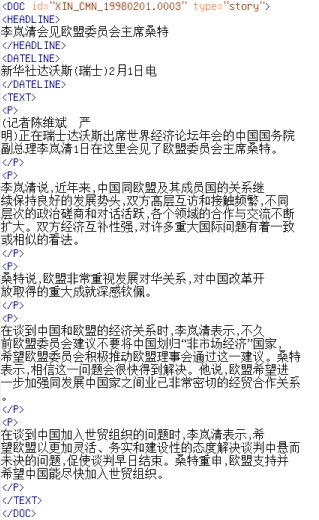
Chinese Gigaword corpus consists of 2.2M of headline-document pairs of news stories covering over 284 months from two Chinese newspapers, namely the Xinhua News Agency of China (XIN) and the Central News Agency of Taiwan (CNA). Source: Order-Preserving Abstractive Summarization for Spoken Content Based on Connectionist Temporal Classification Image Source: https://catalog.ldc.upenn.edu/desc/addenda/LDC2011T13.jpg
CLUENER2020 is a well-defined fine-grained dataset for named entity recognition in Chinese. CLUENER2020 contains 10 categories. Source: CLUENER2020: Fine-grained Named Entity Recognition Dataset and Benchmark for Chinese
A test dataset that annotated articles in 2020 following the CoNLL-2003 NER task.
출처: Papers with Code · CC BY-SA 4.0. 아카이브 자료와 새로 수집한 논문은 별도로 관리합니다.