Papers with Code · CC BY-SA 4.0

데이터셋 탐색

데이터셋의 설명·홈페이지를 찾고, 관련 태스크의 평가 기록을 살펴보세요.

관련 논문 214편

OpenSubtitles

OpenSubtitles 설명 보기

OpenSubtitles is collection of multilingual parallel corpora. The dataset is compiled from a large database of movie and TV subtitles and includes a total of 1689 bitexts spanning 2.6 billion sentences across 60 languages.

관련 논문 210편

MegaFace

MegaFace 설명 보기

MegaFace was a publicly available dataset which is used for evaluating the performance of face recognition algorithms with up to a million distractors (i.e., up to a million people who are not in the test set). MegaFace contains 1M images from 690K individuals with unconstrained pose, expression, lighting, and exposure. MegaFace captures many different subjects rather than many images of a small number of subjects. The gallery set of MegaFace is collected from a subset of Flickr. The probe set of MegaFace used in the challenge consists of two databases; Facescrub and FGNet. FGNet contains 975 images of 82 individuals, each with several images spanning ages from 0 to 69. Facescrub dataset contains more than 100K face images of 530 people. The MegaFace challenge evaluates performance of face recognition algorithms by increasing the numbers of “distractors” (going from 10 to 1M) in the gallery set. In order to evaluate the face recognition algorithms fairly, MegaFace challenge has two protocols including large or small training sets. If a training set has more than 0.5M images and 20K subjects, it is considered as large. Otherwise, it is considered as small. NOTE: This dataset has been retired. Source: A Deep Face Identification Network Enhanced by Facial Attributes Prediction

관련 논문 208편

Wikipedia Squirrel

Wiki Squirrel
Wiki Squirrel 설명 보기

The data was collected from the English Wikipedia (December 2018). These datasets represent page-page networks on specific topics (chameleons, crocodiles and squirrels). Nodes represent articles and edges are mutual links between them. The edges csv files contain the edges - nodes are indexed from 0. The features json files contain the features of articles - each key is a page id, and node features are given as lists. The presence of a feature in the feature list means that an informative noun appeared in the text of the Wikipedia article. The target csv contains the node identifiers and the average monthly traffic between October 2017 and November 2018 for each page. For each page-page network we listed the number of nodes an edges with some other descriptive statistics.

관련 논문 207편

ShanghaiTech Campus

ShanghaiTech Campus 설명 보기

The ShanghaiTech Campus dataset has 13 scenes with complex light conditions and camera angles. It contains 130 abnormal events and over 270, 000 training frames. Moreover, both the frame-level and pixel-level ground truth of abnormal events are annotated in this dataset.

관련 논문 206편

300 Faces-In-The-Wild

300W
300W 설명 보기

The 300-W is a face dataset that consists of 300 Indoor and 300 Outdoor in-the-wild images. It covers a large variation of identity, expression, illumination conditions, pose, occlusion and face size. The images were downloaded from google.com by making queries such as “party”, “conference”, “protests”, “football” and “celebrities”. Compared to the rest of in-the-wild datasets, the 300-W database contains a larger percentage of partially-occluded images and covers more expressions than the common “neutral” or “smile”, such as “surprise” or “scream”. Images were annotated with the 68-point mark-up using a semi-automatic methodology. The images of the database were carefully selected so that they represent a characteristic sample of challenging but natural face instances under totally unconstrained conditions. Thus, methods that achieve accurate performance on the 300-W database can demonstrate the same accuracy in most realistic cases. Many images of the database contain more than one annotated faces (293 images with 1 face, 53 images with 2 faces and 53 images with [3, 7] faces). Consequently, the database consists of 600 annotated face instances, but 399 unique images. Finally, there is a large variety of face sizes. Specifically, 49.3% of the faces have size in the range [48.6k, 2.0M] and the overall mean size is 85k (about 292 × 292) pixels. Source: https://ibug.doc.ic.ac.uk/media/uploads/documents/sagonas_2016_imavis.pdf Image Source: https://www.researchgate.net/profile/Xuanyi_Dong/publication/323722412/figure/fig1/AS:679426136227845@1538999222829/Face-samples-from-300-W-dataset-Different-faces-have-different-styles-whereas-the-style_Q640.jpg

관련 논문 206편

CIFAR100 few-shots

CIFAR-FS
CIFAR-FS 설명 보기

CIFAR100 few-shots (CIFAR-FS) is randomly sampled from CIFAR-100 (Krizhevsky & Hinton, 2009) by using the same criteria with which miniImageNet has been generated. The average inter-class similarity is sufficiently high to represent a challenge for the current state of the art. Moreover, the limited original resolution of 32×32 makes the task harder and at the same time allows fast prototyping. Source: Bertinetto et al. Image source: Bertinetto et al.

관련 논문 206편

Words in Context

WiC
WiC 설명 보기

WiC is a benchmark for the evaluation of context-sensitive word embeddings. WiC is framed as a binary classification task. Each instance in WiC has a target word w, either a verb or a noun, for which two contexts are provided. Each of these contexts triggers a specific meaning of w. The task is to identify if the occurrences of w in the two contexts correspond to the same meaning or not. In fact, the dataset can also be viewed as an application of Word Sense Disambiguation in practise. Source: WiC: the Word-in-Context Dataset for Evaluating Context-Sensitive Meaning Representations

관련 논문 205편

CodeXGLUE

CodeXGLUE 설명 보기

CodeXGLUE is a benchmark dataset and open challenge for code intelligence. It includes a collection of code intelligence tasks and a platform for model evaluation and comparison. CodeXGLUE stands for General Language Understanding Evaluation benchmark for CODE. It includes 14 datasets for 10 diversified code intelligence tasks covering the following scenarios: - code-code (clone detection, defect detection, cloze test, code completion, code repair, and code-to-code translation) - text-code (natural language code search, text-to-code generation) - code-text (code summarization) - text-text (documentation translation) A brief summary of CodeXGLUE is provided in the figure, including tasks, datasets, language, sizes in various states, baseline systems, providers, and short definitions of each task. Datasets highlighted in BLUE are newly introduced. Image source: https://github.com/microsoft/CodeXGLUE

관련 논문 205편

LAION-5B

LAION-5B 설명 보기

LAION 5B is a large-scale dataset for research purposes consisting of 5,85B CLIP-filtered image-text pairs. 2,3B contain English language, 2,2B samples from 100+ other languages and 1B samples have texts that do not allow a certain language assignment (e.g. names ). Additionally, we provide several nearest neighbor indices, an improved web interface for exploration & subset creation as well as detection scores for watermark and NSFW.

관련 논문 204편

MUSAN

MUSAN 설명 보기

MUSAN is a corpus of music, speech and noise. This dataset is suitable for training models for voice activity detection (VAD) and music/speech discrimination. The dataset consists of music from several genres, speech from twelve languages, and a wide assortment of technical and non-technical noises.

관련 논문 204편

The TAC Relation Extraction Dataset

TACRED
TACRED 설명 보기

TACRED is a large-scale relation extraction dataset with 106,264 examples built over newswire and web text from the corpus used in the yearly TAC Knowledge Base Population (TAC KBP) challenges. Examples in TACRED cover 41 relation types as used in the TAC KBP challenges (e.g., per:schools_attended and org:members) or are labeled as no_relation if no defined relation is held. These examples are created by combining available human annotations from the TAC KBP challenges and crowdsourcing. Source: https://nlp.stanford.edu/projects/tacred/

관련 논문 203편

Gowalla

Gowalla 설명 보기

Gowalla is a location-based social networking website where users share their locations by checking-in. The friendship network is undirected and was collected using their public API, and consists of 196,591 nodes and 950,327 edges. We have collected a total of 6,442,890 check-ins of these users over the period of Feb. 2009 - Oct. 2010.

관련 논문 203편

Youtube Video Object Segmentation

YouTube-VOS 2018
YouTube-VOS 2018 설명 보기

Youtube-VOS is a Video Object Segmentation dataset that contains 4,453 videos - 3,471 for training, 474 for validation, and 508 for testing. The training and validation videos have pixel-level ground truth annotations for every 5th frame (6 fps). It also contains Instance Segmentation annotations. It has more than 7,800 unique objects, 190k high-quality manual annotations and more than 340 minutes in duration. Source: CapsuleVOS: Semi-Supervised Video Object Segmentation Using Capsule Routing Image Source: https://youtube-vos.org/

관련 논문 202편

Leeds Sports Pose

LSP
LSP 설명 보기

The Leeds Sports Pose (LSP) dataset is widely used as the benchmark for human pose estimation. The original LSP dataset contains 2,000 images of sportspersons gathered from Flickr, 1000 for training and 1000 for testing. Each image is annotated with 14 joint locations, where left and right joints are consistently labelled from a person-centric viewpoint. The extended LSP dataset contains additional 10,000 images labeled for training. Source: Deep Deformation Network for Object Landmark Localization Image: Sumer et al

관련 논문 202편

Visual Task Adaptation Benchmark

VTAB
VTAB 설명 보기

The Visual Task Adaptation Benchmark (VTAB) is a benchmark designed to evaluate general visual representations². It consists of a diverse and challenging suite of tasks². The benchmark defines a good general visual representation as one that yields good performance on unseen tasks, when trained on limited task-specific data². The VTAB benchmark contains the following 19 tasks that are derived from public datasets¹: - Caltech101 - CIFAR-100 - CLEVR distance prediction - CLEVR counting - Diabetic Rethinopathy - Dmlab Frames - dSprites orientation prediction - dSprites location prediction - Describable Textures Dataset (DTD) - EuroSAT - KITTI distance prediction - 102 Category Flower Dataset - Oxford IIIT Pet dataset - PatchCamelyon - Resisc45 - Small NORB azimuth prediction - Small NORB elevation prediction - SUN397 - SVHN The given model is independently fine-tuned for solving each of the above tasks¹. Average accuracy across all tasks is used to measure the model's performance¹. Detailed description of all tasks, evaluation protocol, and other details can be found in the VTAB paper¹. (1) Visual Task Adaptation Benchmark. https://google-research.github.io/task_adaptation/. (2) GitHub - google-research/task_adaptation. https://github.com/google-research/task_adaptation. (3) GitHub - KMnP/vpt: ️ Visual Prompt Tuning [ECCV 2022] https://arxiv .... https://github.com/KMnP/vpt.

관련 논문 201편

HumanML3D

HumanML3D 설명 보기

HumanML3D is a 3D human motion-language dataset that originates from a combination of HumanAct12 and Amass dataset. It covers a broad range of human actions such as daily activities (e.g., 'walking', 'jumping'), sports (e.g., 'swimming', 'playing golf'), acrobatics (e.g., 'cartwheel') and artistry (e.g., 'dancing'). Overall, HumanML3D dataset consists of 14,616 motions and 44,970 descriptions composed by 5,371 distinct words. The total length of motions amounts to 28.59 hours. The average motion length is 7.1 seconds, while average description length is 12 words.

관련 논문 198편

IAM Handwriting

IAM
IAM 설명 보기

The IAM database contains 13,353 images of handwritten lines of text created by 657 writers. The texts those writers transcribed are from the Lancaster-Oslo/Bergen Corpus of British English. It includes contributions from 657 writers making a total of 1,539 handwritten pages comprising of 115,320 words and is categorized as part of modern collection. The database is labeled at the sentence, line, and word levels. Source: Measuring Human Perception to Improve Handwritten Document Transcription Image Source: https://fki.tic.heia-fr.ch/databases/iam-handwriting-database

관련 논문 198편

MPI Sintel

MPI Sintel 설명 보기

MPI (Max Planck Institute) Sintel is a dataset for optical flow evaluation that has 1064 synthesized stereo images and ground truth data for disparity. Sintel is derived from open-source 3D animated short film Sintel. The dataset has 23 different scenes. The stereo images are RGB while the disparity is grayscale. Both have resolution of 1024×436 pixels and 8-bit per channel. Source: Fast Disparity Estimation using Dense Networks*

관련 논문 198편

PASCAL Visual Object Classes Challenge

PASCAL VOC
PASCAL VOC 설명 보기

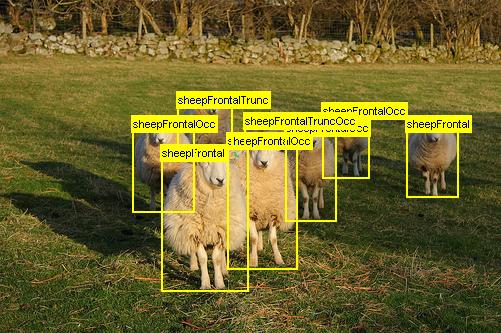
The PASCAL Visual Object Classes (VOC) 2012 dataset contains 20 object categories including vehicles, household, animals, and other: aeroplane, bicycle, boat, bus, car, motorbike, train, bottle, chair, dining table, potted plant, sofa, TV/monitor, bird, cat, cow, dog, horse, sheep, and person. Each image in this dataset has pixel-level segmentation annotations, bounding box annotations, and object class annotations. This dataset has been widely used as a benchmark for object detection, semantic segmentation, and classification tasks. The PASCAL VOC dataset is split into three subsets: 1,464 images for training, 1,449 images for validation and a private testing set. Source: Self-supervised Visual Feature Learning with Deep Neural Networks: A Survey Image Source: http://host.robots.ox.ac.uk/pascal/VOC/voc2012/examples/images/sheep_06.jpg

관련 논문 198편

YouCook2

YouCook2 설명 보기

YouCook2 is the largest task-oriented, instructional video dataset in the vision community. It contains 2000 long untrimmed videos from 89 cooking recipes; on average, each distinct recipe has 22 videos. The procedure steps for each video are annotated with temporal boundaries and described by imperative English sentences (see the example below). The videos were downloaded from YouTube and are all in the third-person viewpoint. All the videos are unconstrained and can be performed by individual persons at their houses with unfixed cameras. YouCook2 contains rich recipe types and various cooking styles from all over the world. Source: http://youcook2.eecs.umich.edu/ Image Source: https://competitions.codalab.org/competitions/20594

관련 논문 197편

AISHELL-1

AISHELL-1 설명 보기

AISHELL-1 is a corpus for speech recognition research and building speech recognition systems for Mandarin. Source: AISHELL-1: An Open-Source Mandarin Speech Corpus and A Speech Recognition Baseline

관련 논문 197편

CINIC-10

CINIC-10 설명 보기

CINIC-10 is a dataset for image classification. It has a total of 270,000 images, 4.5 times that of CIFAR-10. It is constructed from two different sources: ImageNet and CIFAR-10. Specifically, it was compiled as a bridge between CIFAR-10 and ImageNet. It is split into three equal subsets - train, validation, and test - each of which contain 90,000 images. Source: Group Knowledge Transfer:Collaborative Training of Large CNNs on the Edge Image Source: https://arxiv.org/abs/1810.03505

관련 논문 196편

Wikipedia open-domain Question Answering

WikiQA
WikiQA 설명 보기

The WikiQA corpus is a publicly available set of question and sentence pairs, collected and annotated for research on open-domain question answering. In order to reflect the true information need of general users, Bing query logs were used as the question source. Each question is linked to a Wikipedia page that potentially has the answer. Because the summary section of a Wikipedia page provides the basic and usually most important information about the topic, sentences in this section were used as the candidate answers. The corpus includes 3,047 questions and 29,258 sentences, where 1,473 sentences were labeled as answer sentences to their corresponding questions. Source: http://aka.ms/WikiQA Image Source: Yang et al

관련 논문 194편

Moving MNIST

Moving MNIST 설명 보기

The Moving MNIST dataset contains 10,000 video sequences, each consisting of 20 frames. In each video sequence, two digits move independently around the frame, which has a spatial resolution of 64×64 pixels. The digits frequently intersect with each other and bounce off the edges of the frame Source: Mutual Suppression Network for Video Prediction using Disentangled Features Image Source: http://www.cs.toronto.edu/~nitish/unsupervised_video/

관련 논문 192편

Exchange Rate Multivariate

Exchange
Exchange 설명 보기

Daily exchange rates of eight countries’ currencies against the US dollar, spanning from 1990 to 2010 with 7588 timesteps in total. | Dataset | Dim | Lengths | Granularity | Split | p-value | |----------------|-----|---------|-------------|--------|---------| | Exchange Rate | 8 | 7,588 | 1 day | 7:1:2 | 0.416 |

관련 논문 191편

FlyingChairs

FlyingChairs 설명 보기

The "Flying Chairs" are a synthetic dataset with optical flow ground truth. It consists of 22872 image pairs and corresponding flow fields. Images show renderings of 3D chair models moving in front of random backgrounds from Flickr. Motions of both the chairs and the background are purely planar.

관련 논문 190편

CMU-MOSEI

CMU-MOSEI 설명 보기

CMU Multimodal Opinion Sentiment and Emotion Intensity (CMU-MOSEI) is the largest dataset of sentence-level sentiment analysis and emotion recognition in online videos. CMU-MOSEI contains over 12 hours of annotated video from over 1000 speakers and 250 topics.

관련 논문 190편

XQuAD

XQuAD 설명 보기

XQuAD (Cross-lingual Question Answering Dataset) is a benchmark dataset for evaluating cross-lingual question answering performance. The dataset consists of a subset of 240 paragraphs and 1190 question-answer pairs from the development set of SQuAD v1.1 (Rajpurkar et al., 2016) together with their professional translations into ten languages: Spanish, German, Greek, Russian, Turkish, Arabic, Vietnamese, Thai, Chinese, and Hindi. Consequently, the dataset is entirely parallel across 11 languages. Source: XQuAD Image Source: https://arxiv.org/pdf/1910.11856v3.pdf

관련 논문 189편

Few-Shot Relation Classification Dataset

FewRel
FewRel 설명 보기

The FewRel (Few-Shot Relation Classification Dataset) contains 100 relations and 70,000 instances from Wikipedia. The dataset is divided into three subsets: training set (64 relations), validation set (16 relations) and test set (20 relations). Source: Neural Snowball for Few-Shot Relation Learning Image Source: https://www.aclweb.org/anthology/D18-1514.pdf

관련 논문 189편

Infant Health and Development Program

IHDP
IHDP 설명 보기

The Infant Health and Development Program (IHDP) is a randomized controlled study designed to evaluate the effect of home visit from specialist doctors on the cognitive test scores of premature infants. The datasets is first used for benchmarking treatment effect estimation algorithms in Hill [35], where selection bias is induced by removing non-random subsets of the treated individuals to create an observational dataset, and the outcomes are generated using the original covariates and treatments. It contains 747 subjects and 25 variables.