Papers with Code · CC BY-SA 4.0

데이터셋 탐색

데이터셋의 설명·홈페이지를 찾고, 관련 태스크의 평가 기록을 살펴보세요.

관련 논문 2편

Covid-HeRA

Covid-HeRA 설명 보기

Covid-HeRA is a dataset for health risk assessment and severity-informed decision making in the presence of COVID19 misinformation. It is a benchmark dataset for risk-aware health misinformation detection, related to the 2019 coronavirus pandemic. Social media posts (Twitter) are annotated based on the perceived likelihood of health behavioural changes and the perceived corresponding risks from following unreliable advice found online. Source: https://github.com/TIMAN-group/covid19_misinformation
관련 논문 2편

Creative Flow+ Dataset

Creative Flow+ Dataset 설명 보기

Includes 3000 animated sequences rendered using styles randomly selected from 40 textured line styles and 38 shading styles, spanning the range between flat cartoon fill and wildly sketchy shading. The dataset includes 124K+ train set frames and 10K test set frames rendered at 1500x1500 resolution, far surpassing the largest available optical flow datasets in size. Source: Creative Flow+ Dataset

관련 논문 2편

Cross-View Time Dataset

Cross-View Time Dataset 설명 보기

The appearance of the world varies dramatically not only from place to place but also from hour to hour and month to month. Every day billions of images capture this complex relationship, many of which are associated with precise time and location metadata. We propose to use these images to construct a global-scale, dynamic map of visual appearance attributes. Such a map enables fine-grained understanding of the expected appearance at any geographic location and time. Our approach integrates dense overhead imagery with location and time metadata into a general framework capable of mapping a wide variety of visual attributes. A key feature of our approach is that it requires no manual data annotation. We demonstrate how this approach can support various applications, including image-driven mapping, image geolocalization, and metadata verification.

관련 논문 2편

Cumulo

Cumulo 설명 보기

A benchmark dataset for training and evaluating global cloud classification models. It consists of one year of 1km resolution MODIS hyperspectral imagery merged with pixel-width 'tracks' of CloudSat cloud labels. Source: Cumulo: A Dataset for Learning Cloud Classes

관련 논문 2편

Curiosity

Curiosity 설명 보기

The Curiosity dataset consists of 14K dialogs (with 181K utterances) with fine-grained knowledge groundings, dialog act annotations, and other auxiliary annotation. In this dataset users and virtual assistants converse about geographic topics like geopolitical entities and locations. This dataset is annotated with pre-existing user knowledge, message-level dialog acts, grounding to Wikipedia, and user reactions to messages. Source: https://github.com/facebookresearch/curiosity Image Source: https://www.pedro.ai/curiosity

관련 논문 2편

Curlie

Curlie 설명 보기

Curlie dataset is a dataset with more than 1M websites in 92 languages with relative labels collected from Curlie, the largest multilingual crowdsourced Web directory. The dataset contains 14 website categories aligned across languages. It is used for language-agnostic website embedding and classification

관련 논문 2편

Cyberbullying Classification

Cyberbullying Classification 설명 보기

As social media usage becomes increasingly prevalent in every age group, a vast majority of citizens rely on this essential medium for day-to-day communication. Social media’s ubiquity means that cyberbullying can effectively impact anyone at any time or anywhere, and the relative anonymity of the internet makes such personal attacks more difficult to stop than traditional bullying. On April 15th, 2020, UNICEF issued a warning in response to the increased risk of cyberbullying during the COVID-19 pandemic due to widespread school closures, increased screen time, and decreased face-to-face social interaction. The statistics of cyberbullying are outright alarming: 36.5% of middle and high school students have felt cyberbullied and 87% have observed cyberbullying, with effects ranging from decreased academic performance to depression to suicidal thoughts. In light of all of this, this dataset contains more than 47000 tweets labelled according to the class of cyberbullying: Age; Ethnicity; Gender; Religion; Other type of cyberbullying; Not cyberbullying The data has been balanced in order to contain ~8000 of each class. Trigger Warning These tweets either describe a bullying event or are the offense themselves, therefore explore it to the point where you feel comfortable.

관련 논문 2편

Cylinder in Crossflow

Cylinder in Crossflow 설명 보기

Cylinder in Crossflow is a synthetic dataset that involves unsteady laminar flow past a cylinder that generates vortex shedding pattern known as a von Kármán vortex street. The governing equations for this system are the incompressible Navier-Stokes equations. The cylinder has a diameter of 1 and the free stream velocity is 1. The kinematic viscosity $\nu$ is varied such that the Reynolds number is between 100 and 400. Symmetry boundary conditions are applied at the top and bottom edges of the domain and an open pressure boundary condition is applied at the outlet. Solutions are generated on the unstructured mesh of 6384 quad elements.

관련 논문 2편

CylinderFlow with dynamic grid

CylinderFlow
CylinderFlow 설명 보기

This dataset captures incompressible fluid dynamics around a 2D circular cylinder within a channel: \begin{align} \nabla \cdot \mathbf{u} &= 0, \ \partial_t \mathbf{u} + (\mathbf{u} \cdot \nabla) \mathbf{u} &= \nu \nabla^2 \mathbf{u} - \frac{1}{\rho} \nabla p, \end{align} with boundary conditions set for velocity and pressure. It features 100 snapshots per case, with 7600 training, 1000 validation, and 1000 test samples.

관련 논문 2편

CypherBench

CypherBench 설명 보기

Click to add a brief description of the dataset (Markdown and LaTeX enabled). Provide: * a high-level explanation of the dataset characteristics * explain motivations and summary of its content * potential use cases of the dataset

관련 논문 2편

CytoImageNet: A large-scale pretraining dataset for bioimage transfer learning

CytoImageNet
CytoImageNet 설명 보기

CytoImageNet is a large-scale pretraining dataset of microscopy images (890K, 894 classes). In the paper, CytoImageNet pretraining yielded features competitive to and different from ImageNet pretrained features on downstream microscopy tasks. * It was constructed from 40 openly available microscopy datasets. * Weak labels (from experimental metadata) were assigned to each image in the dataset. * Images are of varying sizes. The primary purpose of the dataset is to be used for pretraining as a pretext task for learning useful bioimage representations. However, it may be used for validation or exploratory analysis.

관련 논문 2편

DACCORD

DACCORD 설명 보기

DACCORD is a new dataset dedicated to the task of automatically detecting contradictions between sentences in French. The dataset is currently composed of 1034 sentence pairs. It covers the themes of Russia’s invasion of Ukraine in 2022, the Covid-19 pandemic, and the climate crisis.

관련 논문 2편

DAPlankton

DAPlankton 설명 보기

The DAPlankton dataset consists of over 110k expert-labeled plankton images. The data is divided into two subsets: DAPlankton_LAB and DAPlankton_SEA. DAPlankton_LAB consists of images captured from multiple mono-specific phytoplankton cultures, which were analysed using three different imaging instruments: Imaging FlowCytoBot (IFCB), CytoSense (CS) flow cytometer, and FlowCam (FC) imaging microscope each producing cropped images with one plankton particle in each. An expert further verified the class of each image, ensuring that there was no cross contamination between different cultures. This process resulted in a balanced dataset with negligible label uncertainty. DAPlankton_SEA consists of images captured from water samples collected from the Baltic Sea using two different imaging instruments: IFCB and CS. Each image was manually labeled by an expert. DAPlankton_SEA provides a realistic and more challenging dataset with a large class imbalance and natural intra-class variance.

관련 논문 2편

DARK FACE: Face Detection in Low Light Condition

DARK FACE
DARK FACE 설명 보기

DARK FACE dataset provides 6,000 real-world low light images captured during the nighttime, at teaching buildings, streets, bridges, overpasses, parks etc., all labeled with bounding boxes for of human face, as the main training and/or validation sets. We also provide 9,000 unlabeled low-light images collected from the same setting. Additionally, we provided a unique set of 789 paired low-light/normal-light images captured in controllable real lighting conditions (but unnecessarily containing faces), which can be used as parts of the training data at the participants' discretization. There will be a hold-out testing set of 4,000 low-light images, with human face bounding boxes annotated.

관련 논문 2편

DART-Math-Hard

DART-Math-Hard 설명 보기

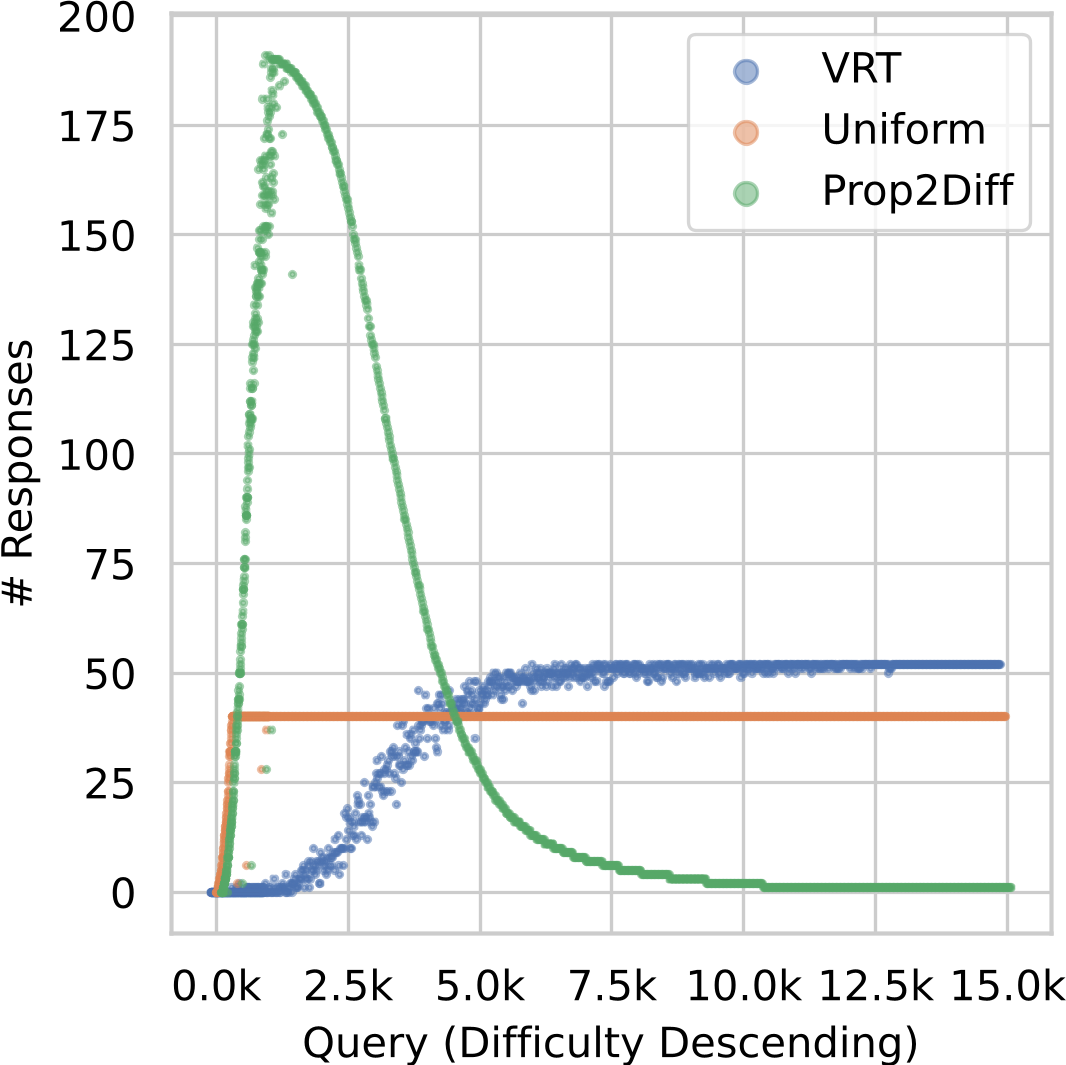
🎯 DART-Math > Difficulty-Aware Rejection Tuning for Mathematical Problem-Solving 📝 Paper@arXiv | 🤗 Datasets&Models@HF | 🐱 Code@GitHub 🐦 Thread@X(Twitter) | 🐶 中文博客@知乎 | 📊 Leaderboard@PapersWithCode | 📑 BibTeX ## Datasets: DART-Math DART-Math datasets are the state-of-the-art and data-efficient open-source instruction tuning datasets for mathematical reasoning. DART-Math-Hard contains ~585k mathematical QA pair samples constructed by applying DARS-Prop2Diff to the query set from MATH and GSK8K training sets, achieves SOTA on many challenging mathematical reasoning benchmarks. It introduces a deliberate bias towards hard queries, opposite to vanilla rejection sampling. Performance produced by DART-Math-Hard is usually but not necessarily slightly better (~1% absolutely) than DART-Math-Uniform, which contains ~591k samples constructed by applying DARS-Uniform. ### Comparison between Mathematical Instruction Tuning Datasets Most of previous datasets are constructed with ChatGPT, and many of them are not open-source, especially for ones of the best performance. | Math SFT Dataset | # of Samples | MATH | GSM8K | College | Synthesis Agent(s) | Open-Source | | :--------------------------------------------------------------------------------- | -----------: | -----------------------------------------------------------------: | ---------------------------------------------: | -----------------------------------------------------------------------------------------------------------: | :---------------------- | :-------------------------------------------------------------------------: | | WizardMath | 96k | 32.3 | 80.4 | 23.1 | GPT-4 | ✗ | | MetaMathQA | 395k | 29.8 | 76.5 | 19.3 | GPT-3.5 | ✓ | | MMIQC | 2294k | 37.4 | 75.4 | 28.5 | GPT-4+GPT-3.5+Human | ✓ | | Orca-Math | 200k | -- | -- | -- | GPT-4 | ✓ | | Xwin-Math-V1.1 | 1440k | 45.5 | 84.9 | 27.6 | GPT-4 | ✗ | | KPMath-Plus | 1576k | 46.8 | 82.1 | -– | GPT-4 | ✗ | | MathScaleQA | 2021k | 35.2 | 74.8 | 21.8 | GPT-3.5+Human | ✗ | | DART-Math-Uniform | 591k | 43.5 | 82.6 | 26.9 | DeepSeekMath-7B-RL | ✓ | | DART-Math-Hard | 585k | 45.5 | 81.1 | 29.4 | DeepSeekMath-7B-RL | ✓ | <sup>MATH and GSM8K are in-domain, while College(Math) is out-of-domain. Performance here are of models fine-tuned from Mistral-7B, except for Xwin-Math-V1.1 based on Llama2-7B. Bold/Italic means the best/second best score here.</sup> ## Dataset Construction: DARS - Difficulty-Aware Rejection Sampling Previous works usually synthesize data from proprietary models to augment existing datasets, followed by instruction tuning to achieve top-tier results. However, our analysis of these datasets reveals severe biases towards easy queries, with frequent failures to generate any correct response for the most challenging queries. Motivated by the observation above, we propose to Difficulty-Aware Rejection Sampling (DARS), to collect more responses for more difficult queries. Specifically, we introduce two strategies to increase the number of correct responses for difficult queries: 1) Uniform, which involves sampling responses for each query until each query accumulates $k_u$ correct responses, where $k_u$ is a preset hyperparameter determined by the desired size of the synthetic dataset; 2) Prop2Diff, where we continue sampling responses until the number of correct responses for each query is proportional to its difficulty score. The most challenging queries will receive $k_p$ responses and kp is a hyperparameter. This method introduces a deliberate bias in the opposite direction to vanilla rejection sampling, towards more difficult queries, inspired by previous works that demonstrate difficult samples can be more effective to enhance model capabilities (Sorscher et al., 2022; Liu et al., 2024b). See Figure 1 (Right) for examples of DART-Math-Uniform by DARS-Uniform and DART-Math-Hard by DARS-Prop2Diff. ## Citation If you find our data, model or code useful for your work, please kindly cite our paper: latex @article{tong2024dartmath, title={DART-Math: Difficulty-Aware Rejection Tuning for Mathematical Problem-Solving}, author={Yuxuan Tong and Xiwen Zhang and Rui Wang and Ruidong Wu and Junxian He}, year={2024}, eprint={2407.13690}, archivePrefix={arXiv}, primaryClass={cs.CL}, url={https://arxiv.org/abs/2407.13690}, }

관련 논문 2편

Danish Stance

DAST
DAST 설명 보기

This is an SDQC stance-annotated Reddit dataset for the Danish language generated within a thesis project. The dataset consists of over 5000 comments structured as comment trees and linked to 33 source posts. The dataset is applicable for supervised stance classification and rumour veracity prediction.

관련 논문 2편

DAVANet

DAVANet 설명 보기

A large-scale multi-scene dataset for stereo deblurring, containing 20,637 blurry-sharp stereo image pairs from 135 diverse sequences and their corresponding bidirectional disparities. Source: DAVANet: Stereo Deblurring with View Aggregation

관련 논문 2편

DataBase of Audio features, Text and visual Expressions in competitive debate Speeches

DBATES
DBATES 설명 보기

DBATES is a database of multimodal communication features extracted from debate speeches in the 2019 North American Universities Debate Championships (NAUDC). Author's note: If you want to access the dataset for research purposes, please email the authors. Image source: https://arxiv.org/pdf/2103.14189v1.pdf

관련 논문 2편

Dutch Book Reviews Dataset

DBRD
DBRD 설명 보기

The DBRD (pronounced dee-bird) dataset contains over 110k book reviews along with associated binary sentiment polarity labels. It is greatly influenced by the Large Movie Review Dataset and intended as a benchmark for sentiment classification in Dutch. Source: DBRD

관련 논문 2편

DCASE 2017

DCASE 2017 설명 보기

The DCASE 2017 rare sound events dataset contains isolated sound events for three classes: 148 crying babies (mean duration 2.25s), 139 glasses breaking (mean duration 1.16s), and 187 gun shots (mean duration 1.32s). As with the DCASE 2016 data, silences are not excluded from active event markings in the annotations. While this data set contains many samples per class, there are only three classes Source: The NIGENS General Sound Events Database Image Source: https://arxiv.org/pdf/1911.06878.pdf

관련 논문 2편

DDD17-SEG

DDD17-SEG 설명 보기

Based on the DDD17 dataset, we select some image-event pairs to evaluate the segmentation performance, namely DDD17-SEG, which only serves as a test set. The DDD17-SEG consists of 1,000 image-event pairs in five sequences (dir0,dir1,dir3,dir4,dir7), containing 86,000 masks.

관련 논문 2편

DEplain-APA-sent

DEplain-APA-sent 설명 보기

DEplain-APA-sent: A German Parallel Corpus for Sentence Simplification on News Texts DEplain is a new dataset of parallel, professionally written and manually aligned simplifications in plain German “plain DE” (or in German: “Einfache Sprache”). DEplain consists of four main subcorpora: DEplain-APA-doc, DEplain-APA-sent, DEplain-web-doc, and DEplain-web-sent. DEplain-APA-sent consists of approx. 500 news document pairs and approx. 13k sentence pairs. The sentence pairs are all manually aligned. The data is available upon request, please see https://doi.org/10.5281/zenodo.7674560 for more information. The corpus can be used for German text simplification, or in more detail sentence simplification.

관련 논문 2편

DEplain-web-sent

DEplain-web-sent 설명 보기

DEplain-web-sent: A German Parallel Corpus for Sentence Simplification on Web Texts DEplain is a new dataset of parallel, professionally written and manually aligned simplifications in plain German “plain DE” (or in German: “Einfache Sprache”). DEplain consists of four main subcorpora: DEplain-APA-doc, DEplain-APA-sent, DEplain-web-doc, and DEplain-web-sent. DEplain-web-sent consists of approx. 150 aligned documents and approx. 2k manually aligned sentence pairs. The data is publicly available (see licenses). The corpus include texts from the following domains: fictional texts (literature and fairy tales), bible texts, health-related texts, and texts for language learners. The corpus can be used for German text simplification, or in more detail sentence simplification. The corpus is also available on Huggingface: https://huggingface.co/datasets/DEplain/DEplain-web-sent.

관련 논문 2편

Danish Fungi 2020 - Mini

DF20 - Mini
DF20 - Mini 설명 보기

Danish Fungi 2020 (DF20) is a novel fine-grained dataset and benchmark. The dataset, constructed from observations submitted to the Danish Fungal Atlas, is unique in its taxonomy-accurate class labels, small number of errors, highly unbalanced long-tailed class distribution, rich observation metadata, and well-defined class hierarchy. DF20 has zero overlap with ImageNet, allowing unbiased comparison of models fine-tuned from publicly available ImageNet checkpoints. Source: Danish Fungi 2020 - Not Just Another Image Recognition Dataset Image source: Danish Fungi 2020 - Not Just Another Image Recognition Dataset

관련 논문 2편

DeepGTAV-SeaDronesSee

DGTA-SeaDronesSee
DGTA-SeaDronesSee 설명 보기

Object Detection data set created from the engine DeepGTAV, which is based on the video game GTAV. Part of the three data sets proposed in the paper. This data set is motivated from the SeaDronesSee dataset with almost the same classes.

관련 논문 2편

DeepGTAV-VisDrone

DGTA-VisDrone
DGTA-VisDrone 설명 보기

Object Detection data set created from the engine DeepGTAV, which is based on the video game GTAV. Part of the three data sets proposed in the paper. This data set is motivated from the VisDrone data set with almost the same classes.

관련 논문 2편

Dynamic Vision Sensor 3D Human Pose Dataset

DHP19
DHP19 설명 보기

DHP19 is the first human pose dataset with data collected from DVS event cameras. It has recordings from 4 synchronized 346x260 pixel DVS cameras and marker positions in 3D space from Vicon motion capture system. The files have event streams and 3D positions recorded from 17 subjects each performing 33 movements. Source: DHP19

관련 논문 2편

DongNiao International Birds 10000

DIB-10K
DIB-10K 설명 보기

Is a challenging image dataset which has more than 10 thousand different types of birds. It was created to enable the study of machine learning and also ornithology research. Source: The DongNiao International Birds 10000 Dataset

관련 논문 2편

The DIDI dataset: Digital Ink Diagram data

DIDI Dataset
DIDI Dataset 설명 보기

The dataset contains digital ink drawings of diagrams with dynamic drawing information. The dataset aims to foster research in interactive graphical symbolic understanding. The dataset was obtained using a prompted data collection effort.

관련 논문 2편

DISC-Law-SFT

DISC-Law-SFT 설명 보기

DISC-Law-SFT comprises two subsets, DISC-Law-SFT-Pair and DISC-Law-SFT-Triplet. The former aims to introduce legal reasoning abilities to the LLM, while the latter helps enhance the model's capability to utilize external legal knowledge.

관련 논문 2편

Fueling Research with A Large Dataset of Solidity Smart Contracts

DISL
DISL 설명 보기

DISL The full dataset report is available at: https://arxiv.org/abs/2403.16861 The DISL dataset features a collection of 514, 506 unique Solidity files that have been deployed to Ethereum mainnet. It caters to the need for a large and diverse dataset of real-world smart contracts. DISL serves as a resource for developing machine learning systems and for benchmarking software engineering tools designed for smart contracts. - Curated by: Gabriele Morello - License: [MIT] ## Instructions to explore the dataset python from datasets import load_dataset # Load the raw dataset dataset = load_dataset("ASSERT-KTH/DISL", "raw") # OR # Load the decomposed dataset dataset = load_dataset("ASSERT-KTH/DISL", "decomposed") # number of rows and columns num_rows = len(dataset["train"]) num_columns = len(dataset["train"].column_names) # random row import random random_row = random.choice(dataset["train"]) # random source code random_sc = random.choice(dataset["train"])['source_code'] print(random_sc)

관련 논문 2편

Dragon Lake Park

DLP
DLP 설명 보기

Click to add a brief description of the dataset (Markdown and LaTeX enabled). Provide: * a high-level explanation of the dataset characteristics * explain motivations and summary of its content * potential use cases of the dataset

관련 논문 2편

DONeRF: Evaluation Dataset

DONeRF: Evaluation Dataset 설명 보기

This is the dataset for the CGF 2021 paper "DONeRF: Towards Real-Time Rendering of Compact Neural Radiance Fields using Depth Oracle Networks". Please note the original creators of the individual 3D scenes themselves (individual license files can be found in the individual .zip archives in the dataset): Bulldozer by "Heinzelnisse" (CC-BY-NC): https://www.blendswap.com/blend/11490 Forest by Robin Tran (CC-BY-SA 3.0): https://cloud.blender.org/p/gallery/5fbd186ec57d586577c57417 Classroom by Christophe Seux (CC-0): https://download.blender.org/demo/test/classroom.zip San Miguel by Guillermo M. Leal Llaguno (CC-BY 3.0): https://casual-effects.com/g3d/data10/index.html# Pavillon by Hamza Cheggour / "eMirage" (CC-BY): https://download.blender.org/demo/test/pabellon_barcelona_v1.scene_.zip Barbershop by Blender Animation Studio (CC-BY): https://svn.blender.org/svnroot/bf-blender/trunk/lib/benchmarks/cycles/barbershop_interior/

관련 논문 2편

DRACO20K

DRACO20K 설명 보기

DRACO20K dataset is used for evaluating object canonicalization on methods that estimate a canonical frame from a monocular input image. Provides: 1. Mixed Reality Multi-view RGB-D images rendered from ShapeNet objects 2. Camera poses 3. NOCS maps 4. Semantic 2D keypoints with visibility 5. Object-centric mask

관련 논문 2편

Dr. Inventor Multi-layer Scientific Corpus

DRI Corpus
DRI Corpus 설명 보기

The Dr. Inventor Multi-Layer Scientific Corpus (DRI Corpus) includes 40 Computer Graphics papers, selected by domain experts. Each paper of the Corpus has been annotated by three annotators by providing the following layers of annotations, each one characterizing a core aspect of scientific publications: * Scientific discourse: each sentence has been associated to a specific scientific discourse category (Background, Approach, Challenge, Future Work, etc.). * Subjective statements and novelty: each sentence has been characterized with respect to advantages, disadvantages and novel aspects presented. * Citation purpose: to each citation has been associated a purpose specifying the reason why the authors of the paper cited the specific piece of research. * Summary relevance of sentences and hand written summaries: each sentence of the paper has been characterized by an integer score ranging from 1 to 5, to point out the relevance of the same sentence for its inclusion in the summary of the paper. Sentences rated as 5 are the most relevant ones to summarize a paper. For each paper three hand-written summaries (max 250 words) are provided. Source: Dr. Inventor Multi-layer Scientific Corpus

관련 논문 2편

DSD100

DSD100 설명 보기

The dsd100 is a dataset of 100 full lengths of music tracks of different styles along with their isolated drums, bass, vocals, and other stems. dsd100 contains two folders, a folder with a training set: "train", composed of 50 songs, and a folder with a test set: "test", composed of 50 songs. Supervised approaches should be trained on the training set and tested on both sets. For each file, the mixture corresponds to the sum of all the signals. All signals are stereophonic and encoded at 44.1kHz.

관련 논문 2편

DSEC-SEG

DSEC-SEG 설명 보기

Based on the DSEC dataset, we select some image-event pairs to evaluate the segmentation performance, namely DSEC-SEG, which only serves as a test set. The DSEC-SEG consists of 1,000 image-event pairs in two sequences (zurich_city_01_a, zurich_city_04_c), containing 63,200 masks.

관련 논문 2편

DSEval-Exercise

DSEval-Exercise 설명 보기

In this paper, we introduce a novel benchmarking framework designed specifically for evaluations of data science agents. Our contributions are three-fold. First, we propose DSEval, an evaluation paradigm that enlarges the evaluation scope to the full lifecycle of LLM-based data science agents. We also cover aspects including but not limited to the quality of the derived analytical solutions or machine learning models, as well as potential side effects such as unintentional changes to the original data. Second, we incorporate a novel bootstrapped annotation process letting LLM themselves generate and annotate the benchmarks with ``human in the loop''. A novel language (i.e., DSEAL) has been proposed and the derived four benchmarks have significantly improved the benchmark scalability and coverage, with largely reduced human labor. Third, based on DSEval and the four benchmarks, we conduct a comprehensive evaluation of various data science agents from different aspects. Our findings reveal the common challenges and limitations of the current works, providing useful insights and shedding light on future research on LLM-based data science agents. This is one of DSEval benchmarks.

관련 논문 2편

DSEval-Kaggle

DSEval-Kaggle 설명 보기

In this paper, we introduce a novel benchmarking framework designed specifically for evaluations of data science agents. Our contributions are three-fold. First, we propose DSEval, an evaluation paradigm that enlarges the evaluation scope to the full lifecycle of LLM-based data science agents. We also cover aspects including but not limited to the quality of the derived analytical solutions or machine learning models, as well as potential side effects such as unintentional changes to the original data. Second, we incorporate a novel bootstrapped annotation process letting LLM themselves generate and annotate the benchmarks with ``human in the loop''. A novel language (i.e., DSEAL) has been proposed and the derived four benchmarks have significantly improved the benchmark scalability and coverage, with largely reduced human labor. Third, based on DSEval and the four benchmarks, we conduct a comprehensive evaluation of various data science agents from different aspects. Our findings reveal the common challenges and limitations of the current works, providing useful insights and shedding light on future research on LLM-based data science agents. This is one of DSEval benchmarks.

관련 논문 2편

DSEval-SO

DSEval-SO 설명 보기

In this paper, we introduce a novel benchmarking framework designed specifically for evaluations of data science agents. Our contributions are three-fold. First, we propose DSEval, an evaluation paradigm that enlarges the evaluation scope to the full lifecycle of LLM-based data science agents. We also cover aspects including but not limited to the quality of the derived analytical solutions or machine learning models, as well as potential side effects such as unintentional changes to the original data. Second, we incorporate a novel bootstrapped annotation process letting LLM themselves generate and annotate the benchmarks with ``human in the loop''. A novel language (i.e., DSEAL) has been proposed and the derived four benchmarks have significantly improved the benchmark scalability and coverage, with largely reduced human labor. Third, based on DSEval and the four benchmarks, we conduct a comprehensive evaluation of various data science agents from different aspects. Our findings reveal the common challenges and limitations of the current works, providing useful insights and shedding light on future research on LLM-based data science agents. This is one of DSEval benchmarks.